Written by Donna
Affiliate marketing researcher and founder of AffiliateEducationForBeginners.com
↑ Top
If you are wondering how to use AI for affiliate marketing, you may be hoping it can make content creation feel less overwhelming. That was my hope too.
When you are learning affiliate marketing, one article can require keyword research, source checking, outlining, writing, editing, internal linking, images, disclosures, and SEO. AI can help with many of those jobs. But it can also produce confident mistakes, generic advice, invented experience, and writing that sounds nothing like you.
That is why I do not ask AI to “write an affiliate article” and publish whatever comes back.
I use it as a working assistant. It helps me organize research, question my assumptions, find gaps, and improve explanations. I still decide what the article should answer, which sources deserve trust, what I can honestly say, and whether the finished page is useful enough to publish under my name.
This guide walks you through that process from the first idea to the final review.
It is part of my How Beginners Can Get Found in AI Search learning page, where you can see how traditional SEO, AI search, trustworthy content, and website structure work together.
Quick Answer: How Do I Use AI to Create Affiliate Content?
I use AI to help identify reader questions, organize an outline, examine content gaps, improve clarity, and check whether an article feels complete. I do not rely on it as the source of product facts, personal experience, keyword data, or final recommendations. Every article receives human research, fact-checking, internal links, original judgment, and a complete read-through before I publish it.
The simplest way to remember my approach is this:
AI helps me prepare and improve the content. It does not replace the person responsible for it.
Here is the complete workflow:
- Start with one real beginner question.
- Confirm the search intent and keyword with reliable data.
- Decide how the article fits the website.
- Research facts before drafting claims.
- Use AI to organize, challenge, and clarify.
- Add human experience, judgment, and useful examples.
- Verify every claim, link, and recommendation.
- Review the article in WordPress and monitor it after publishing.
Why I Do Not Let AI Run the Entire Process
The temptation is easy to understand. You type a title into an AI tool, ask for 2,000 words, and receive something that looks like a finished article.
But “looks finished” and “deserves to be published” are not the same thing.
An AI draft may:
- repeat advice already published elsewhere on your website
- target a keyword without understanding its actual search demand or intent
- misstate a product feature, price, commission, or policy
- cite a source that does not support the claim
- invent personal experience
- sound polished while saying very little
- include affiliate recommendations without enough context
- direct readers to unnecessary external sources
I learned that AI is most useful when I give it a defined job inside a human-controlled process. That keeps the speed while reducing the risk.
| Task | What AI Can Help Me Do | What I Must Decide |
|---|---|---|
| Topic selection | Suggest related beginner questions | Whether the question belongs on my website |
| Keyword planning | Generate phrases and search variations | Which terms have real demand and fit the intent |
| Outlining | Arrange sections into a logical order | What the reader must understand and what belongs elsewhere |
| Research | Identify facts that need checking | Which original sources are trustworthy |
| Drafting | Turn notes into a starting explanation | Whether the wording is accurate, useful, and honest |
| Editing | Notice repetition, gaps, and confusing sentences | Whether the finished article still sounds like me |
| Recommendations | Create a list of factors to compare | What I can fairly recommend and why |
| SEO review | Check headings and natural keyword use | Whether the article truly satisfies the reader |
This division of responsibility matters even more in affiliate marketing. A reader may spend money based on what you publish. That makes accuracy, disclosure, and fair recommendations part of the job—not optional finishing touches.
If you are still learning the overall business model, my Affiliate Marketing Basics guide explains how content, traffic, affiliate links, and commissions fit together before AI enters the picture.
Step 1: I Begin With One Question, Not a Request for an Article
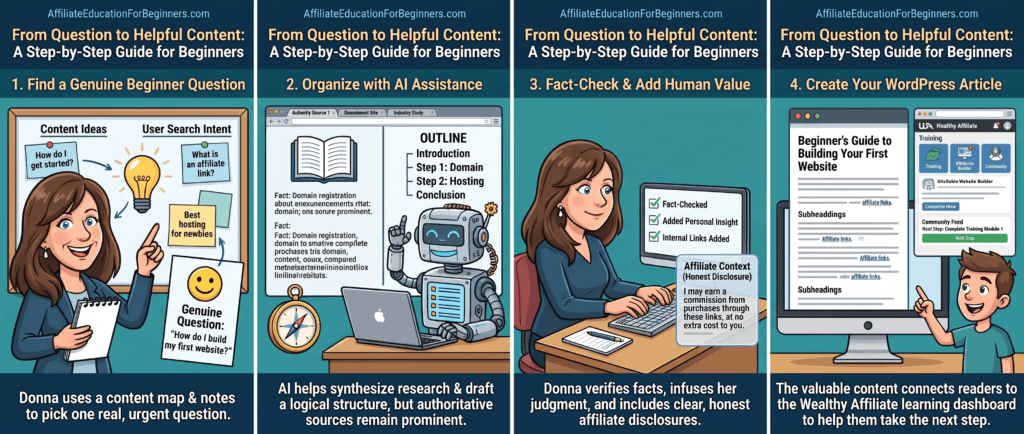
Before I prompt AI, I decide what the article exists to answer.
For this article, that question is:
How can a beginner use AI to create affiliate content without losing accuracy, originality, or a human voice?
That single question prevents the article from wandering into every related topic. It also protects the website from having several pages competing to answer the same search intent.
I ask:
- What is the reader worried about?
- What do they need to understand before taking action?
- What should they be able to do after reading?
- Which related questions already have their own articles?
- What is the most useful next lesson?
AI can help me brainstorm questions, but I do not assume every suggestion deserves a page. I compare the idea with my existing hubs and cluster articles first.
That is how I keep this guide separate from Can AI Content Hurt Google Rankings?. That article answers whether AI-assisted content creates a Google risk. This one shows the practical workflow I use to create it responsibly.
A prompt I might use at this stage
I am planning a beginner article about using AI to create affiliate content. List the questions a cautious beginner may have. Group questions by search intent. Do not draft the article or assume every question needs its own page.
The answer gives me ideas—not my final content plan.
Step 2: I Confirm Search Intent and Keyword Data
AI tools can suggest keywords, but a suggestion is not search-volume data.
I use the suggestions to broaden my thinking, then confirm the language with a keyword research tool, Google results, and my own website data where available. The primary keyword must accurately describe the page; it should not be forced into every paragraph.
For a beginner article, I pay particular attention to long-tail keywords because they often reveal the reader’s exact concern. Phrases such as “how to use AI without losing your voice” are more specific than “AI marketing.”
| Keyword Type | Example for This Article | Purpose |
| Primary | how to use AI for affiliate marketing | Defines the central topic |
| Supporting | AI affiliate marketing | Builds topical context |
| Supporting | AI content creation | Connects the workflow to content production |
| Long-tail | how to use AI to create affiliate content | Matches the practical process |
| Long-tail | how to write affiliate articles with AI | Reaches beginners looking for writing help |
| Long-tail | how to fact-check AI-generated content | Supports the verification section |
I also inspect the search results. If the pages ranking for a phrase answer a different question from the one I planned, that is a warning that the keyword may not fit.
Ahrefs explains an important limitation in its discussion of AI keyword research: AI can help explore ideas and patterns, but a useful workflow still needs access to dependable search data. That is why I do not treat a chatbot’s keyword list as proof of demand.
My Affiliate SEO for Beginners guide explains keyword research, search intent, on-page SEO, internal linking, and other foundations in more detail.
Step 3: I Map the Article Into the Website Before Drafting
I do not want each new post to sit alone.
Before writing, I decide:
- which hub owns the topic
- which previous article gives the reader necessary background
- which supporting guides deserve contextual links
- what the reader should learn next
- whether an older article should link back to the new one
This is where AI can be useful if I provide an accurate list of existing content. It can identify possible relationships or accidental overlap. It cannot know my website structure unless I give it that context and verify the results.
For this article, the relationship is clear:
| Relationship | Article | Why It Belongs |
| Hub | How Beginners Can Get Found in AI Search | Places the workflow inside the full AI-search curriculum |
| Previous lesson | Can AI Content Hurt Google Rankings? | Explains the quality and policy concerns first |
| Supporting lesson | AI Writing Tools for Affiliate Marketing Beginners | Helps readers evaluate the tools they may use |
| Next lesson | How to Create Content That Sells | Shows how to turn a responsible draft into useful, persuasive content |
This planning also helps me balance internal and external links. External sources verify important facts. Internal links keep the reader moving through the learning system. One should not replace the other.
Step 4: I Research Before I Ask AI to Make Claims
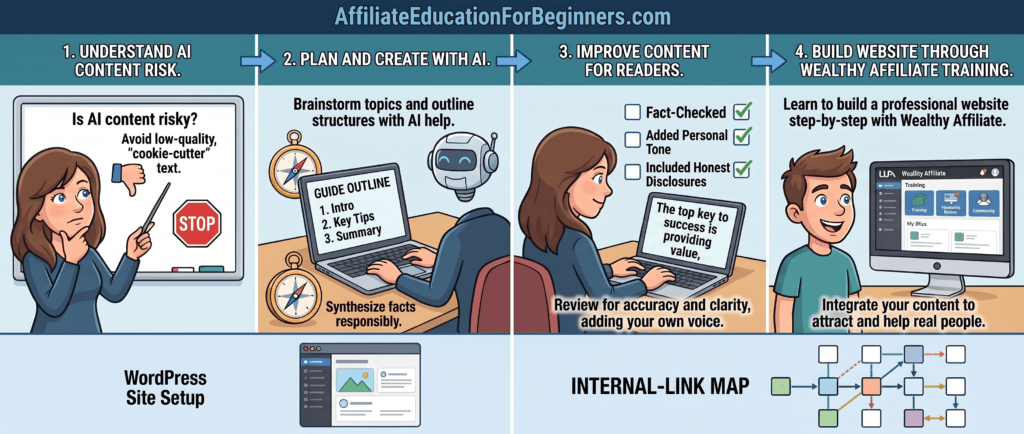
AI may sound certain even when its information is incomplete or outdated. Affiliate offers make that especially risky because prices, features, commission rates, cookie periods, and program rules can change.
I begin with first-party or authoritative sources whenever possible:
- the company’s official product or pricing page
- the affiliate program’s current terms
- official documentation
- government or regulatory guidance
- original research rather than a summary of it
- my own observations, clearly described as observations
I open the source and read it. I do not rely on a quotation or citation merely because AI supplied it.
Google’s guidance on using generative AI content explains that creators remain responsible for accuracy, quality, and relevance. That matches the standard I use: AI may help with the work, but responsibility cannot be automated.
When I write about a product I have not personally used, I say that my assessment is based on research. I do not turn secondhand information into a personal story.
What I verify before publishing an affiliate recommendation
- the product’s current purpose and intended user
- what is included and what may cost extra
- whether a free plan, trial, or refund policy exists
- material limitations a beginner should know
- the action that can earn an affiliate commission
- whether my disclosure is clear and easy to find
- whether the recommendation still makes sense without the commission
If an offer uses unrealistic promises or unclear terms, I stop and investigate. My Online Business Scams & Warnings hub gives beginners a framework for evaluating those warning signs.
Step 5: I Use AI to Build a Working Outline
Once I know the question, keyword, content relationship, and reliable sources, I ask AI to help organize the material.
I usually want an outline that:
- moves in the order a beginner would naturally learn
- separates explanation from action
- includes examples, tables, and checkpoints where useful
- avoids sections already owned by another page
- ends with one logical next step
I do not keep every suggested heading. AI often creates more sections than the reader needs, and several may say nearly the same thing.
A stronger outline prompt
Create a beginner-friendly outline that answers one question: How can beginners use AI to create affiliate content without losing accuracy, originality, or their own voice? Use the research notes I provide. Keep the article focused on my workflow. Exclude full explanations of GEO vs. SEO, AI citation selection, and Google penalties because separate articles cover them. Identify any section that appears repetitive.
The details in the prompt matter. Semrush’s AI marketing guide emphasizes giving an AI workflow relevant brand context, such as writing guidelines, audience information, and good content examples. Without that context, generic output is exactly what you should expect.
Step 6: I Treat the Draft as Material to Work With
A draft is not a finished article.
Sometimes I write the opening myself and ask AI to help structure the middle. Sometimes I provide detailed notes and ask for a rough explanation. Sometimes I write a section and ask what a beginner may still find confusing.
What matters is that I remain involved.
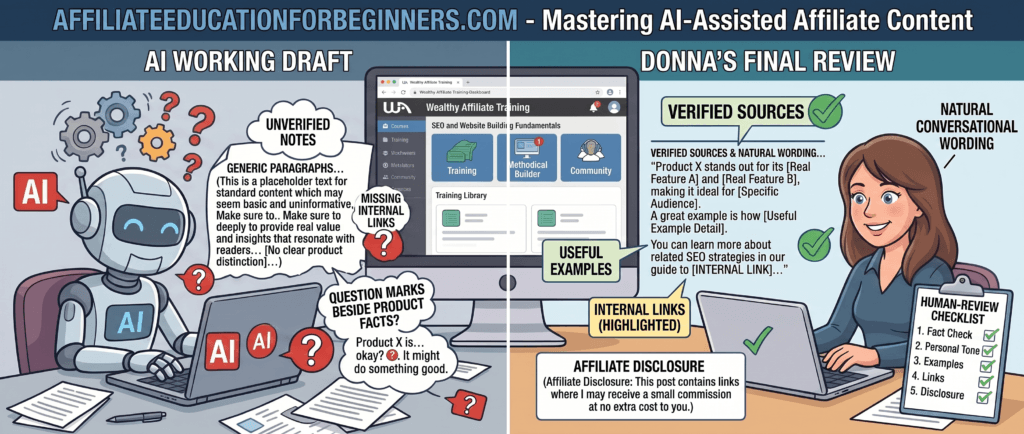
I look for signs that the draft needs more work:
- every paragraph is the same length
- the article keeps saying “it is important to” without explaining why
- the tone sounds like a lecture
- claims appear without evidence
- transitions feel mechanical
- lists replace real explanations
- the recommendation appears before the reader has enough information
- the article could belong to any author or website
This is also where I make the writing conversational. I ask what I would say if a beginner were sitting beside me, confused by the same problem.
Instead of writing:
Affiliate marketers must implement a comprehensive human-oversight protocol.
I would say:
Before you publish, read every word and make sure you are willing to put your name on it.
The second version is clearer, more direct, and sounds like one person helping another.
My AI Writing Tools for Affiliate Marketing Beginners guide can help you compare what these tools are good at and where human review still matters.
Step 7: I Add What AI Cannot Honestly Supply
Original value does not mean inventing a revolutionary idea for every article. It means giving the reader something more useful than a rearranged summary of pages that already exist.
I may add:
- a mistake I made while learning
- a decision framework I actually use
- an explanation shaped around beginner confusion
- a comparison table that makes a choice clearer
- a screenshot or example from my process
- a limitation that promotional content often leaves out
- a connection to another step in the learning journey
AI cannot truthfully provide my experience. It can help me express an experience I describe, but it should never manufacture one.
That distinction is central to E-E-A-T. Experience is not a collection of phrases such as “in my experience” scattered through an article. It is evidence that a real person understood the subject, made choices, recognized limitations, and took responsibility for the recommendation.
Google’s people-first content guidance encourages creators to consider whether content demonstrates firsthand knowledge, has a clear audience, and leaves readers feeling they learned enough to achieve their goal. I use those questions as a practical editorial check—not as words to add artificially.
Step 8: I Fact-Check, Link, and Review the Entire Article
The final review is where I slow down.
I check the article in layers instead of trying to notice everything at once.
Accuracy review
- Open every external source.
- Confirm that the source supports the nearby statement.
- Recheck product features, terms, dates, and prices.
- Remove unsupported claims and fabricated quotations.
- Separate personal experience from research.
Reader review
- Does the introduction speak to the reader rather than at them?
- Is the quick answer clear without reading the whole page?
- Does each section move the reader forward?
- Are technical terms explained in ordinary language?
- Does the recommendation include limitations?
Website review
- Is the article linked to the correct hub?
- Are internal links placed where they help the reader?
- Have I avoided using the same URL more than once?
- Does Continue Learning identify the next lesson?
- Should earlier articles link back to this one?
Publishing review
- Is the SEO title under 60 characters?
- Does the meta description encourage the right reader to click?
- Is the primary keyword used naturally near the beginning?
- Do images have useful alt text and captions?
- Are both affiliate CTAs tracked separately?
- Are the disclosure, disclaimer, FAQs, and schema present?
- Does the page display correctly on mobile?
I also read the article aloud. Awkward, repetitive, or overly formal writing becomes much easier to hear.
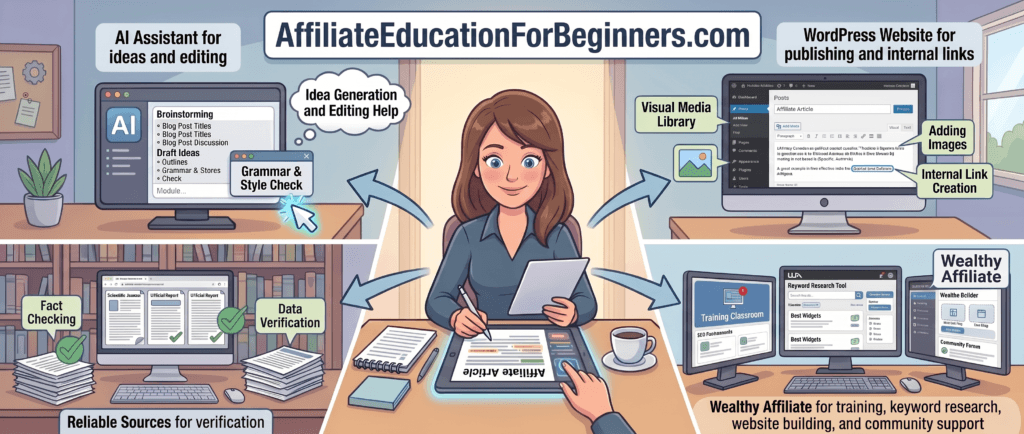
How Wealthy Affiliate Fits Into My Process
AI can help with a draft, but it does not replace learning how an affiliate website works.
You still need to understand niches, WordPress, keyword research, SEO, content structure, affiliate disclosures, traffic, and how to evaluate programs. Those are the skills that help you recognize whether an AI suggestion is useful or wrong.
That is where Wealthy Affiliate fits naturally into my process. It brings training, website tools, research support, and a community into one place where beginners can learn while building. I see AI as an assistant within that larger education—not a substitute for it.
Learn the Skills Behind the Content
If you want a structured place to learn affiliate marketing while building your website, you can explore Wealthy Affiliate before deciding whether it fits you.
👉 Start With a Free Wealthy Affiliate Account
The starter account lets you look around and begin learning without a promise of rankings, traffic, commissions, or income.
What I Never Delegate Completely to AI
Some responsibilities stay with me from beginning to end.
| I Keep Responsibility For | Why |
| The article’s purpose | A tool should not decide what my audience needs most |
| Personal experience | AI cannot use a product or live my experience for me |
| Factual accuracy | Plausible wording is not evidence |
| Affiliate recommendations | Readers may make purchasing decisions based on them |
| Internal-link strategy | Each link should serve the learning journey |
| Disclosure | Readers deserve to know when I may earn a commission |
| Final wording | My name appears on the published article |
| Publishing decision | Speed is not a reason to release weak content |
Here is the self-contained rule I would give any beginner:
Use AI for assistance, not authority. If a statement could affect a reader’s money, trust, or decision, verify it yourself before publishing.
That sentence applies whether you use ChatGPT, another writing assistant, or no AI tool at all.
What I Check After Publishing
Publishing is not the end of the workflow.
After Google has had time to discover the page, I use Google Search Console to look for real evidence:
- Is the page indexed?
- Which searches produce impressions?
- Are those searches relevant to the article’s purpose?
- Does the title earn clicks when the page appears?
- Is another page competing for the same query?
- Are there sections readers appear to need that the article does not answer?
Google’s Search Console performance-report guide explains how to examine queries, pages, clicks, impressions, and positions. I would rather improve an article using actual performance information than rewrite it because an AI tool guessed what Google might prefer.
My Traffic Generation Strategies hub explains how search traffic works alongside social media, email, Pinterest, and other ways of bringing the right readers to your website.
Common AI Content Mistakes I Would Avoid
You do not have to reject AI to avoid careless AI content. You need boundaries.
Publishing the first draft
The first output may be organized, but it has not passed your fact-check, reader review, internal-link plan, or final judgment.
Asking AI to invent experience
Never allow a tool to claim you tested, bought, earned from, or achieved something you did not.
Creating several articles with the same intent
Changing the title does not make the search intent different. Check your existing website before approving a new topic.
Trusting generated keywords as data
Use AI for brainstorming, then confirm demand and intent with appropriate research tools and search results.
Adding external links simply to look authoritative
Every external source should support a specific statement. Internal links should guide the reader through your own learning system.
Removing your personality during editing
A perfectly polished article can still feel distant. Keep the questions, explanations, and honest limitations that make the reader feel you are speaking with them.
Recommending products without balance
Explain who a product may help, what it does not guarantee, and what the reader should consider before spending money.
For more help connecting individual articles to a complete publishing strategy, visit my Content Marketing Strategies hub. It explains how useful content can attract readers, build trust, and support the larger website.
My Final AI Content Checklist
Before I publish, I want to answer yes to these questions:
- Does the article answer one clear question?
- Is the primary answer easy to find?
- Did I verify every important factual claim?
- Did I open and review every source?
- Are all personal statements true?
- Did I add judgment, examples, or structure that AI could not supply alone?
- Does the article sound like Donna speaking to a beginner?
- Are internal links more prominent than unnecessary external detours?
- Is every affiliate relationship disclosed?
- Are recommendations fair and specific?
- Does the reader know what to do next?
- Would I confidently publish every sentence under my name?
If the answer to one of those questions is no, the article is not finished yet.
Final Thoughts
AI has made content creation faster, but faster is only useful when the process still produces something worth reading.
I use AI because it can help me organize ideas, challenge an outline, clarify a difficult explanation, and notice what I missed. I do not use it to manufacture authority or avoid learning the skills behind affiliate marketing.
The goal is not to prove that an article was written by a person or a machine. The goal is to publish something accurate, original, helpful, and honest enough that a beginner can make a better decision after reading it.
That requires a human being who is willing to remain responsible from the first question to the final click on Publish.
Build Your Skills While You Build Your Website
If you want step-by-step training, website tools, keyword research support, and a community where you can ask questions as you learn, take a look inside Wealthy Affiliate.
👉 Explore Wealthy Affiliate With a Free Starter Account
You can evaluate the platform for yourself. No training program, AI tool, or SEO method can guarantee rankings, traffic, citations, commissions, or income.
Continue Learning
Now that you have seen how I create and review AI-assisted affiliate content, the next step is learning how helpful content can earn attention and guide readers toward an informed action.
👉 How to Create Content That Sells — learn how useful content builds trust and supports conversions without pressure
Then continue with these supporting lessons:
👉 GEO vs. SEO for Beginners — understand how traditional rankings and AI visibility relate
👉 How to Rank in AI Search — make your content easier for AI-powered search systems to discover and understand
👉 How to Get Your Website Cited by AI — learn what makes a page useful as a supporting source
Key Takeaways
- I use AI as an assistant for planning, outlining, drafting, editing, and identifying gaps.
- I remain responsible for the topic, keyword decision, research, facts, experience, recommendations, links, and final wording.
- AI keyword suggestions require confirmation through dependable search data and search-intent review.
- First-party sources are especially important for product details, affiliate terms, prices, policies, and features.
- Internal links should move readers through a deliberate learning path rather than merely filling an SEO checklist.
- Personal experience must be real, and research must never be presented as firsthand product use.
- Google Search Console provides real performance evidence after publishing.
- Wealthy Affiliate can help beginners learn the broader website, SEO, content, and affiliate marketing skills that responsible AI use still requires.
- AI tools, SEO methods, and training platforms cannot guarantee rankings, traffic, citations, commissions, or income.
Frequently Asked Questions
Can I use AI to write affiliate marketing content?
Yes. AI can help you brainstorm, outline, draft, edit, and identify missing information. You should still verify facts, add original value, review recommendations, disclose affiliate relationships, and approve every word before publishing.
How do I use AI for affiliate marketing without losing my voice?
Give the tool examples of your natural writing, describe your audience, and supply your own notes before drafting. Then rewrite formal or generic passages as you would explain them directly to a beginner.
Can AI choose profitable affiliate keywords for me?
AI can suggest keyword ideas, but its suggestions are not dependable proof of search volume, competition, or profitability. Confirm keywords with research tools, search results, and your own Search Console data.
Should I publish an AI-generated article without editing it?
No. Review the article for accuracy, originality, search intent, sources, invented experience, internal links, disclosure, tone, and usefulness before publishing it under your name.
How do I fact-check AI-generated affiliate content?
Check important claims against first-party sources such as official product pages, affiliate terms, documentation, and original research. Open every cited source and make sure it supports the exact statement.
Can AI write an affiliate product review?
AI can help organize research or edit your wording, but it cannot honestly claim that you used a product. Clearly distinguish personal experience from research and verify current product details before making a recommendation.
Does Google allow AI-assisted affiliate content?
Google focuses on the quality and purpose of the finished content rather than banning content merely because AI assisted with it. Content should be accurate, original, helpful, people-first, and not created primarily to manipulate rankings.
Can Wealthy Affiliate guarantee success with AI content?
No. Wealthy Affiliate can provide training, website tools, research support, and community help, but it cannot guarantee rankings, traffic, citations, commissions, or income.
About the Author
Donna is an affiliate marketing researcher and the founder of AffiliateEducationForBeginners.com. She creates beginner-friendly guides about affiliate marketing, SEO, AI search, content creation, and online-business risks without unrealistic income promises.
Affiliate Disclosure and Disclaimer
This article contains affiliate links. If you join Wealthy Affiliate through one of these links, I may earn a commission at no additional cost to you.
This article is educational and reflects the research and editorial process used when it was prepared. Search policies, AI tools, product features, affiliate terms, and reporting systems can change. No AI tool, SEO method, course, or affiliate platform can guarantee rankings, traffic, citations, commissions, or income. Verify current information and decide whether any product fits your needs and budget.