Written by Donna
Affiliate marketing researcher and founder of AffiliateEducationForBeginners.com
↑ Top
If you’ve been following my How Beginners Can Get Found in AI Search guide, you may be wondering how AI search vs. traditional search actually compares.
More importantly, you may be wondering whether everything you’ve already learned about SEO is becoming outdated.
It isn’t.
Traditional search usually gives you a page of links and lets you decide which one to visit. AI search often does some of that work for you by gathering information, summarizing it, and showing the sources it used.
That is a real change—but it does not mean SEO is disappearing.
Google says its AI features are still built on the same core Search ranking and quality systems that support traditional results.
For beginners, that is encouraging.
You do not have to throw away what you have learned and start over. You just need to understand what has changed, what still matters, and how one helpful article can be discovered in more than one way.
If traditional SEO is still new to you, my Affiliate SEO for Beginners post explains how keywords, content, internal links, and technical SEO work together to help people find your website. If you need the complete foundation first, start with my Affiliate Marketing for Beginners roadmap.
What I Learned While Researching Both Types of Search
When AI search started appearing everywhere, I wondered whether everything I had learned about SEO was becoming outdated.
The more I researched it, the clearer the answer became:
The search experience is changing. The foundation of a trustworthy website is not.
That is why I am not creating one version of my content for Google and another for AI. I am continuing to build focused, connected guides that answer real beginner questions.
I cannot promise that every article will rank in Google or be cited by ChatGPT, Google AI Overviews, Copilot, or any other AI platform. No honest website owner can promise that.
What I can do is make every guide helpful enough to deserve the opportunity.
Quick Answer: What Is the Difference Between AI Search and Traditional Search?
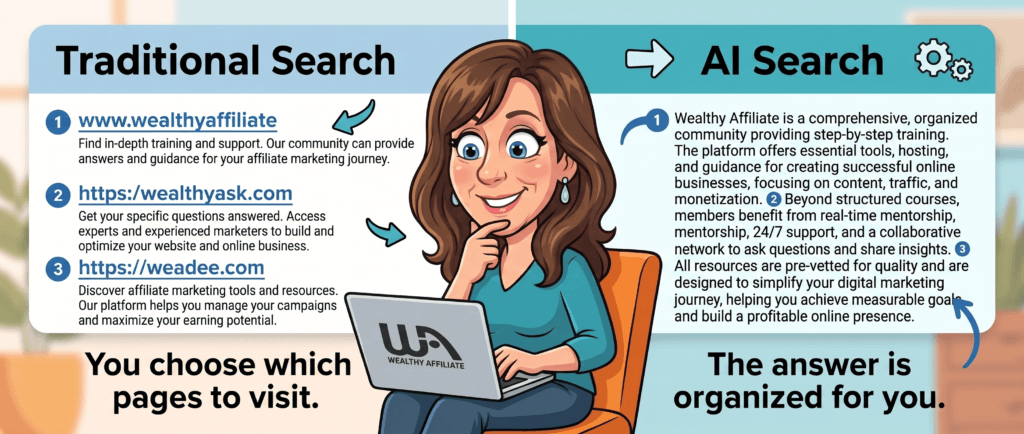
Traditional search usually gives you a ranked list of webpages to choose from. AI search usually gives you a direct, conversational answer that may combine information from several sources and cite those sources.
Traditional search asks the user to compare results and choose which page to visit. AI search often does more of that initial sorting and summarizing before the user clicks.
The important part is that these are not two completely separate worlds. Both still need useful information from websites. In Google’s case, AI Overviews and AI Mode are built on the same core Search systems that support traditional results.
So what does that mean for you?
Keep using sound SEO, but make every article clear enough to answer the question wherever your reader happens to search.
What Is Traditional Search?
Traditional search gives people a selection of webpages that may answer what they searched for.
When someone types a question into Google or Bing, the search engine generally returns a results page containing elements such as:
- Page titles
- Short descriptions or snippets
- Website links
- Images or videos
- Featured snippets
- Maps, products, or other specialized results
You look over the choices, decide which title seems most helpful, and click.
We have all done it so many times that we barely think about the process anymore.
Behind that simple results page, the search engine still has to:
- Discover a page
- Crawl its content
- Understand and index it
- Decide when it is relevant enough to show
Google describes its traditional Search process in three broad stages: crawling, indexing, and serving search results.
? Google Search Central – How Google Search Works
Traditional Search Is More Than Exact Keywords
This is where the comparison often gets oversimplified.
Traditional search is sometimes described as nothing more than “keyword search.” That is not really accurate anymore.
Modern search engines do not rely only on whether a page repeats the exact words someone typed. They also try to understand meaning, context, search intent, quality, location, freshness, and many other signals.
Keywords still matter because they show you how real people describe a problem. But Google is not simply counting how many times you repeat the phrase.
The keyword helps you find the question.
Your article still has to provide the answer. This is very important.
What Is AI Search?
AI search gives you a generated answer that can explain, summarize, compare, or organize information—and often shows the sources behind that answer.
Think about it this way.
With traditional search, you might type “best beginner affiliate marketing training,” open five tabs, and compare the programs yourself.
With AI search, you might ask:
“What should a beginner look for in an affiliate marketing training platform if they have limited time and no technical experience?”
Now the system has more than a keyword. It knows the person is a beginner, short on time, and worried about the technical side.
It can use that extra context to organize a much more specific answer.
Examples include:
- ChatGPT Search
- Google AI Overviews
- Google AI Mode
- Microsoft Copilot
- Perplexity
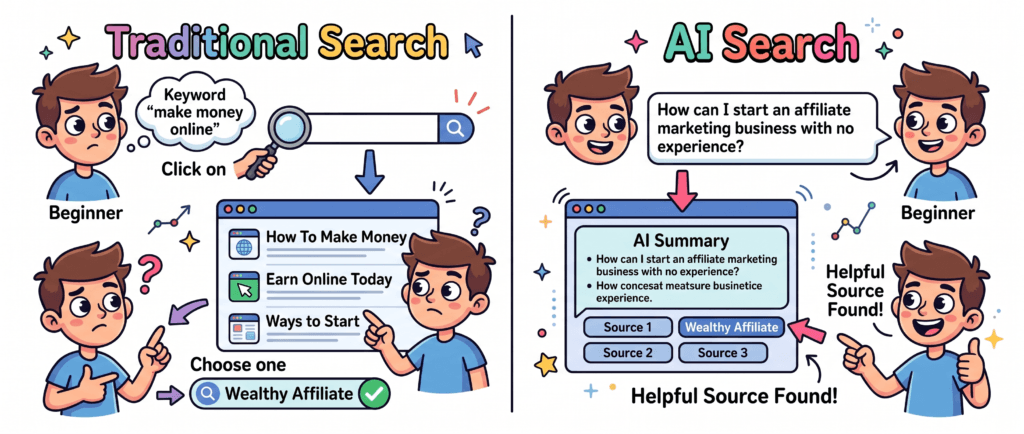
OpenAI explains that ChatGPT can search the web when a question needs current information. When sources are available, readers can open the Sources panel and follow the cited links.
Google describes a similar process called query fan-out. That sounds technical, but the idea is simple: instead of running only one search, the system may search several related parts of the question before building its answer.
? Google Search Central – AI Features and Your Website
That matters for content creators. Your page may help answer one important part of a larger question even when it does not repeat the user’s exact wording.
AI Search vs. Traditional Search: Side-by-Side Comparison
Here is the simplest way to see the difference.
| Feature | Traditional Search | AI Search |
| Typical result | A ranked list of links and search features | A generated answer with supporting links or citations |
| User’s role | Reviews several results and chooses where to click | Reads a synthesized answer and may ask follow-up questions |
| Query style | Often short or keyword-based, but can be conversational | Often detailed, conversational, and context-rich |
| How information is explored | The user opens pages and compares them | The system may search several related subtopics first |
| Website opportunity | Rank as a visible result and earn a click | Be referenced, cited, or offered as a supporting source |
| Best content foundation | Relevant, helpful, trustworthy, crawlable content | Relevant, helpful, trustworthy, crawlable content |
| Is SEO important? | Yes | Yes—especially for AI features built on search indexes |
At first glance, the two columns look very different.
Underneath them, though, they still depend on many of the same things.
A well-researched article does not suddenly become useless because the answer appears in a different format. It may simply be discovered and presented in a new way. My guide to The Role of Blogging in Affiliate Marketing explains why useful articles can remain valuable long after they are published.
What AI Search and Traditional Search Have in Common
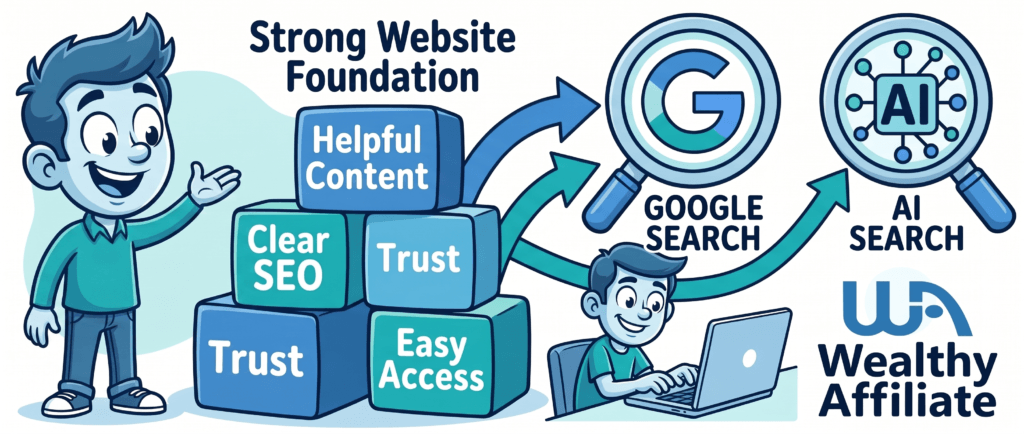
Both still need content they can find, understand, and trust.
The results may look different, but the basic needs have not changed. Your content must be accessible, clearly focused, accurate, and genuinely helpful.
For Google’s AI features, a page still needs to be indexed and eligible to appear in Search. Google also says you do not need special AI schema or a separate technical setup.
Helpful content is not a new AI tactic. Clear explanations, real experience, original examples, and sensible organization have always helped readers.
? Google Search Central – Optimizing for Generative AI Features
Can both send visitors to your website?
Yes—but this is where the comparison becomes more complicated.
Traditional results often need the click because the answer lives on the webpage. AI search may answer a simple question before the reader ever visits a site.
But AI answers can also introduce readers to sources they may never have found in an ordinary list of results.
I do not want to pretend that every AI citation will send a flood of visitors. The research does not support that.
Pew Research Center analyzed 68,879 Google searches performed by U.S. adults in March 2025. Users clicked a traditional result in 8% of visits when an AI summary appeared, compared with 15% of visits without one. A link inside the AI summary was clicked in only 1% of visits that contained a summary.
That study covered Google during one period, so it cannot predict every topic or platform. It does show why your article needs to offer more than the same short answer found everywhere else.
? Pew Research Center – Do People Click Links in Google AI Summaries?
Here is what both search experiences still need from your website:
| Website Foundation | Why It Helps Traditional Search | Why It Helps AI Search |
| Crawlable, indexable pages | Allows search engines to discover and store the content | Makes the content available to search-based AI features |
| Clear search intent | Helps the page match a relevant query | Helps the system identify which part answers the user’s question |
| Helpful, original information | Gives readers a reason to choose the page | Provides useful details that may support a generated answer |
| First-hand experience | Builds reader confidence and distinguishes the page | Adds perspective that cannot be recreated by summarizing common information |
| Internal links | Helps readers and crawlers discover related pages | Clarifies relationships among connected topics |
| Accurate sources and updates | Protects quality and maintains relevance | Helps keep information reliable when current facts matter |
| Strong page experience | Makes the result easier to read and use | Helps visitors who follow an AI citation engage with the page |
This is why I am not abandoning SEO. The same work that strengthens a website for traditional search can also improve its chances of being understood in AI search.
How the Search Journey Is Changing
People can now search with a complete thought instead of trying to guess the perfect keyword.
Think about how a beginner might research affiliate marketing.
In traditional search, that person might type four separate questions:
- What is affiliate marketing?
- Do I need a website?
- How do affiliate websites get traffic?
- How long does it take to earn a commission?
With AI search, that person may combine those concerns into one prompt:
“I am completely new to affiliate marketing, have five hours a week, and want to build a website without falling for a scam. What should I learn first?”
That one prompt gives the AI system the whole situation instead of four disconnected keywords.
People are not using the two tools in exactly the same way, either.
In a 2026 study, Nielsen Norman Group observed that people often chose generative AI when they had a vague idea, several requirements, or information that needed to be pulled together. They were more likely to choose traditional search when they wanted more control or needed to verify an important fact.
That helps explain why both experiences continue to matter. People do not always want the same type of answer, even when they are researching the same topic.
? Nielsen Norman Group – GenAI for Complex Questions, Search for Critical Facts
Traditional results are not disappearing. The path from the question to your website is simply becoming less predictable.
A reader may now discover your article through:
- A standard organic result
- A featured snippet
- A Google AI Overview
- Google AI Mode
- A ChatGPT citation
- A follow-up question in an AI conversation
- Another article that links to your guide
For affiliate marketers, that means one good article can have more than one doorway.
Does AI Search Mean SEO Is Dying?
No. AI search is changing the results page, but it has not made SEO unnecessary.
Google says its AI features still rely on its core Search ranking and quality systems. In plain language, Google has not thrown away its search engine and started over.
Of course, that does not mean SEO will remain frozen in time.
Search behavior changes. Results pages change. The kinds of questions people ask change. Website owners need to pay attention to those changes.
But the answer is not to abandon:
- Keyword and audience research
- Search intent
- Helpful content
- Internal linking
- Page experience
- Crawlability and indexing
- Accurate titles and descriptions
- Original experience and trustworthy recommendations
Those are still the building blocks of a website that can be found, understood, and trusted.
The better question is not:
“Should I choose SEO or AI search?”
It is:
“How can I build one trustworthy website that serves readers in both?”
Do You Need Separate Content for AI Search?
No. You do not need one article for Google, another for ChatGPT, and a third for Google AI Overviews.
Please do not create duplicate versions of the same article. That would give you more work, divide your internal links, and make the website harder to maintain.
Instead, create one strong article that:
- Answers one primary question thoroughly
- Gives the answer early
- Uses descriptive headings
- Explains the topic in natural language
- Includes first-hand experience or original insight
- Supports important claims with reliable sources
- Connects readers to related guides
- Remains accurate and up to date
Google specifically says website owners do not need to rewrite content in a special way for generative AI search. Its systems can understand synonyms and meaning without a page targeting every possible variation of a question.
That should take some pressure off.
You are not writing one article for people, one for Google, and another for AI.
You are writing one genuinely helpful article for the person who needs the answer.
Can the Same Page Rank in Google and Be Cited by AI?
Yes. The same page can rank in Google and also be cited or referenced in an AI-generated answer. Neither result is guaranteed.
You do not have to choose which one you want before you publish.
In traditional search, the page may rank because it is relevant, useful, accessible, and competitive for the query.
In AI search, information from that page may help answer all or part of a conversational question. The AI experience may then show the webpage as a citation or supporting source.
There is one wording difference worth understanding.
Google presents ranked search results. An AI answer does not always provide a stable list of positions that can be tracked in the same way. The sources may change when the user changes the wording, adds context, asks a follow-up question, or searches at a different time.
That is why I would never promise that a page can “rank number one in ChatGPT.” AI citations can change from one prompt to the next.
A more honest goal is to make your page relevant and useful enough to be discovered when it genuinely supports the answer.
| Visibility Goal | What the Page Needs | How the Result May Appear |
| Rank in Google Search | Crawlability, indexing, relevance, quality, authority, and a good page experience | Organic result, featured snippet, image, video, or another search feature |
| Appear in Google AI features | Eligibility for Search plus helpful information that supports the generated response | Supporting link in AI Overviews or AI Mode |
| Be cited by ChatGPT Search | Accessible web content that is relevant to the searched question | Linked citation or source in a search-supported response |
| Earn the reader’s click | A clear title, distinctive value, trustworthy explanation, and useful next step | Visit from either a traditional result or an AI source link |
The goal is not to build a different page for every platform.
Build one page that deserves to be found wherever the reader searches. If you want to understand what makes a page useful as an AI source, my How to Get Your Website Cited by AI guide explains the process in more detail.
How to Optimize Content for AI Search and Google
Start with solid SEO. Then make the article easier to understand, easier to trust, and worth citing.
If I were publishing the article today, this is the order I would follow:
- Choose one primary search question.
- Research the keyword and the reader’s complete intent.
- Give a concise answer near the beginning.
- Explain the answer with original examples and honest experience.
- Support factual claims with authoritative sources.
- Use descriptive headings, tables, and helpful visuals.
- Connect the article to its parent hub and related lessons.
- Review the page for accuracy, readability, and outdated information.
Notice that none of those steps involves stuffing extra keywords into the page or writing stiff little paragraphs “for AI.”
You are still helping the reader. You are simply making the answer clearer and better supported.
If you want the complete implementation process, continue with:
This article is focused on understanding the difference between the two search experiences; that guide explains the ranking and visibility steps in greater detail.
What Should Affiliate Marketers Focus on Now?
Keep using SEO—but give readers something more valuable than a generic answer they could find anywhere. My Organic Traffic Techniques for Affiliate Marketers guide explains how helpful content, keyword targeting, and consistent publishing work together to attract visitors over time.
If this still feels like one more thing to learn, narrow it down to four priorities.
Understand the Question Behind the Keyword
Keywords help you find the question. They do not tell you everything the reader is worried about.
If the keyword is “best affiliate programs for beginners,” the reader may also care about approval requirements, costs, training, payout rules, and whether the program fits someone with no audience.
That is the difference between targeting a keyword and actually helping the person who searched it.
Add Something Only You Can Contribute
AI can summarize common information in seconds, but it still needs human judgment, experience, and careful fact-checking. My AI Tools for Affiliate Marketing Beginners guide explains how beginners can use AI as a helpful assistant without allowing it to replace their own voice.
It cannot replace your experience, judgment, screenshots, examples, tests, warnings, or honest recommendations. Those are the reasons someone may still choose your article over a summary.
For me, that means explaining affiliate marketing the way I wish it had been explained when I was a beginner—and being honest about scams, unrealistic promises, and the time it takes to build something real. My Online Business Scams & Warnings page can help you recognize those warning signs before trusting a program or income claim.
Build Connected Learning Paths
One article cannot answer everything without turning into the very textbook we are trying to avoid.
Create related guides that each answer one question, then connect them through useful internal links. This helps readers continue learning while giving search systems a clearer understanding of how your content fits together.
My Content Marketing Strategies page explains how individual articles work together to educate readers and build trust, while my Traffic Generation Strategies guide shows how those connected pages can attract visitors from search and other channels.
Make Recommendations Worth Trusting
Affiliate content should help someone make a confident decision—not push them toward the button.
Explain who a product is for, who it is not for, what it costs, what limitations it has, and why you recommend it. My Best Affiliate Programs for Beginners page shows how to compare programs without treating the highest commission as the only thing that matters. A trustworthy recommendation is more valuable in every kind of search.
Trust also requires clearly telling readers when you may earn a commission. The Federal Trade Commission says affiliate relationships should be disclosed clearly and close enough to the recommendation or link for a reasonable reader to notice and understand them.
? Federal Trade Commission – Endorsement Guides for Affiliate Links
That disclosure is not just legal wording at the bottom of a page. It tells the reader, “I may earn something from this recommendation, and I want you to know that before you decide.”
A Practical Content Checklist for Both Types of Search
You do not need to double your workload. Before you publish, walk through these questions once.
| Before Publishing, Ask… | Traditional Search Benefit | AI Search Benefit |
| Does the title clearly describe the answer? | Can improve relevance and encourage the right click | Helps identify the page’s primary subject |
| Is the main answer easy to find? | Satisfies readers who want a quick response | Makes the key explanation clear and quotable |
| Did I add experience or an original example? | Makes the article more useful than competing results | Provides distinctive information beyond a generic summary |
| Are important claims supported? | Strengthens credibility with readers | Gives the information a more reliable foundation |
| Do the headings describe each section? | Improves scanning and content understanding | Helps systems identify relevant passages and context |
| Did I connect the next helpful guide? | Keeps readers moving through the website | Clarifies the relationship between related topics |
| Is the article accurate and current? | Protects rankings, trust, and conversions | Reduces the chance that outdated information is used |
If an article can pass this checklist, I would publish it before spending another week looking for an AI shortcut. My How to Create Content That Sells guide provides more help with writing clear, useful content that keeps readers engaged and encourages them to take the next step.
Learn SEO While Building for the Future
Trying to learn SEO while AI search keeps changing can feel like aiming at a moving target.
That is one reason I recommend Wealthy Affiliate for beginners. You can learn website building, keyword research, SEO, and content creation while working on a real site instead of trying to piece the entire process together from unrelated tutorials.
It cannot guarantee a Google ranking or an AI citation. What it can provide is the training, tools, hosting, and community support to help you build the kind of website that has a fair chance to earn visibility over time.
? Start the Free Wealthy Affiliate Starter Membership
What Should You Measure?
Do not measure AI visibility as though it were a traditional ranking report. Watch the larger pattern instead.
For traditional search, you are probably already watching things such as:
- Google Search Console impressions
- Search clicks
- Click-through rate
- Average position
- Organic landing pages
- Conversions and affiliate clicks
AI visibility is still harder to track consistently, although the tools are beginning to improve.
In June 2026, Google announced dedicated generative AI performance reports in Search Console for a subset of websites. The reports include impressions, pages, countries, devices, and dates for appearances in features such as AI Overviews and AI Mode.
? Google Search Central – Generative AI Performance Reports
If that report is not in your Search Console, do not panic. Google said it was rolling out to a subset of websites first. Its absence does not mean your content cannot appear in AI features.
You can also watch your analytics for referral visits from AI platforms and pay attention to the pages those visitors choose.
Microsoft is beginning to provide useful information too.
In February 2026, Microsoft introduced AI Performance in Bing Webmaster Tools as a public preview. It reports total citations, average cited pages, page-level citation activity, visibility trends, and samples of the grounding queries used when content is retrieved for AI-generated answers across supported Microsoft experiences.
Microsoft makes an important distinction that I appreciate: a citation count tells you that a page was referenced. It does not prove that the page has a fixed AI ranking or special authority.
? Microsoft Bing – AI Performance in Bing Webmaster Tools
That is why I would not keep typing the same question into ChatGPT every morning to see whether my website appears.
The answer can change with the wording, timing, location, available sources, and platform.
Focus on the larger pattern:
- Is your search visibility growing?
- Are more useful pages being discovered?
- Are visitors staying and continuing to related guides?
- Are your recommendations earning trust and clicks?
Those signs tell you far more about the health of your website than one exciting—but isolated—AI citation.
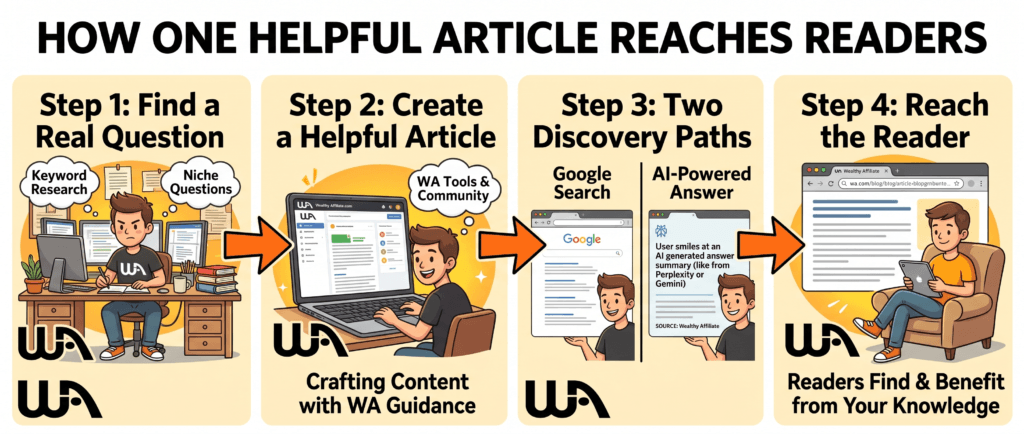
One Helpful Article, Two Discovery Paths
One helpful article can travel down two different discovery paths. Both begin in the same place: understanding what the reader needs.
Final Thoughts
When I started researching this topic, I expected to find a long list of new rules for AI search.
What I found was much more reassuring.
AI search and traditional search may present information differently, but they are not two completely separate worlds.
Traditional search usually presents options and asks the user to choose a page. AI search can synthesize information, answer follow-up questions, and point the user toward supporting sources.
For affiliate marketers, choosing one and ignoring the other would be a mistake.
Keep learning SEO.
Keep researching what your readers need.
Keep creating honest, useful content that deserves to be found.
You will not control exactly where every article appears. None of us can.
But if your page is clear, original, trustworthy, crawlable, and connected to other helpful guides, you are building a foundation that can support both Google rankings and AI citations.
The way people search will continue to change.
Your purpose does not have to.
Help the reader find the right answer and confidently take the next step.
Ready to Build for Traditional and AI Search?
Now that you understand the difference, the next step is building a website that can keep growing as search evolves.
Wealthy Affiliate gives beginners step-by-step training, website hosting, keyword research, AI-assisted content tools, and a supportive community in one platform.
You do not have to master Google SEO and AI search before publishing your first article. You can learn one skill, apply it to your website, and improve as you go.
? Start the Free Wealthy Affiliate Starter Membership
Continue Learning
These guides can help you explore the next part of AI search and website visibility.
? How Beginners Can Get Found in AI Search
Follow the complete beginner roadmap for understanding AI search.
Learn the practical steps that can improve your visibility in traditional and AI search.
? How to Get Your Website Cited by AI
Understand what can make a webpage useful as a supporting AI source.
? AI Tools for Affiliate Marketing Beginners
Learn how to use AI for research, content, and everyday affiliate marketing tasks.
Key Takeaways
- Traditional search usually shows ranked webpages; AI search can generate a direct answer with supporting sources.
- Traditional search already understands meaning and intent—it is not based only on exact keywords.
- AI search and traditional SEO share the same foundation of helpful, trustworthy, discoverable content.
- Google says its generative AI features are rooted in its core Search ranking and quality systems.
- Beginners do not need duplicate content or special AI schema.
- One strong article can create opportunities for visibility in both traditional and AI search.
Frequently Asked Questions
What is the main difference between AI search and traditional search?
Traditional search usually provides a ranked list of webpages for the user to explore. AI search can create a summarized or conversational response using information from multiple sources and may include links or citations for further reading.
Is AI search replacing traditional search?
AI search is changing the search experience, but it has not eliminated traditional results. Google combines AI features with its existing Search systems, and people can still use standard results to explore websites directly.
Is traditional SEO still worth learning?
Yes. Foundational SEO helps search systems discover, crawl, index, understand, and evaluate website content. Google states that SEO best practices remain relevant for AI Overviews and AI Mode.
Do I need separate articles for Google and AI search?
No. In most cases, one helpful, well-organized article can support visibility in both. Avoid creating duplicate versions and focus on answering the reader’s question with clear, original, trustworthy information.
Can the same page rank in Google and be cited by AI?
Yes. A page may rank as a traditional Google result and may also be used as a supporting link or cited source in an AI-generated search experience. Appearance is never guaranteed in either format.
How can I track traffic from AI search?
Use Google Search Console and website analytics to monitor impressions, landing pages, referrals, engagement, and conversions. Google has also begun rolling out dedicated generative AI performance reports to a subset of Search Console users.
About the Author
Written by Donna
Affiliate marketing researcher and founder of AffiliateEducationForBeginners.com
Donna researches affiliate marketing, SEO, AI search, and online business strategies to help beginners build sustainable websites without hype or unrealistic promises.
Her goal is to turn complicated topics into clear, practical lessons that help beginners understand what to do next.
Disclaimer
This article is for educational purposes only and reflects my research and experience building Affiliate Education for Beginners.
Some links on this website are affiliate links. If you choose to purchase through one of these links, I may earn a commission at no additional cost to you.
I only recommend products and services that I believe provide genuine value for beginners learning affiliate marketing.
↑ Back to Top