Written by Donna
Affiliate marketing researcher and founder of AffiliateEducationForBeginners.com
Last updated: June 2026
Reviewed for beginner-friendly accuracy: June 2026
Quick Answer: What Is SEO for Affiliate Marketing?
SEO for affiliate marketing is the process of optimizing your website and content so it appears in search engine results when people search for information related to your niche.
For affiliate marketers, SEO is one of the most effective ways to generate free, long-term traffic without relying on paid advertising. By targeting the right keywords, creating helpful content, and improving your website experience, you can attract visitors who are already searching for solutions, products, and recommendations.
Unlike paid traffic, SEO continues working long after content is published, making it one of the most valuable skills beginners can learn.
SEO can help affiliate marketers:
- Generate free organic traffic
- Build authority and trust
- Rank content in Google search results
- Increase affiliate clicks and commissions
- Create long-term traffic assets
- Reduce reliance on paid advertising
This guide is part of the complete SEO for Affiliate Marketing learning system.
? SEO for Affiliate Marketing Hub
If you’re completely new to affiliate marketing, start here:
? Affiliate Marketing for Beginners
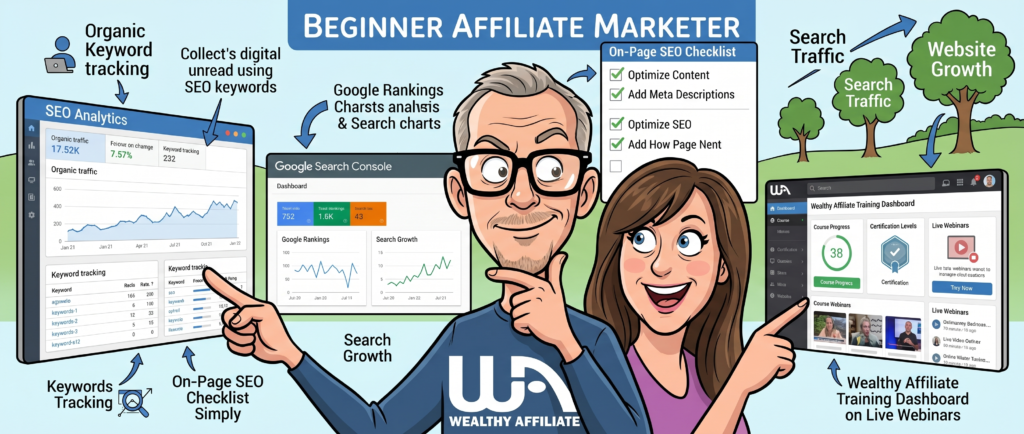
What I Learned About SEO for Affiliate Marketing
When I first started learning affiliate marketing, I spent most of my time researching affiliate programs and very little time thinking about traffic.
Eventually, I realized that even the best affiliate program cannot generate commissions if nobody finds your content.
Learning SEO completely changed how I viewed affiliate marketing. It showed me how helpful content can continue attracting visitors long after it is published. Instead of constantly chasing traffic, SEO allows you to build content that works for you over time.
One thing that surprised me most is that SEO is often less about tricks and more about helping people. The websites that consistently answer questions, solve problems, and provide useful information tend to perform best in search results.
That is why SEO remains one of the most valuable long-term skills for affiliate marketers.
Why SEO Matters for Affiliate Marketers
One of the first challenges every affiliate marketer faces is learning how to get traffic.
You can build a great website, write helpful content, and join excellent affiliate programs, but without visitors, it is difficult to generate commissions.
SEO helps solve that problem.
By optimizing content for search engines, you create opportunities for people to discover your website when they search for answers online.
Benefits of SEO include:
| SEO Benefit | Why It Matters |
|---|---|
| Organic Traffic | Visitors arrive without paying for ads |
| Long-Term Growth | Content can rank for months or years |
| Higher Trust | Organic rankings often build credibility |
| Scalable Results | Traffic grows as content grows |
| Better User Experience | SEO encourages site improvements |
| Increased Commissions | More targeted visitors create more opportunities |
Google continues to emphasize helpful, people-first content that demonstrates experience and provides value to users.
? Google Search Central Helpful Content Guidance
SEO works best when you focus on helping users rather than trying to manipulate search engines.
? How to Drive Traffic to a New Affiliate Website (2026)
? The Role of Blogging in Affiliate Marketing
How SEO Works for Affiliate Websites
SEO is not a single tactic.
It is a system made up of several connected strategies working together.
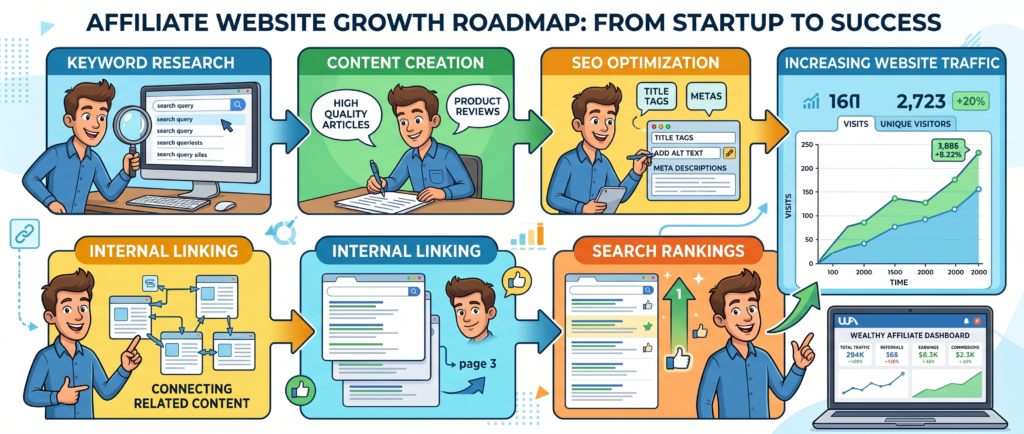
The core SEO process includes:
- Keyword research
- Content creation
- On-page optimization
- Internal linking
- Technical SEO
- Authority building
- Ongoing updates
Each step supports the next.
For example:
- Keyword research identifies opportunities.
- Content targets those opportunities.
- On-page SEO helps search engines understand the content.
- Internal linking strengthens relationships between pages.
- Technical SEO improves user experience.
- Authority signals improve rankings.
Affiliate websites that consistently follow this process often build stronger traffic over time.
? How Affiliate Marketing Works: A Step-by-Step Guide
Keyword Research for Affiliate Marketing
Keyword research is the foundation of affiliate SEO.
Before creating content, you need to understand what your audience is searching for and how they are searching for it.
Many beginners make the mistake of writing articles based on what they think people want to read. Keyword research removes the guesswork by showing you the actual terms people use in search engines.
Good keyword research helps you discover:
- Beginner questions
- Product comparisons
- Buyer-intent searches
- Problem-solving topics
- Content opportunities
- Long-tail keywords
One lesson I learned is that content performs much better when it starts with real search demand instead of assumptions.
| Keyword Type | Example |
|---|---|
| Informational | What is affiliate marketing? |
| Tutorial | How to start affiliate marketing |
| Comparison | Wealthy Affiliate vs ClickBank |
| Commercial | Best affiliate programs for beginners |
| Problem Solving | Why am I not getting affiliate sales? |
Helpful resources:
? Keyword Research for Affiliate Marketing
Why Long-Tail Keywords Matter
Long-tail keywords are longer, more specific search phrases that typically have lower competition and clearer search intent.
For new affiliate websites, they are often the fastest path to search visibility.
Instead of targeting:
“affiliate marketing”
you might target:
“how to start affiliate marketing with no experience”
or
“best affiliate programs for beginners in 2026”
These phrases are often easier to rank for because they are more specific.
| Broad Keyword | Long-Tail Keyword |
|---|---|
| SEO | SEO for affiliate marketing beginners |
| Affiliate Marketing | How to start affiliate marketing with no experience |
| Affiliate Programs | Best affiliate programs for beginners |
| Website Traffic | How to drive traffic to a new affiliate website |
Quick Insight:
Long-tail keywords often bring visitors who know exactly what they are looking for, making them valuable for both traffic and conversions.
? How to Use Long-Tail Keywords for Affiliate Marketing

On-Page SEO Techniques for Affiliate Websites
Once you know what people are searching for, the next step is optimizing your content.
On-page SEO helps search engines understand what your page is about while making it easier for readers to consume your content.
Important on-page SEO elements include:
- Clear page titles
- Optimized meta descriptions
- Descriptive headings
- Internal linking
- Image alt text
- Keyword placement
- Mobile-friendly formatting
Good on-page SEO is not about stuffing keywords into every paragraph.
It is about making content clear, organized, and helpful.
Google rewards content that provides a strong user experience and answers search queries effectively.
External resource:
? Nielsen Norman Group User Experience Research
? On-Page SEO Techniques for Affiliate Websites
Internal Linking: The SEO Strategy Most Beginners Miss
Internal linking is one of the simplest and most overlooked SEO strategies.
Internal links help:
- Search engines understand your site structure
- Visitors discover related content
- Pages share authority
- Readers stay on your site longer
For example, someone reading about affiliate SEO may also benefit from learning:
? Affiliate Marketing for Beginners
? How Affiliate Marketing Works
? Content Marketing Strategies for Affiliate Success
? Traffic Generation Strategies for Affiliate Marketers
Strong internal linking creates a connected content system that helps both users and search engines navigate your website.
One thing I noticed while building content hubs is that internal linking often improves the performance of older articles because search engines gain a clearer understanding of how content connects together.
Technical SEO and Site Performance
Technical SEO focuses on how your website functions behind the scenes.
While beginners often worry about advanced SEO tactics, improving the basics usually has the biggest impact.
Areas to focus on include:
- Mobile responsiveness
- Page speed
- Secure HTTPS connections
- Image optimization
- Crawlability
- Structured site architecture
A fast, mobile-friendly website improves both user experience and search performance.
? Improving Site Speed for SEO
? How to Optimize Content for Mobile
Many affiliate marketers are surprised to discover that improving site speed can increase engagement as much as improving rankings.
SEO Tools for Affiliate Marketers
The right tools can make SEO significantly easier.
Popular SEO tools include:
| Tool | Purpose |
|---|---|
| Google Search Console | Monitor rankings and indexing |
| Google Analytics | Analyze traffic behavior |
| Ahrefs | Keyword and backlink research |
| Semrush | SEO and competitor analysis |
| PageSpeed Insights | Site speed testing |
| Wealthy Affiliate Keyword Tool | Beginner keyword research |
| Rank Math | WordPress SEO optimization |
One thing I learned is that tools provide information, but content and consistency create results.
Many beginners spend too much time searching for the perfect tool and not enough time publishing helpful content.
Learn SEO While Building Your Website
Many beginners struggle because they’re trying to learn keyword research, content creation, website building, and SEO all at once.
One reason I recommend Wealthy Affiliate is that it combines training, keyword research tools, website hosting, and community support in one beginner-friendly platform.
Instead of piecing together multiple tools and courses, you can learn SEO while building your affiliate website step by step.
? Start the Free Wealthy Affiliate Starter Membership

Affiliate Marketing SEO Checklist
SEO can feel overwhelming when you’re first getting started.
The good news is that most affiliate marketers do not need to master every SEO tactic immediately. Focusing on a few core activities consistently often produces the best results.
Use this checklist as a starting point:
Keyword Research
- Target long-tail keywords
- Understand search intent
- Research competitor content
- Identify beginner questions
- Look for low-competition opportunities
Content Optimization
- Use clear page titles
- Write compelling meta descriptions
- Add descriptive headings
- Include internal links
- Optimize images and alt text
Technical SEO
- Ensure mobile responsiveness
- Improve page speed
- Check for broken links
- Use HTTPS security
- Submit pages to Google Search Console
Content Maintenance
- Update older articles regularly
- Improve underperforming pages
- Add new internal links
- Refresh statistics and examples
- Monitor rankings and traffic
Quick Insight:
Most affiliate websites do not fail because of a lack of SEO knowledge. They struggle because they stop publishing helpful content before SEO has time to work.
How to Increase Affiliate Traffic with SEO
Many beginners focus exclusively on rankings.
While rankings matter, traffic growth usually comes from improving multiple areas at the same time.
The most effective affiliate traffic strategies include:
| Strategy | Benefit |
|---|---|
| Target Long-Tail Keywords | Easier rankings |
| Create Helpful Content | Better user experience |
| Build Topic Clusters | Stronger authority |
| Improve Internal Linking | Better site navigation |
| Update Existing Content | Improved freshness |
| Improve Site Speed | Better engagement |
| Answer User Questions | Higher relevance |
One thing I learned while building content is that updating existing articles can sometimes generate results faster than publishing brand-new content.
Search engines often reward content that remains accurate, useful, and current.
Affiliate SEO works best when keyword research, helpful content, internal linking, and regular updates work together. Rather than focusing on a single ranking factor, successful affiliate websites improve multiple areas over time to increase traffic and visibility.
Helpful resources:
? How to Drive Traffic to a New Affiliate Website (2026)
? Organic Traffic Techniques for Affiliate Marketers
? What Actually Converts for Beginners in Affiliate Marketing
The 80/20 Rule for Affiliate SEO
One of the most important lessons I learned about SEO is that not all activities produce equal results.
The 80/20 Rule suggests that approximately 80% of your results often come from 20% of your efforts.
For affiliate marketers, that usually means focusing on:
- Publishing high-quality content consistently
- Targeting realistic keywords
- Improving your best-performing pages
- Building strong internal links
- Updating important articles regularly
Many beginners spend too much time chasing advanced SEO tactics while ignoring the fundamentals.
In most cases, consistent content creation and useful information produce better results than complicated SEO strategies.
If you only focus on a handful of activities, focus on:
- Keyword research
- Helpful content
- Internal linking
- Content updates
These four areas often produce the biggest long-term impact.
Learn SEO While Building Your Affiliate Website
Many beginners are trying to learn:
- SEO
- Content creation
- Keyword research
- Website building
- Traffic generation
- Affiliate marketing
all at the same time.
That can feel overwhelming.
One reason I recommend Wealthy Affiliate is because it combines these skills into one platform.
You can learn:
- Keyword research
- SEO fundamentals
- Content creation
- Website building
- Traffic generation
- Affiliate monetization
while building your website step by step.
If you’re ready to learn SEO and affiliate marketing together, you can start with a free Starter Membership.
? Start the Free Wealthy Affiliate Starter Membership
Frequently Asked Questions About Affiliate Marketing SEO
What is SEO in affiliate marketing?
SEO in affiliate marketing is the process of optimizing content and websites to attract organic search traffic from search engines like Google.
How long does SEO take for affiliate marketing?
SEO is a long-term strategy. Many websites begin seeing meaningful improvements within several months, while competitive niches may take longer.
Do beginners need SEO for affiliate marketing?
Yes. SEO is one of the most effective ways for beginners to attract targeted traffic without paying for advertising.
What are long-tail keywords?
Long-tail keywords are longer, more specific search phrases that typically have lower competition and clearer search intent than broad keywords.
What tools help with affiliate marketing SEO?
Popular tools include Google Search Console, Google Analytics, Ahrefs, Semrush, Rank Math, and Wealthy Affiliate’s keyword research tools.
Can beginners learn SEO without experience?
Absolutely. Many successful affiliate marketers started with no SEO experience and learned through practice, training, and consistent content creation.
Continue Learning
Ready to take the next step?
Explore these related guides:
? Affiliate Marketing for Beginners
? How Affiliate Marketing Works: A Step-by-Step Guide
? The Role of Blogging in Affiliate Marketing
? How to Create Content That Sells
? Best Affiliate Programs for Beginners
? Traffic Generation Strategies for Affiliate Marketers
? Content Marketing Strategies for Affiliate Success
Final Thoughts
SEO remains one of the most powerful long-term traffic strategies available to affiliate marketers.
While it takes time to learn and implement, the ability to attract free, targeted visitors can dramatically improve the growth potential of an affiliate website.
Focus on helping people, creating useful content, targeting realistic keywords, and improving your website over time.
The combination of helpful content and consistent SEO efforts often produces results that continue long after an article is published.
Affiliate Disclaimer
Some links on this page may be affiliate links. If you choose to purchase through them, I may earn a commission at no extra cost to you. I only recommend products, tools, and services that I personally use, trust, or believe can genuinely help beginners build an online business.