Written by Donna
Affiliate marketing researcher and founder of AffiliateEducationForBeginners.com
When I first saw people comparing GEO vs. SEO, it sounded as though beginners needed to learn an entirely new marketing system.
That is not the conclusion I reached after researching it.
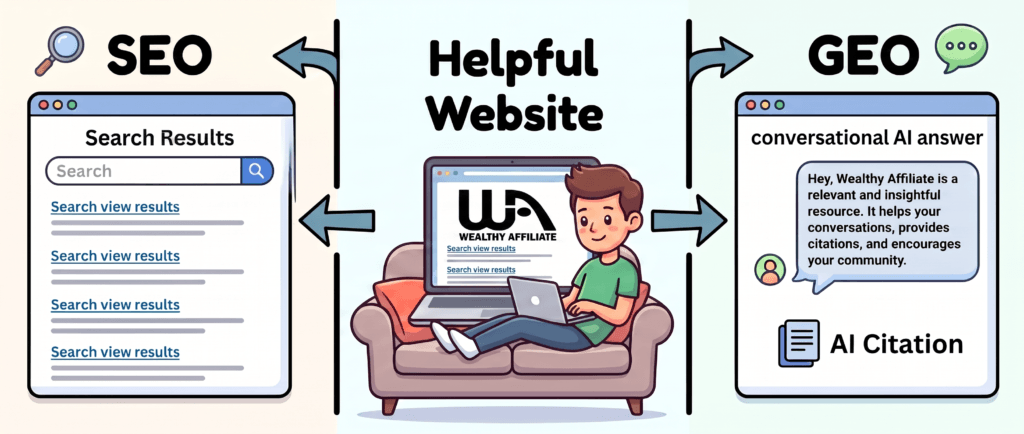
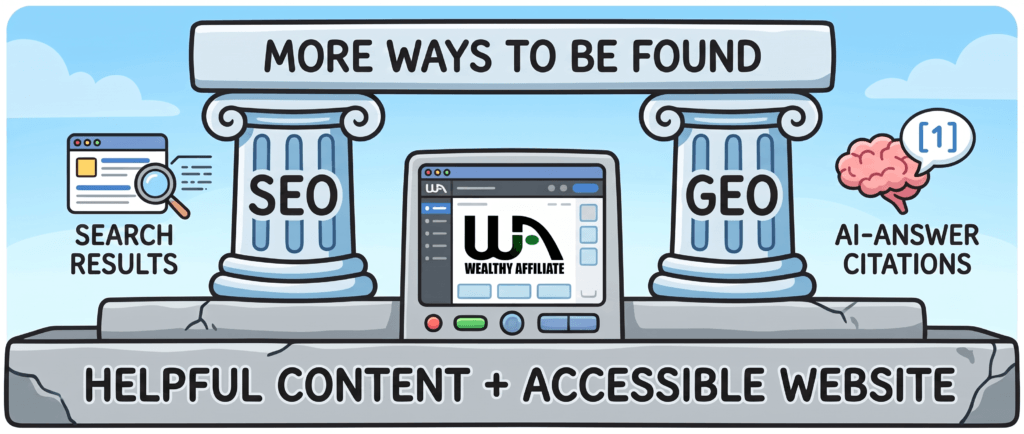
SEO helps a page become discoverable in traditional search results. GEO focuses on making useful information easy for generative AI systems to understand, select, summarize, and cite. The destinations look different, but the foundation is largely the same: a technically accessible website, original information, clear answers, credible sources, and content created for people.
The practical question is not, “Should I abandon SEO for GEO?”
It is, “How can I create one trustworthy page that deserves visibility in both?”
If the entire subject of AI-powered discovery is still new to you, my How Beginners Can Get Found in AI Search guide explains where AI visibility fits into a beginner’s overall website strategy.
Quick Answer: What Is the Difference Between GEO and SEO?
SEO improves a website’s visibility in search-engine results. GEO improves the likelihood that a website’s information can be understood, selected, and cited in AI-generated answers.
Strong GEO usually begins with strong SEO because content must be accessible, understandable, useful, and trustworthy before a search engine or AI system will confidently show it to users.
The main difference is the outcome you are trying to earn:
- SEO can earn rankings, impressions, and clicks from search results.
- GEO can earn mentions, citations, and referral visits from generated answers.
- A well-built page can do both.
That does not mean every page will rank or be cited. No platform, course, or optimization method can guarantee either result.
What Do SEO and GEO Mean?
Let’s remove the jargon before going any further.
What Is SEO?
Search engine optimization, or SEO, is the process of helping search engines crawl, understand, index, and appropriately rank website content.
SEO includes:
- understanding what people search for
- matching content to search intent
- organizing pages with descriptive headings
- improving site speed and mobile usability
- using internal links to show relationships between pages
- earning trust through useful content and reputable references
- writing titles and descriptions that encourage relevant clicks
SEO does not mean repeating a keyword until the writing sounds unnatural. It means making a page genuinely useful and ensuring that search engines can interpret it.
What Is GEO?
Generative engine optimization, or GEO, is the practice of improving how clearly and credibly content can contribute to AI-generated answers.
An AI answer may combine information from several sources rather than display one traditional list of ten blue links. GEO therefore pays particular attention to:
- direct, self-contained answers
- statements that can be quoted without losing their meaning
- clear facts, definitions, comparisons, and limitations
- identifiable authorship and first-hand perspective
- accurate citations to original or authoritative sources
- consistent information about a person, brand, or topic
GEO is newer terminology, but much of the work is familiar. Helpful content did not stop being helpful because the answer format changed.
GEO vs. SEO: A Side-by-Side Comparison
The easiest way to understand the difference is to compare the purpose, signals, and results side by side.
| Question | SEO | GEO |
|---|---|---|
| What is the main goal? | Earn visibility in search results | Earn visibility or citations in generated answers |
| Where might the content appear? | Organic listings, rich results, images, or video results | AI Overviews, AI Mode, ChatGPT search, Copilot, and other answer systems |
| What does the user often see? | A choice of links | A synthesized answer with possible source links |
| What should the page provide? | Relevant, useful content that satisfies search intent | Clear, credible passages that can support a generated answer |
| Do keywords matter? | Yes, as clues to language and intent | Yes, but questions, entities, context, and natural phrasing also matter |
| Does technical accessibility matter? | Yes | Yes—systems cannot use content they cannot access |
| How is success measured? | Rankings, impressions, clicks, engagement, and conversions | Citations, mentions, AI referrals, engagement, and conversions |
| Can results be guaranteed? | No | No |
The important part is the overlap. Both reward content that answers a real question clearly. Both depend on discoverability. Both benefit from trustworthy authorship, sensible structure, and information that adds something beyond a generic summary.
That is why I would not build one weak “SEO version” and a second repetitive “GEO version” of the same article. I would build the strongest version once.
Is GEO Replacing SEO?
No. GEO is not replacing SEO; it extends search optimization into AI-generated discovery experiences.
This is more than my interpretation. Google now addresses the question directly in its guidance for site owners. Google says its generative AI features are rooted in its core ranking and quality systems and that established SEO best practices remain relevant.
Before paying for a supposed GEO shortcut, read Google Search Central’s guide to optimizing for generative AI features. It explains that Google views optimization for its generative search experiences as part of SEO and warns against unsupported tactics such as special AI markup, unnecessary AI text files, and manufactured mentions.
That matters for beginners because fear creates expensive decisions.
If someone tells you traditional SEO is dead and you must buy a completely separate system immediately, slow down. You still need a crawlable site. You still need pages that match a real question. You still need accurate information, descriptive titles, useful internal links, and reasons for a reader to trust you.
What has changed is that a useful answer might now be discovered in more than one format.
What Does GEO Add to Traditional SEO?
GEO changes the way I think about the usefulness of an individual passage.
A page may answer the overall search intent and still make its key information difficult to extract. The definition may be buried under a long introduction. A comparison may be scattered across several paragraphs. A strong claim may have no source. The author may never explain how the conclusion was reached.
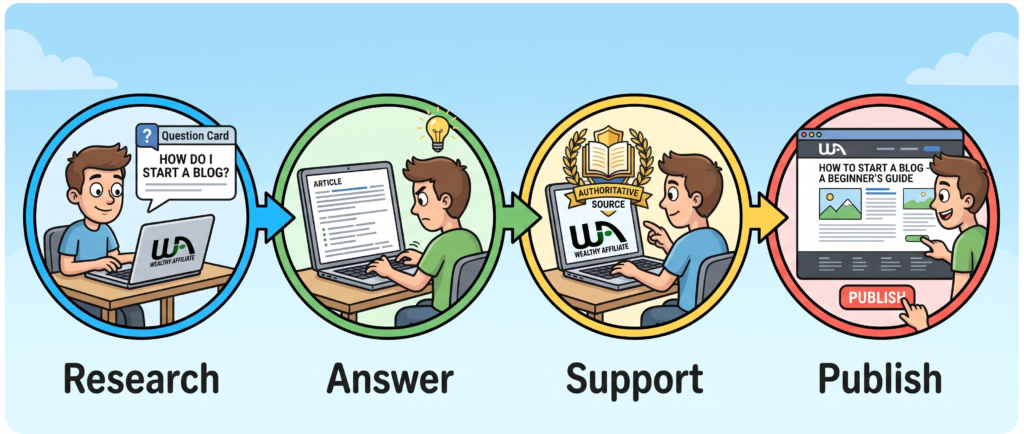
For GEO, each important section should make sense on its own while still belonging naturally to the complete article.
That can mean:
- Opening a section with a direct answer.
- Explaining the answer in plain language.
- Supporting factual claims with an original or authoritative source.
- Adding first-hand context, judgment, or an example.
- Stating limitations instead of making absolute promises.
Researchers introduced the term generative engine optimization in a paper that tested ways of improving source visibility in generated responses. The study reported that some methods improved visibility in its experimental setting, but results differed by subject. That is useful evidence—not a universal recipe or a promise that one formatting trick will produce citations everywhere.
You can review the methodology and limitations in the original GEO: Generative Engine Optimization research paper. I would treat its findings as a reason to improve clarity and sourcing, not as permission to stuff articles with quotations or statistics that do not help the reader.
An AI-Quotable Passage Is Still Written for a Person
Here is the standard I use:
If a short passage answers one question accurately, makes sense outside the article, and gives the reader a reason to trust it, it is easier for both people and machines to use.
That is not a secret ranking factor. It is a practical editing test.
What Should Beginners Optimize First?
If you are building your first affiliate website, do not let a new acronym rearrange your priorities.
Use this order:
| Priority | What to Do | Why It Helps SEO and GEO |
| 1. Build a sound website | Use secure hosting, mobile-friendly pages, logical navigation, and a sitemap | Search and AI systems need to access the content |
| 2. Choose one clear question | Understand the reader’s intent before writing | Focus improves relevance and answer quality |
| 3. Publish original value | Add experience, examples, comparisons, observations, or research | Generic summaries are easy to replace |
| 4. Structure the answer | Use descriptive headings, short answer-first passages, lists, and tables where useful | Readers can scan and systems can interpret the page |
| 5. Support factual claims | Link to original studies, official guidance, or authoritative documentation | Evidence strengthens accuracy and trust |
| 6. Connect related pages | Add natural internal links without repeating the same destination unnecessarily | Topic relationships become clearer |
| 7. Update and measure | Correct outdated details and monitor how visitors discover the page | Improvement should follow evidence, not guesses |
Notice what is not on that list: publishing dozens of near-identical AI articles, forcing a quotation into every paragraph, or pretending that a tool can guarantee a citation.
If you want the detailed process for earning AI visibility, use my How to Get Your Website Cited by AI guide. This comparison article is meant to help you choose the right strategy; that guide handles the deeper citation work.
Build the Foundation Before Chasing the Acronym
Learning SEO, content creation, WordPress, keyword research, and affiliate marketing separately can feel like trying to assemble a puzzle without the picture on the box.
That is one reason I recommend Wealthy Affiliate to beginners. It brings website hosting, research tools, structured training, and community support into one place, so you can build the SEO foundation that also supports future AI visibility.
It does not guarantee Google rankings, AI citations, traffic, or income. What it can provide is a guided place to learn and apply the skills instead of collecting disconnected advice from dozens of tabs.
? Start the Free Wealthy Affiliate Starter Membership
A Practical GEO and SEO Workflow
Here is how I would approach a new article without creating two competing versions.
1. Start With the Search Decision
Ask what the reader needs to understand, compare, choose, avoid, or do.
For this article, the decision is simple: Do I need GEO instead of SEO, or should I use them together?
That question keeps the article from drifting into a duplicate of a complete AI-ranking guide.
2. Research the Language People Use
Use the main phrase naturally, then include closely related questions where they genuinely belong:
- What is GEO in digital marketing?
- What is the difference between GEO and SEO?
- Is GEO replacing SEO?
- Does GEO help with Google AI Overviews?
- Can one article rank in search and appear in AI answers?
- Do beginners need a GEO strategy?
These long-tail phrases are useful because each represents a specific concern. They should shape the coverage, not be repeated mechanically.
3. Give the Best Answer Early
A reader should not have to scroll through 800 words to discover whether GEO replaces SEO.
Lead with the answer. Then provide the comparison, evidence, exceptions, and next steps.
4. Add Information a Generic Summary Cannot Replace
This is where E-E-A-T becomes visible rather than decorative.
You can add:
- what you tested or observed
- screenshots of your process or results
- an original checklist
- a decision table
- a mistake you made and corrected
- a fair explanation of who a recommended product is not for
- the date and source of a changing fact
Do not invent experience. If your contribution comes from careful research rather than personal results, say so.
5. Edit Each Section for Clarity
Check whether every major heading has:
- a direct answer near the beginning
- enough context to prevent misunderstanding
- evidence for factual or changing claims
- natural language rather than keyword stuffing
- a useful next step
6. Connect the Article to the Right Learning Path
Internal links should help the reader continue—not merely move authority around a website.
Someone who understands this comparison but still needs a practical publishing system can continue with my Content Marketing Strategies for Affiliate Success guide.
Common GEO Mistakes That Can Hurt the Article
The biggest risk is optimizing for a theory instead of helping the reader.
Avoid these mistakes:
- Creating a second article that answers the same question. This can cause overlap and leave both pages weaker.
- Using unsupported statistics. A precise number without a reliable source can reduce trust.
- Adding quotations only to attract AI systems. Quote a source because it improves the explanation.
- Writing robotic answer blocks. Direct answers should still sound like a knowledgeable person speaking to a beginner.
- Ignoring technical SEO. A brilliant page that cannot be crawled or indexed has limited discovery potential.
- Treating schema as a GEO switch. Useful structured data can support eligible search features, but there is no universal “AI citation” schema.
- Manufacturing mentions or reviews. Trust is not created by pretending other people are talking about a brand.
- Promising results. Rankings, citations, traffic, and affiliate income depend on many factors outside your control.
I would also be careful with mass-produced AI content. Google’s official guidance says generative AI can help with research and structure, but generating many pages without adding value may violate its spam policies. The safest approach is to use AI as an assistant while keeping human judgment, fact-checking, and original contribution at the center.
Read Google’s guidance on using generative AI content before scaling production. It is a much better reference point than advice promising hundreds of effortless ranking pages.
How Do You Measure GEO and SEO Results?
SEO measurement is more established. You can monitor
- search impressions
- average positions
- clicks and click-through rate
- indexed pages
- organic landing pages
- email sign-ups and affiliate conversions
GEO measurement is still developing. Look for:
- citations or referenced pages in supported AI tools
- referral traffic from AI platforms
- landing pages receiving that traffic
- branded searches and direct visits after AI exposure
- conversions from visitors who arrive through AI referrals
Microsoft now provides a useful example of how this measurement is evolving. Its AI Performance report shows citations across supported Microsoft AI experiences, cited URLs, and changes over time. Microsoft also cautions that citation counts do not show a page’s ranking, authority, or position inside a particular answer.
Read Microsoft’s explanation of AI Performance in Bing Webmaster Tools before interpreting the numbers.
Also remember that referral reports will never show every AI interaction. A person may read an AI answer, remember your brand, and return later through Google or by typing the address directly.
Measure business outcomes, not citations alone.
Can ChatGPT Find and Cite Any Public Website?
A public website may appear in ChatGPT search, but inclusion and citation are not guaranteed.
OpenAI explains that publishers should allow its search crawler if they want content to be eligible for discovery in ChatGPT search. Blocking the relevant crawler can prevent a page from appearing in search answers even though the page remains public elsewhere.
Site owners can review the current crawler requirements in OpenAI’s Publishers and Developers FAQ. This is a technical eligibility step, not a promise that the content will be selected.
The Beginner’s GEO vs. SEO Decision
If you remember only one thing from this guide, make it this:
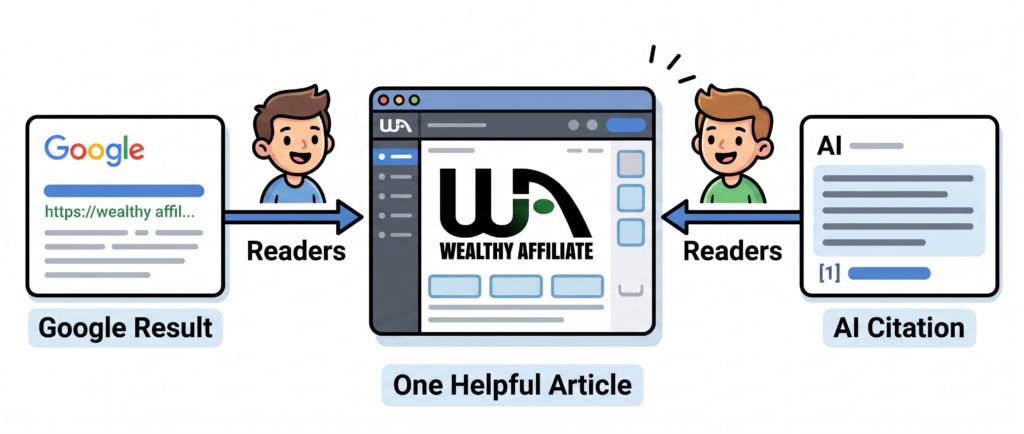
Do not choose between GEO and SEO. Build a strong SEO foundation, then make every important answer clear, credible, original, and easy to cite.
For most beginners, the right allocation is not 50% SEO work and 50% GEO tricks.
It looks more like this:
| Keep Doing | Add for AI Discovery | Do Not Chase |
| Search-intent research | Direct answer-first summaries | Guaranteed citation services |
| Technical SEO | Self-contained definitions and comparisons | Keyword or quotation stuffing |
| Original, people-first content | Clear sourcing and factual support | Duplicate “AI versions” of pages |
| Internal linking | Consistent author and brand information | Unsupported special markup claims |
| Updating and measuring | AI referral and citation monitoring | Manufactured mentions |
The terminology will continue to change. The value of being genuinely useful is much less likely to change.
Final Thoughts
GEO deserves attention because people are discovering information through generated answers as well as traditional search results.
But I do not believe beginners benefit from treating it as a replacement for SEO—or from buying every new tactic attached to the acronym.
Build a website search engines can access. Answer a question better than a generic summary. Support claims. Add your own experience or careful judgment. Make recommendations responsibly. Then structure the information so a reader, a search engine, and an AI system can understand what the page contributes.
That is a sustainable strategy even as individual platforms change.
Ready to Build a Website for Search and AI Discovery?
Wealthy Affiliate gives beginners a place to build a WordPress website while learning keyword research, SEO, content creation, and affiliate marketing in a connected sequence.
The free Starter membership lets you explore the platform before deciding whether it fits you. There is no guarantee of rankings, AI citations, traffic, or income, and success still requires consistent work. I recommend it because the training and tools can make the learning process less fragmented—not because it removes the work.
? Explore Wealthy Affiliate With the Free Starter Membership
Continue Learning
If you are ready to turn the comparison into action, these guides cover the next steps without repeating this article:
- ? How to Rank in AI Search
- ? Affiliate Marketing SEO: The Complete Beginner Guide
- ? Organic Traffic Techniques for Affiliate Marketers
- ? AI Tools for Affiliate Marketing Beginners
Key Takeaways
- SEO targets visibility in search results; GEO targets visibility in generated answers.
- GEO does not replace SEO. It builds on many of the same accessibility, quality, and trust foundations.
- One strong page can support both Google rankings and AI citations.
- Direct answers, original value, clear sourcing, and honest limitations make content more useful in both environments.
- New terminology does not create guaranteed results or eliminate the need for consistent work.
- Wealthy Affiliate can help beginners learn the website, SEO, and content skills behind both discovery paths.
Frequently Asked Questions
What is GEO in digital marketing?
GEO, or generative engine optimization, is the practice of improving content so generative AI systems can understand it and may select, summarize, mention, or cite it in generated answers.
What is the main difference between GEO and SEO?
SEO focuses on visibility in search-engine results. GEO focuses on visibility within AI-generated answers. The presentation and measurement differ, but both benefit from accessible, relevant, trustworthy content.
Is GEO replacing SEO?
No. GEO is not replacing SEO. Search engines still need to discover, crawl, index, and evaluate content, and Google states that its generative AI search features rely on core search ranking and quality systems.
Do beginners need a separate GEO strategy?
Most beginners do not need a separate content strategy. They should first learn sound SEO and content principles, then improve each page with direct answers, original information, authoritative sources, and clear structure.
Can the same article rank in Google and be cited by AI?
Yes, the same article can potentially appear in traditional search and be cited in an AI answer. Neither outcome is guaranteed, but publishing one strong page usually makes more sense than creating two pages that answer the same question.
Does adding quotes guarantee AI citations?
No. Quotations do not guarantee citations. Use a quote only when the source strengthens the reader’s understanding, and always provide enough context to avoid misrepresenting it.
Is structured data required for GEO?
No special GEO schema guarantees AI visibility. Appropriate structured data can still help search engines understand a page and qualify it for certain rich results, but it should accurately match the visible content.
How long does GEO take to work?
There is no standard timeline. Discovery, indexing, source selection, competition, platform changes, and content quality all affect visibility. Focus on publishing useful work and measuring results over time instead of expecting immediate citations.
About the Author
Donna is an affiliate marketing researcher and the founder of AffiliateEducationForBeginners.com. She creates beginner-friendly guides that explain affiliate marketing, SEO, AI search, content creation, and online-business risks without unrealistic income promises.
Affiliate Disclosure and Disclaimer
This article contains affiliate links. If you join Wealthy Affiliate through one of these links, I may earn a commission at no additional cost to you.
The information in this article is educational and reflects research available when it was prepared. Search and AI systems change frequently. No SEO, GEO, training platform, or content strategy can guarantee rankings, citations, traffic, commissions, or income. Always confirm current platform requirements and evaluate whether a product is appropriate for your needs and budget.