Written by Donna
Affiliate marketing researcher and founder of AffiliateEducationForBeginners.com
↑ Top
If you have started using ChatGPT or another AI writing tool, you may have had the same uneasy thought I did:
Can AI content hurt your Google rankings?
It is an understandable concern. AI can turn a blank screen into a draft in seconds, but the last thing you want is to save time writing only to damage the website you are working so hard to build.
What I learned while researching this is reassuring—but there is an important catch.
Google does not automatically penalize a page simply because AI helped create it. The risk comes from what you publish. If the finished article is inaccurate, repetitive, unoriginal, or created mainly to manipulate rankings, it can hurt your website whether AI wrote it or a person did.
AI can still be useful. It can help you organize ideas, notice missing information, improve a confusing explanation, or get past writer’s block. You simply cannot hand it your credibility along with the assignment.
This article is part of my How Beginners Can Get Found in AI Search learning hub. Here, we are focusing on how you can use AI without letting it replace the judgment, honesty, and human connection that make readers trust you.
Quick Answer: Does AI Content Hurt Google Rankings?
AI content does not automatically hurt Google rankings. Google cares about whether the finished content is helpful, reliable, original, and created for people—not whether AI assisted with part of the process.
Problems are more likely when someone uses AI to:
- publish articles without checking the facts
- rewrite information already available everywhere else
- create several overlapping pages for similar keywords
- invent experience, statistics, or quotations
- recommend products without checking current details
- produce content mainly to manipulate rankings
The simplest way I can explain it is this:
AI can help you create an article, but it cannot decide whether that article deserves your name.
That decision still belongs to you.
What Does Google Actually Say About AI Content?
There are two extreme versions of this conversation online.
One says Google will penalize anything written with AI. The other says you can generate hundreds of articles, publish them untouched, and watch the traffic arrive.
Neither is a responsible way to look at it.
Google says generative AI can be useful for research and for adding structure to original content. It also warns that using AI or other automation to generate many pages without adding value may violate its scaled content abuse policy.
If you want to read the guidance for yourself, start with Google Search Central’s explanation of generative AI content. Its wording is much clearer than many dramatic claims circulating online.
My takeaway is not that Google “likes” or “dislikes” AI. It is that Google still wants what readers want: a page that answers the question accurately and gives them something worth finding.
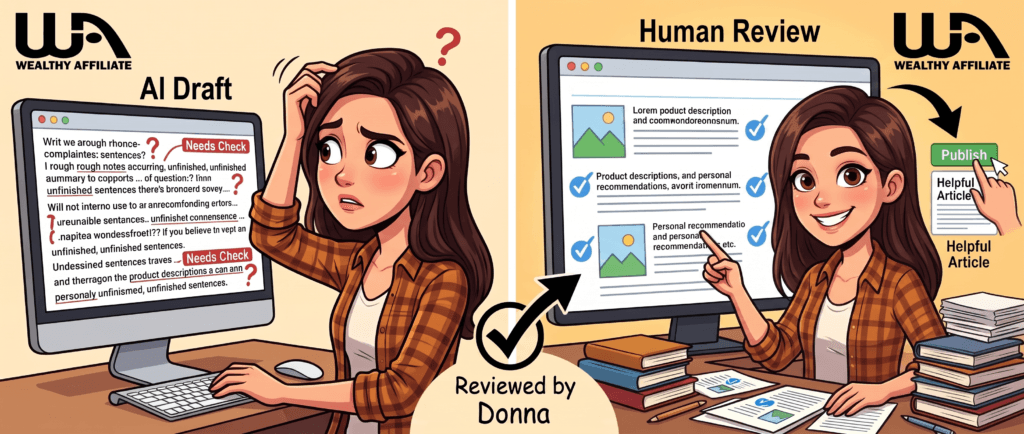
Helpful AI Assistance vs. Risky AI Publishing
The difference becomes easier to see when we look at real writing tasks.
| How AI Is Used | A Helpful Approach | A Riskier Approach |
|---|---|---|
| Finding questions | Use ideas to understand what beginners are asking | Assume every suggested keyword is accurate |
| Creating an outline | Organize research around one clear question | Create several pages answering the same question |
| Drafting | Use the draft to get started, then improve it | Publish the first response untouched |
| Editing | Improve clarity and grammar | Remove so much personality that it sounds generic |
| Product details | Identify details you need to verify | Trust AI for current prices, features, or terms |
| Experience | Add only what you truly learned or observed | Let AI invent a personal story or result |
| Publishing faster | Make a thoughtful process more efficient | Flood the site with low-value content |
I would happily use AI to tell me a paragraph is confusing or that I missed an obvious beginner question.
I would not let it tell readers I tested a product when I did not.
That is not being afraid of AI. It is using the tool without giving up responsibility for the result.
AI may help you produce a draft faster, but the finished article still needs to engage the reader and support a clear purpose. My How to Create Content That Sells guide explains how useful content can build trust and encourage readers to take the next step without relying on pressure.
Can AI-Generated Content Rank on Google?
Yes, AI-assisted content can rank on Google. However, using AI does not make a page deserving of a high position, and avoiding AI does not automatically make a page helpful.
Competition, usefulness, originality, website quality, links, page experience, and search intent can all affect performance.
Industry research gives us additional context.
Ahrefs analyzed hundreds of thousands of ranking pages and found AI-assisted content throughout the results. It also found that pages classified as entirely AI-generated appeared less often in the number-one position. You can review the methodology in Ahrefs’ analysis of AI-generated content and Google rankings.
Semrush examined a separate dataset and also found that human involvement remained common among successful content teams. Its results do not prove that a certain percentage of human writing causes rankings, but they support human-led research and editing. The methodology appears in the Semrush AI content ranking study.
I would not use either study to promise that AI content will rank. AI detectors are imperfect, and a relationship between two things does not prove one caused the other.
What the research does show is that AI assistance is common. The better question is whether the finished article is useful.
Why Affiliate Content Needs Extra Care
Affiliate content is not just information. A reader may decide whether to spend money based partly on what you tell them.
AI can confidently give you an outdated commission rate, expired free trial, or feature that no longer exists. It may describe a product as perfect for beginners without understanding the cost, learning curve, or limitations.
Imagine following a recommendation and discovering the price was wrong or the “free” option required a credit card. You would probably question the rest of the article too.
That is why I would never let AI make the final decision about:
- who a product is best for
- whether the cost is reasonable
- which limitations matter
- whether a claim is current
- whether I would recommend it
My AI Writing Tools for Affiliate Marketing Beginners guide looks at the tools themselves. This article deals with the more important question afterward: is the work accurate and helpful enough to publish?
Misleading claims are also one reason beginners can struggle to distinguish legitimate affiliate education from online-business hype. My Online Business Scams & Warnings page explains the warning signs readers should recognize before trusting a program or income claim.
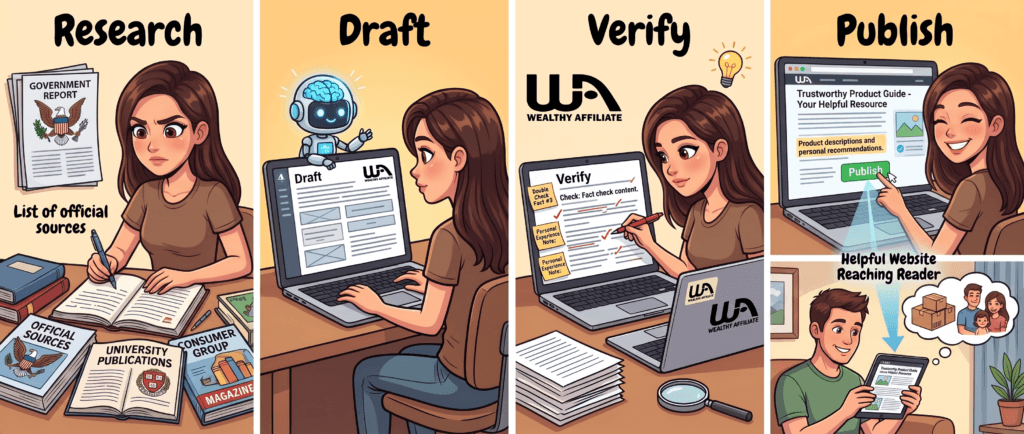
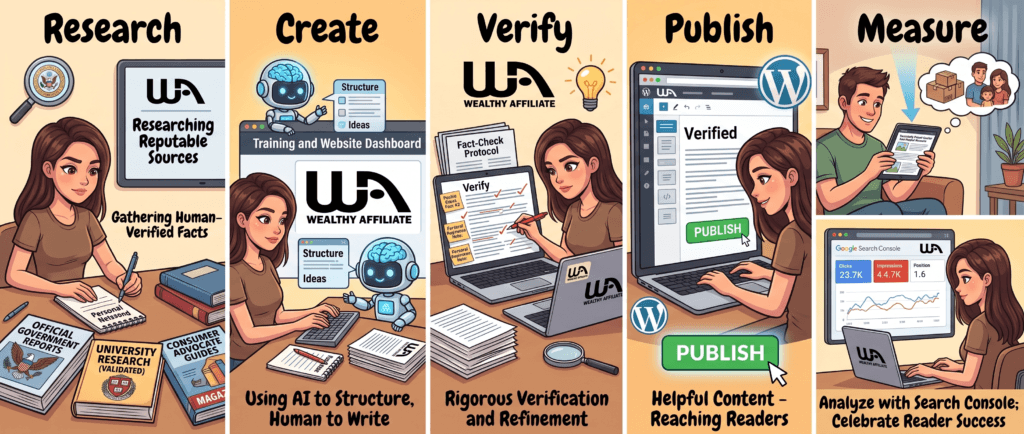
How I Would Use AI Without Sacrificing Quality
You do not need an intimidating 30-step system. This is the practical process I would follow.
Start With the Reader, Not the Tool
Before opening AI, I would decide what the reader needs.
Are they trying to understand a term? Compare two programs? Avoid a scam? Choose a first step?
That decision prevents AI from turning a focused article into a broad collection of everything it knows.
If you are still building the foundation of your website, my Affiliate Marketing Basics page shows how content, traffic, affiliate programs, and commissions fit together before AI enters the process.
Research the Facts That Cannot Be Wrong
I would gather official program terms, Google policies, product costs, original studies, and current features before trusting the draft.
AI can remind me what needs checking, but I would still open the source myself.
Let AI Help With the Difficult Parts
Sometimes you know what you mean but cannot find a simple way to say it. That is a useful time to ask AI for help.
You might also ask:
- Which part could confuse a beginner?
- Have I made a claim that needs a source?
- Does this repeat something I already explained?
- What important limitation did I overlook?
- Does this comparison treat both choices fairly?
Those questions make AI an extra set of editorial eyes rather than a replacement author.
Add What AI Cannot Know
This is where the article becomes yours.
You could add what surprised you during your research, a beginner mistake you now understand, an original comparison, a useful screenshot, or an honest reason a product may not suit everyone.
You do not need to pretend you have ten years of experience. Careful research and honest observations can still help someone who is one step behind you.
Read It Like a Visitor
Before publishing, I would step away and then read the article from beginning to end.
I would ask:
- Does this sound like me?
- Did I answer the question?
- Can I support the important claims?
- Would I feel misled if I followed this advice?
- Is this more useful than the first AI draft?
If the answer to that final question is no, the article is not ready.
Measure What Happens
After Google finds the page, Search Console can show which searches produce impressions, whether people click the title, and how performance changes.
Google explains the filters and comparisons in its Search Console performance-report guide. I would use that real evidence before rewriting a page because an AI tool predicted something different.
Search rankings are only useful when they bring the right readers to your website. My Traffic Generation Strategies page explains how SEO, social media, Pinterest, email, and other traffic sources can support long-term website growth.
A Simple Human-Review Checklist
| Before Publishing | Ask Yourself | What Ready Looks Like |
| Purpose | Did I answer one clear question? | The answer appears near the beginning |
| Accuracy | Did I check facts, links, and claims? | Important details use current reliable sources |
| Original value | Did I add more than a generic summary? | The article contains useful judgment or examples |
| Experience | Are personal statements true? | Nothing was invented to sound authoritative |
| Trust | Can readers see who wrote this and why? | Authorship, sources, limitations, and disclosure are clear |
| SEO | Does the keyword fit naturally? | The writing sounds normal when read aloud |
| Recommendation | Did I explain value and limitations? | The reader can make an informed choice |
| Final review | Did I personally read every word? | I am comfortable publishing it under my name |
This is not meant to make publishing harder. It keeps a fast AI draft from creating a slow trust problem later.
Learn While You Build
One reason AI is appealing is that beginners are trying to learn everything at once—WordPress, SEO, keyword research, content, affiliate programs, and traffic.
I understand why a button promising to write the article feels like relief.
The problem is that a finished draft does not teach you whether the topic was right, the advice accurate, or the recommendation fair.
That is where Wealthy Affiliate can help. It combines website hosting, structured training, keyword research, content tools, and community support in one place. You can use AI within that learning process instead of expecting it to replace the process.
Wealthy Affiliate cannot guarantee rankings, traffic, commissions, citations, or income. Its value is helping you understand the work while building something of your own.
? Start the Free Wealthy Affiliate Starter Membership
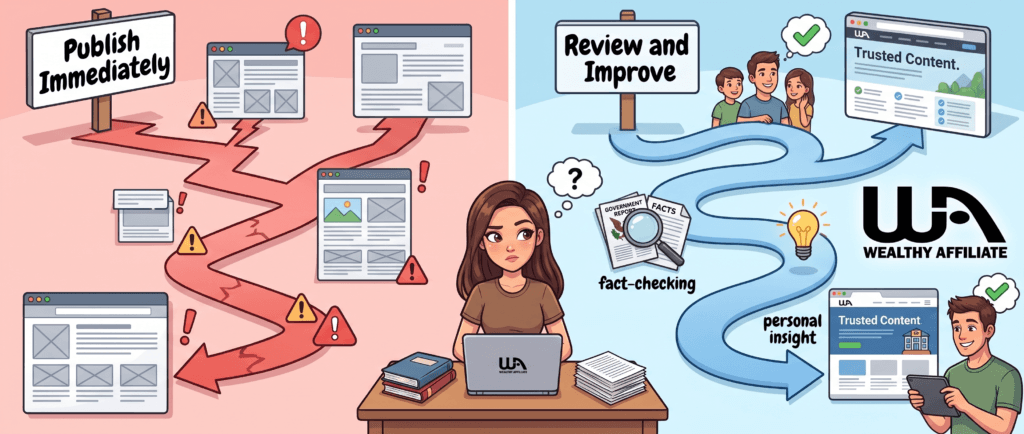
AI Content Mistakes I Would Avoid
Publishing the First Draft
The first response may be a useful beginning, but it can repeat itself, miss context, or state an assumption as fact.
Creating Several Versions of the Same Article
Changing “AI content and SEO” to “AI writing and Google” does not necessarily create a different reader question. Overlapping pages can weaken the learning path.
Allowing AI to Invent Experience
If you did not test the product, do not say you did. Honest research builds more trust than a fictional success story.
Linking Without Opening the Source
AI can invent a source or misunderstand a real one. I would open every external link and confirm that it supports the sentence beside it.
Hiding the Drawbacks
An article can be enticing while explaining limitations. Telling someone who should not buy often makes a recommendation more believable to those who are a good fit.
Publishing at Scale Without Value
Google lists using generative AI to create many pages without added value as a possible example of scaled content abuse.
You can read the examples in Google’s web-search spam policies. The concern is not that a tool made writing faster. It is that speed was used to publish pages that did not help anyone.
What Can AI Do—and What Still Belongs to You?
| AI Can Help You | You Still Decide | Why It Matters |
| Brainstorm questions | Which question deserves an article | Prevents overlapping pages |
| Suggest an outline | What the reader truly needs | Keeps the article focused |
| Draft an explanation | Whether it is accurate | Protects readers from confident mistakes |
| Improve wording | Whether it sounds like you | Builds a recognizable voice |
| Notice gaps | What original value to add | Gives the page a reason to exist |
| Proofread | Whether the recommendation is fair | Keeps responsibility with the author |
| Suggest updates | Whether Search Console shows a need | Prevents changes based on guesses |
AI is most useful when it helps you think—not when it lets you stop thinking.
How This Guide Fits Into the AI Search Series
This article is only about using AI to help create content you want Google to rank.
It does not try to explain every part of AI search. Those questions have their own guides about AI search versus traditional search, GEO versus SEO, ranking in AI answers, and earning AI citations.
Keeping those questions separate gives each article a clear purpose and prevents you from reading the same information four different ways.
If you need help connecting individual articles into a complete strategy, my Content Marketing Strategies for Affiliate Success hub explains how guides, reviews, tutorials, and comparisons can work together.
Final Thoughts
AI content does not automatically hurt Google rankings.
Careless content can.
You do not have to choose between refusing to use AI and allowing it to write your entire website. There is a sensible middle ground.
Let AI help you begin, ask better questions, organize information, and improve clarity. Then bring the article back to what only you can provide: honest judgment, verified facts, original observations, and responsibility for the recommendation.
Before publishing, ask yourself:
If a beginner trusted this article, would I feel good about where it led them?
If the answer is yes, you are using AI as a tool—not as a substitute for trust.
Ready to Build Content With More Support?
Wealthy Affiliate gives beginners a place to build a WordPress website while learning keyword research, SEO, content creation, and affiliate marketing step by step.
It will not do the work for you, and it cannot promise results. What it can do is help you understand how the pieces fit together so AI becomes one useful tool instead of the one making every decision.
The free Starter membership lets you explore the platform before deciding whether it suits your goals and budget.
? Explore Wealthy Affiliate With a Free Starter Account
Continue Learning
Now that you understand how to use AI without sacrificing content quality, the next step is learning how that content can be discovered in traditional and AI-powered search.
Follow the learning path that matches what you need next:
? GEO vs. SEO for Beginners — understand how SEO rankings and AI visibility work together
? How to Rank in AI Search — learn how to make your content easier to discover in generated answers
? How to Get Your Website Cited by AI — learn what makes a page useful as a cited source
? Affiliate SEO for Beginners — strengthen the SEO foundation that supports both Google and AI visibility
Key Takeaways
- Google does not automatically penalize content because AI helped create it.
- The risks are inaccurate, unoriginal, misleading, or mass-produced content that adds little value.
- AI can help with ideas, organization, drafting, editing, and finding missing information.
- You remain responsible for facts, experience, recommendations, links, and disclosure.
- Human review should make the article more useful than the first AI draft.
- Search Console provides better update evidence than an AI ranking prediction.
- Wealthy Affiliate can help beginners learn the skills that make responsible AI use possible.
- No tool or training platform can guarantee rankings, traffic, commissions, citations, or income.
Frequently Asked Questions
Does Google penalize AI-generated content?
Google does not automatically penalize content because AI helped create it. It may act against content created primarily to manipulate rankings or produced at scale without meaningful value.
Can AI-generated content rank on Google?
Yes. AI-assisted content can rank when the finished page is relevant, useful, accurate, original, and competitive. AI involvement does not guarantee or prevent a ranking.
Is AI content bad for SEO?
AI content is not inherently bad for SEO. Inaccurate, repetitive, misleading, or unhelpful content can cause problems regardless of who or what created it.
How much AI content is acceptable to Google?
Google does not publish an acceptable AI percentage. The purpose, accuracy, originality, and usefulness of the completed page matter more than an artificial ratio.
Should I disclose that AI helped create an article?
Consider disclosure when readers would reasonably want to understand how the content was created. It depends on the assistance, subject, and whether the explanation helps readers.
Can I use AI to write affiliate product reviews?
AI can help organize or edit a review, but it should not invent product use, results, quotations, or opinions. Check current details and distinguish experience from research.
How should I review AI content before publishing?
Check important facts, open every source, confirm product terms, remove invented experience, add something original, and read the article in your natural voice.
Can Wealthy Affiliate guarantee that AI content will rank?
No. Wealthy Affiliate, AI tools, SEO services, and other platforms cannot guarantee rankings, traffic, citations, commissions, or income.
About the Author
Donna is an affiliate marketing researcher and the founder of AffiliateEducationForBeginners.com. She creates beginner-friendly guides about affiliate marketing, SEO, AI search, content creation, and online-business risks without unrealistic income promises.
Affiliate Disclosure and Disclaimer
This article contains affiliate links. If you join Wealthy Affiliate through one of these links, I may earn a commission at no additional cost to you.
This article is educational and reflects information available when it was prepared. Search policies, AI tools, platform features, product terms, and reporting systems can change. No AI tool, SEO method, course, or affiliate platform can guarantee rankings, traffic, citations, commissions, or income. Confirm current requirements and decide whether any product fits your needs and budget.