Written by Donna
Affiliate marketing researcher and founder of AffiliateEducationForBeginners.com.
SEO for affiliate marketing is the process of helping search engines understand your content so the right readers can find it. This hub gives beginners a structured path through keyword research, helpful content, on-page SEO, internal linking, backlinks, site speed, and schema markup.
SEO can attract visitors without paying for every click, but rankings take time and are never guaranteed. Use the guides below to learn one skill at a time and build a stronger website gradually.
Explore each SEO strategy in detail below:
- Keyword Research for Affiliate Marketing
- On-Page SEO Techniques for Affiliate Websites
- How to Use Long-Tail Keywords for Affiliate Marketing
- SEO Tools for Affiliate Marketers
- How to Build Backlinks
- Improving Site Speed for SEO
- Schema Markup for Affiliate Websites
- Internal Linking Strategies
Quick insight: SEO can become a valuable long-term traffic source, but results depend on content quality, competition, technical health, authority, and consistent improvement.
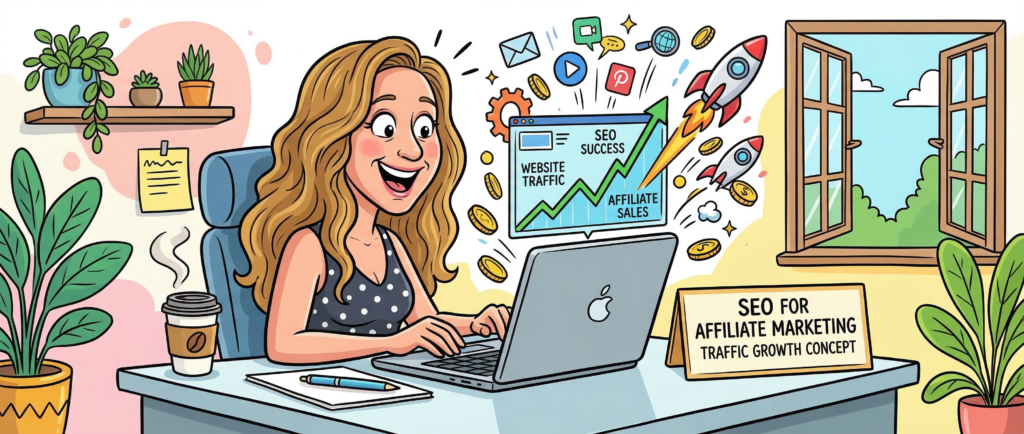
How to Get Traffic with Affiliate SEO
When beginners start affiliate marketing, one of their first questions is: How do I get traffic to my website?
Helpful content cannot produce results if the right audience never finds it. Affiliate SEO helps search engines understand each page’s topic, purpose, and relationship to the rest of your website.
When a page matches a relevant search and provides a useful answer, it may appear in organic search results. Unlike paid advertising, organic SEO does not require you to pay for every visit—but it still requires research, useful content, technical maintenance, and patience.
While building Affiliate Education for Beginners, I learned that choosing affiliate programs is only one part of the process. A website also needs focused content and clear pathways that help both readers and search engines understand where to go next.
New to the complete process? Start with:
Affiliate Marketing for Beginners
What Is Affiliate SEO? (Quick Answer)
Affiliate SEO is the practice of improving an affiliate website’s content, structure, and technical setup so search engines can crawl it, understand it, and consider it for relevant searches. Its purpose is to attract interested visitors through organic search—not to guarantee rankings, traffic, or commissions.
Affiliate SEO includes:
- Understanding search intent and choosing relevant keywords
- Creating original, helpful content for a specific audience
- Optimizing titles, headings, images, and page descriptions
- Connecting related pages with useful internal links
- Improving site speed, mobile usability, and crawlability
- Building credibility through accurate information and reputable references
Start Here: Your Affiliate SEO Learning Roadmap
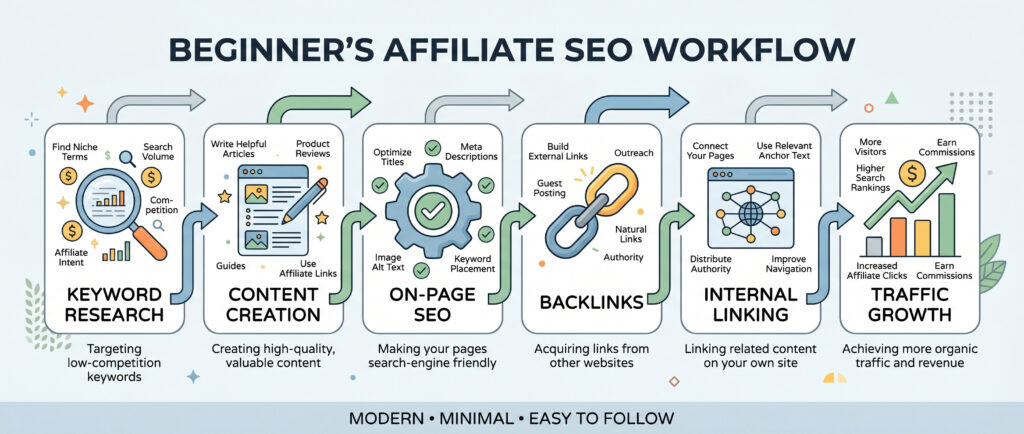
Start with one useful article, not a complete website overhaul. Follow this sequence, using each detailed guide when you reach that step.
1. Choose one question your audience needs answered
Identify a specific reader, their problem, and what they want to learn. Choose a topic that fits your website rather than chasing an unrelated keyword.
Your outcome: One clear question for your next article.
Start with Keyword Research for Affiliate Marketing
2. Narrow the topic with a specific search phrase
Explore more precise searches within your topic. For example, “how to choose hiking boots for wide feet” gives you a clearer reader need than “hiking boots.” A longer phrase is not automatically easy to rank for—check the results and whether you can offer a useful answer.
Your outcome: A focused topic you can cover thoroughly.
Learn How to Use Long-Tail Keywords
3. Write and organize a helpful answer
Answer the main question early. Use descriptive headings, relevant examples, reliable sources, and an accurate title. Explain what you know firsthand and what you researched.
Your outcome: An article that helps the reader complete a task or make an informed decision.
4. Connect the article to your learning path
Link to its main hub, a relevant supporting explanation, and the reader’s next lesson. Check that related existing pages also link to the new article where it genuinely helps.
Your outcome: Readers can find the article and understand where to go next.
Learn Internal Linking Strategies
5. Check access and mobile usability
Open the published page on a phone, test its links, and check it with Search Console and PageSpeed Insights. Investigate access errors and oversized images before making broad technical changes.
Your outcome: A working page that readers can use and search engines can access.
Work Through Site Speed and Technical Improvements
6. Measure before deciding what to change
Use Search Console to distinguish indexing status from impressions and clicks. Review patterns over time rather than treating one test or one quiet day as a verdict.
Your outcome: A specific improvement supported by evidence, rather than guesswork.
Choose SEO Tools for Your Current Stage
7. Understand schema without making it the priority
Learn what structured data describes and check what your SEO plugin already provides before adding more. Schema does not replace useful content or guarantee visibility.
Your outcome: Relevant markup without unnecessary duplication.
8. Build connections around something worth sharing
Once you have a helpful resource, look for relevant opportunities to share it with people who would benefit. Focus on useful contributions and genuine relationships rather than buying ranking promises.
Your outcome: A resource worth recommending and a relevant outreach plan.
You do not need to finish every step before publishing your first useful article. Begin with the foundations, then revisit measurement, maintenance, and outreach as your website develops.
Affiliate disclosure: The Wealthy Affiliate link below is an affiliate link. If you later purchase a paid membership, I may earn a commission at no additional cost to you.
Want Help Practicing These SEO Steps?
If you prefer guided lessons while building your website, Wealthy Affiliate combines beginner training, website tools, keyword research, and community support in one platform.
Explore the Free Wealthy Affiliate Starter Membership
The Affiliate SEO Process (Step-by-Step)
Think of affiliate SEO as a cycle: choose a useful question, publish a clear answer, connect it to related guides, and review what happens.
For example, if Search Console shows that a page is not indexed, investigate its indexing status before changing the headline. If it receives impressions but few clicks, review the searches it appears for and whether its title accurately communicates the page’s value. If visitors reach it but struggle to continue, check its layout and next-step links.
The goal is to identify the problem first, then make a relevant improvement—not change everything at once.
Why SEO Matters for Your Affiliate Website
Choosing an affiliate program gives you something to recommend. It does not give people a reason to visit your website.
That is where helpful content and SEO come together.
What I’m Learning From My Own Website
Working on Affiliate Education for Beginners has shown me why I need to separate publishing from discovery. An article can be live and readable without appearing in Google’s search results.
During my own site checks, I found internal links that still pointed through an old redirected address. I updated those links to lead directly to the current guide. I also checked whether important pages appeared in my sitemap and whether Google could access their content.
Those were specific maintenance improvements—not proof that rankings or traffic would increase. I still need to monitor what happens afterward.
For your website, start with three questions:
- Does this article answer something my intended reader actually needs?
- Can readers find it through relevant links on my site?
- Can search engines access the page?
Google’s people-first content guidance encourages useful, original information and clear evidence of who created it. That is a more practical foundation than repeatedly adding keywords or chasing a perfect tool score.
You can also attract visitors through social media, email, video, and referrals. SEO is one way to help people discover your work—not the only way, and not a guarantee of commissions.
Put Affiliate SEO Into Practice on One Article
You do not need to improve every page today. Choose one article and read it as if you were visiting your website for the first time.
Can you tell what question it answers? Does it help you make a decision? Are the recommendations explained, or are you simply being asked to click a link?
Here is how I would approach a hypothetical hiking-boot guide.
Match the Answer to the Reader’s Question
Someone searching for “how to choose hiking boots for wide feet” needs more than a list of brands. They may want to understand toe room, heel movement, socks, and return policies before ordering.
Use those concerns to shape the article. A heading such as “How Should Hiking Boots Fit Around Your Toes?” tells readers more than a vague heading such as “Important Information.”
Introduce relevant products only where they help answer the question. An affiliate link should support the explanation, not replace it.
Show What Your Advice Is Based On
If you have personally used a product, explain what you tried and what you observed. If you researched it instead, say so and link to the sources supporting your recommendation.
For my own website, I can describe the WordPress changes and Search Console checks I have actually completed. I should not turn those experiences into claims that I have achieved rankings or income that I cannot demonstrate.
The same distinction matters in a product guide: researching hiking boots is not the same as wearing them on a trail.
Give the Reader a Useful Next Step
Before you finish, check that:
- The title accurately describes the article.
- The opening answers the main question without a long detour.
- Headings make the explanation easy to follow.
- Images add useful information and have appropriate alternative text.
- Internal links explain a related question or lead to the next lesson.
- Any affiliate recommendation has a clear disclosure nearby.
These checks help you improve the page’s usefulness and presentation. They do not guarantee that it will rank.
For the detailed walkthrough, continue with On-Page SEO Techniques for Affiliate Websites.
Additional Affiliate SEO Strategies
After learning basic on-page SEO, you can strengthen your website with strategies that connect and support multiple pages:
- Schema markup: Helps search engines interpret specific types of page information.
- Topical coverage: Builds a useful collection of articles around a focused subject.
- Long-tail keywords: Targets narrower, more specific searches.
- Internal linking: Connects related guides and helps readers continue learning.
- Backlink building: Earns links and mentions from relevant websites.
- Content updates: Keeps important information accurate and useful.
Learn each strategy gradually. Adding advanced features cannot compensate for thin, inaccurate, or repetitive content.
What About AI Search—Do I Need to Learn That Too?
If you are wondering whether you need to learn SEO, GEO, and AI search all at once, my advice is to start with the basics. You do not need to master every new term before publishing a useful article.
While checking my own website in Google Search Console, I found that a page could be accessible to Google, appear in my sitemap, and still remain unindexed. That helped me understand an important distinction: making a page available is not the same as having it selected for search results.
I checked the page’s indexing settings, canonical address, and how it appeared in Google’s live test. Those checks helped me rule out some possible problems, but they did not tell me exactly why Google had not indexed it.
That is the approach I encourage here: understand what the evidence shows, fix confirmed problems, and avoid treating any tool or checklist as a guarantee.
Choose the Question You Have Right Now
You do not need to read all these guides today. Pick the one that answers your next question:
- “Where do I begin with AI search?” Start with How Beginners Can Get Found in AI Search.
- “How is an AI answer different from a list of search results?” Read AI Search vs. Traditional Search.
- “What does GEO mean, and how does it relate to SEO?” Explore GEO vs. SEO for Beginners.
- “How might an AI answer reference my website?” Read How to Get Your Website Cited by AI.
- “Could using AI to help write my articles hurt my visibility?” Start with Can AI Content Hurt Your Google Rankings?.
For Google’s AI features specifically, its official guidance explains that established SEO practices remain relevant; there is no special AI markup required. That guidance applies to Google, not automatically to every AI platform.
My starting point is still the reader: answer a real question, explain what you know, verify what you research, and make the next step easy to find.
Affiliate Website SEO Checklist
Here is a simple checklist beginners can follow.
- Research keywords before writing
- Write SEO-friendly affiliate content
- Use headings and structure
- Optimize images with alt text
- Improve site speed
- Make your site mobile-friendly
- Link related content together
- Track performance using Google Search Console
SEO Tools for Affiliate Marketers
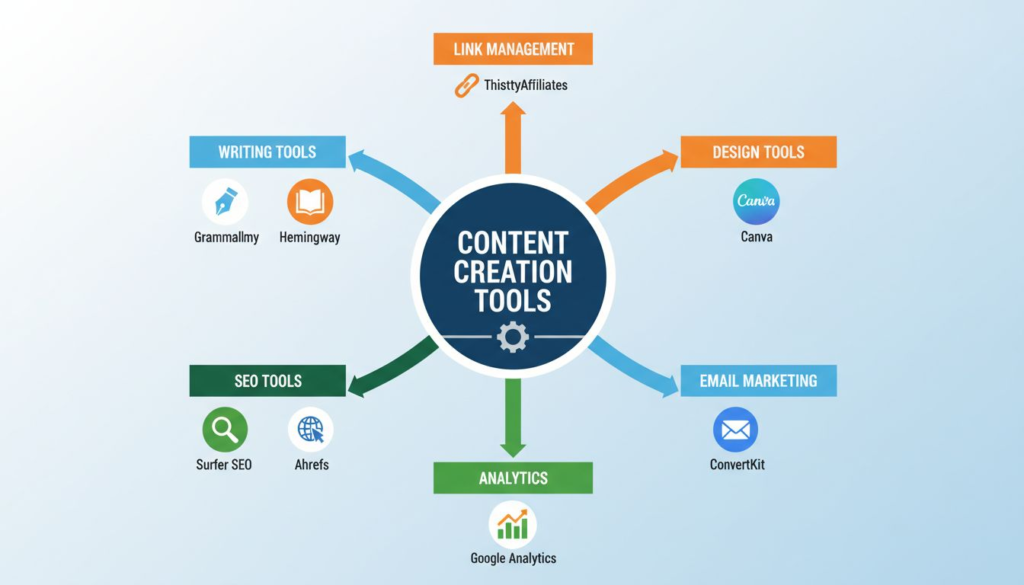
Beginners do not need a large collection of paid tools. Start with tools that help you understand indexing, search performance, visitor behavior, and website speed.
- Google Search Console shows indexing status, search queries, clicks, and technical issues reported by Google.
- Google Analytics helps you understand how visitors use your website.
- PageSpeed Insights evaluates page performance and provides improvement suggestions.
- Paid platforms such as Ahrefs and SEMrush can provide additional keyword and competitor research, but they are optional for beginners.
Detailed guide:
SEO Tools Every Affiliate Marketer Should Use
Want a Structured Way to Learn Affiliate SEO?
You can learn SEO independently using reliable guides and free Google tools. However, some beginners prefer training, website tools, and community support in one place.
Wealthy Affiliate’s current Starter membership includes introductory training, one starter website, community access, and AI credits. The free membership is limited compared with its paid plans, so review the current features before deciding whether it fits your needs.
The platform cannot guarantee rankings, traffic, commissions, or income. Your results depend on your topic, content, competition, decisions, and consistent effort.
Explore the Free Wealthy Affiliate Starter Membership
Affiliate link: I may earn a commission if you later purchase a paid membership, at no additional cost to you.
Key Takeaways
- Affiliate SEO helps search engines understand and evaluate an affiliate website’s content.
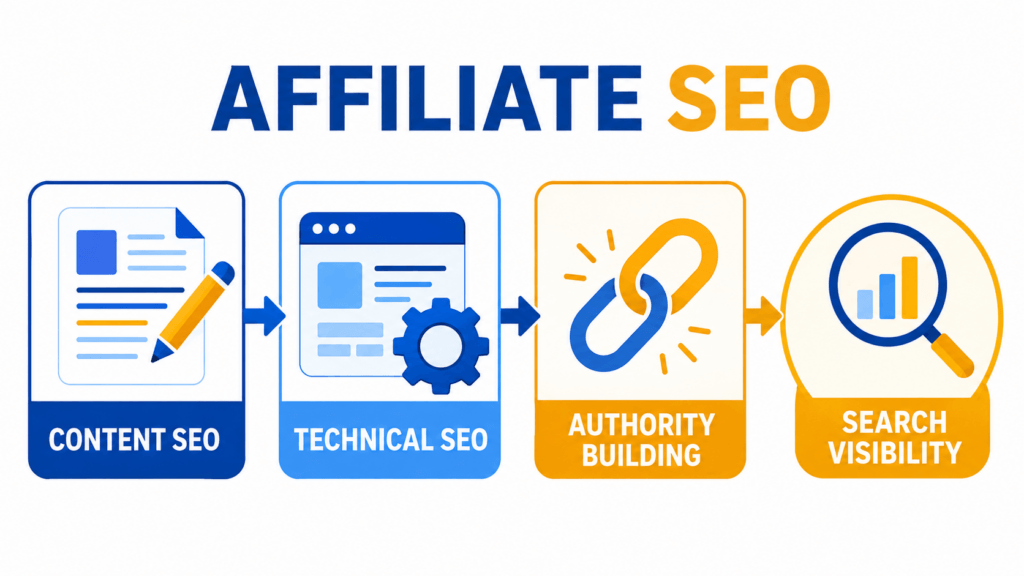
- Helpful content, technical accessibility, internal linking, and authority-building work together.
- Rankings and traffic are never guaranteed and usually require ongoing improvement.
- Beginners should follow the roadmap one step at a time and use Search Console to monitor progress.
Continue Learning
This SEO guide is part of the larger beginner learning path. Continue with the guide that matches your next step:
Main beginner hub: Affiliate Marketing Basics
Next SEO lesson: Keyword Research for Affiliate Marketing
Supporting traffic guide: Traffic Generation Strategies for Beginners
Frequently Asked Questions
What is SEO in affiliate marketing?
SEO in affiliate marketing is the process of improving an affiliate website’s content, structure, and technical setup so search engines can understand it and consider it for relevant searches.
How long does affiliate SEO take?
There is no standard timeline. Search engines may discover a page quickly, but meaningful impressions and traffic can take months or longer. Timing depends on competition, content quality, website history, technical health, authority, and continued improvement.
Do beginners need SEO for affiliate marketing?
No. Affiliate marketers can also attract visitors through social media, video, email, referrals, or paid advertising. SEO is useful for beginners who want to build organic search visibility over time.
What tools help with affiliate marketing SEO?
Google Search Console helps monitor indexing and search performance. Google Analytics helps explain visitor behavior, and PageSpeed Insights evaluates page performance. Paid keyword and competitor-research tools are optional.
Can beginners learn affiliate SEO with Wealthy Affiliate?
Wealthy Affiliate provides introductory training, website tools, and community access that may help some beginners learn. Its free Starter membership is limited, and joining does not guarantee rankings, traffic, commissions, or income.

About the Author
Written by Donna
Affiliate marketing researcher and founder of AffiliateEducationForBeginners.com.
Donna creates beginner-friendly guides about affiliate marketing, SEO, website traffic, content strategy, AI search, and avoiding misleading online-income claims.
While building and managing Affiliate Education for Beginners, she works directly with WordPress, Google Search Console, Google Analytics, internal linking, structured data, and hub-and-cluster content organization. Her goal is to explain what she learns in clear language so beginners can make informed decisions and build their websites one step at a time.
Affiliate Disclosure
This page contains affiliate links. If you join Wealthy Affiliate through one of my links and later purchase a paid membership, I may earn a commission at no additional cost to you.
My recommendation is based on research and the platform features available when this guide was reviewed. Features, access levels, and pricing can change, so verify the current details directly with the provider before making a decision.
Training and tools cannot guarantee rankings, traffic, commissions, or income. Results depend on individual decisions, effort, content quality, competition, and other factors.