Written by Donna
Affiliate marketing researcher and founder of AffiliateEducationForBeginners.com.
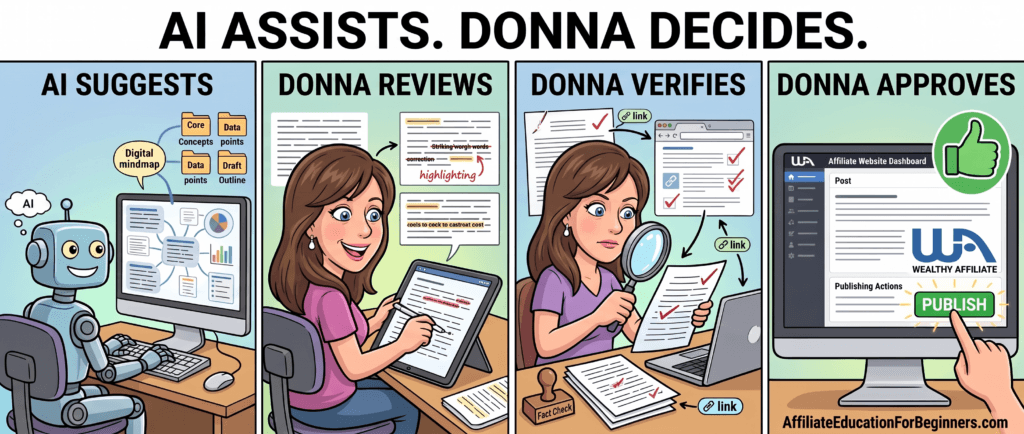
When I began using AI as part of my affiliate-marketing workflow, I quickly learned that producing an answer and producing publishable content are not the same thing.
AI can help organize ideas, compare possible approaches, improve wording, analyze information, and develop visual concepts. It can also produce incorrect facts, awkward sentences, misspelled text, duplicated ideas, and confident recommendations that are not properly supported.
That experience changed how I use AI on Affiliate Education for Beginners. I treat it as an assistant—not as the researcher, editor, fact-checker, or final decision-maker.
This guide organizes AI tools by purpose so you can choose one that solves a real problem, understand its limitations, and keep human judgment in control.
New to affiliate marketing? Begin with the Affiliate Marketing Basics hub.
What Are AI Tools for Affiliate Marketing?
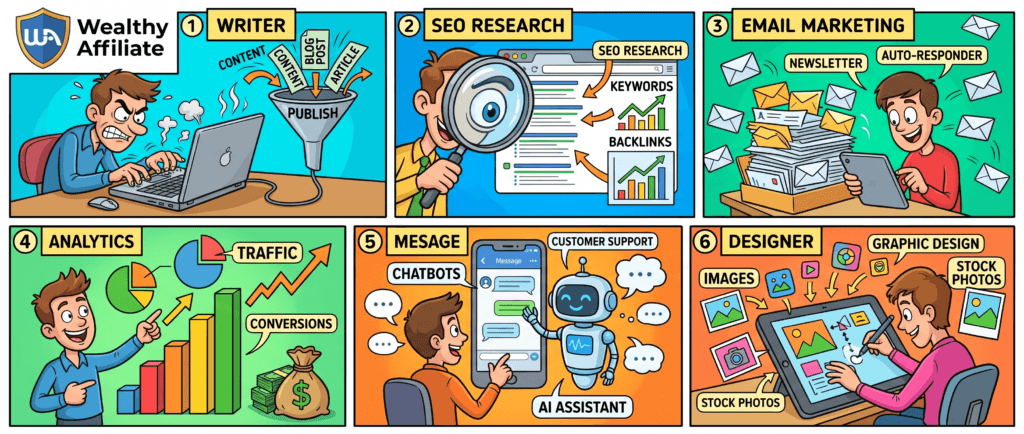
AI tools for affiliate marketing are applications that assist with tasks such as research, content planning, editing, SEO analysis, email marketing, performance analysis, images, and customer support. They can support parts of your workflow, but their output still requires human review for accuracy, originality, and usefulness.
A beginner might use AI to:
- Organize ideas into an outline
- Compare possible content topics
- Edit a draft for clarity
- Summarize performance data
- Suggest email subject-line variations
- Develop an initial image concept
- Identify repetitive administrative tasks
- Turn complicated information into a simpler explanation
AI should support your decisions—not make every decision for you.
What AI Can and Cannot Do
| AI can help you | AI cannot guarantee |
|---|---|
| Organize research and ideas | Accurate information |
| Create a first-draft outline | Google rankings |
| Suggest keywords to investigate | Search traffic |
| Analyze information you provide | Affiliate commissions |
| Generate copy variations | Reader trust |
| Automate selected tasks | A profitable business |
| Identify patterns in data | Correct strategic decisions |
The safest approach is to treat AI output as a starting point that requires human judgment.
How I Evaluate AI Tools for This Website
I do not judge an AI tool only by how quickly it produces an answer. I consider whether it helps me create something accurate, useful, understandable, and appropriate for beginners.
When evaluating an AI tool, I look at:
- Accuracy: Can its claims be verified using reliable sources?
- Usefulness: Does it solve a real problem or merely generate more content?
- Control: Can I revise, correct, and approve the output?
- Transparency: Are its features, limitations, and pricing explained clearly?
- Privacy: What happens to the information entered into the tool?
- Consistency: Can it follow the same editorial standards across multiple tasks?
- Value: Does it improve the workflow enough to justify its cost?
A tool does not earn my recommendation simply because it uses AI. It must be understandable for beginners and useful within a responsible affiliate-marketing workflow.
AI Tool Categories for Beginners
You do not need every AI tool available. Start with the category connected to your most time-consuming or confusing task.
AI Writing and Content-Planning Tools
AI writing tools can help brainstorm topics, develop outlines, reorganize paragraphs, and suggest alternative wording.
They should not be used to publish large quantities of unreviewed content. Add your own research, conclusions, examples, and experience before publishing anything.
Detailed guide:
AI Writing Tools for Affiliate Marketing Beginners
AI SEO and Research Tools
AI-assisted SEO tools may help identify related searches, organize keyword groups, evaluate page structure, or discover gaps in a topic.
Their suggestions are not instructions from Google. Verify keywords, study search intent, and decide whether a topic genuinely belongs on your website.
Detailed guide:
AI-Powered SEO for Affiliate Marketing Beginners
AI Email-Marketing Tools
Email platforms may use AI to suggest subject lines, organize audience segments, draft campaign ideas, or analyze engagement.
Review every message before sending it. Make sure claims are accurate, affiliate relationships are disclosed, and the final email sounds like you.
Detailed guide:
AI Email Marketing Tools for Affiliate Marketing Beginners
AI Analytics Tools
AI can help organize performance data and highlight patterns that deserve further investigation.
A summary is not the same as a conclusion. Check the original data before changing your content or marketing strategy.
Detailed guide:
Using AI to Analyze Affiliate Performance Data
AI Chatbots
AI chatbots can answer routine questions, direct visitors to useful resources, and provide basic support.
They require careful setup and monitoring. A chatbot should not invent product details, make unsupported claims, or hide the fact that visitors are interacting with automation.
Detailed guide:
AI Chatbots for Affiliate Marketing Beginners
AI Image Tools
AI image tools can help create original concepts, diagrams, and supporting article visuals.
One practical lesson came from creating visuals for this website. An AI-generated image could look polished while still containing a misspelled heading or incorrect label. I had to inspect every word, replace inaccurate visuals, and create separate alt text and captions.
That experience reinforced an important rule: a professional-looking AI output is not necessarily an accurate or publishable output.
Before publishing an AI-generated image, check:
- Spelling and labels
- Unwanted logos or watermarks
- Misleading representations
- Distorted objects or people
- Licensing and usage terms
- Image size and page speed
- Alt text and caption accuracy
A Beginner Workflow for Using AI Responsibly
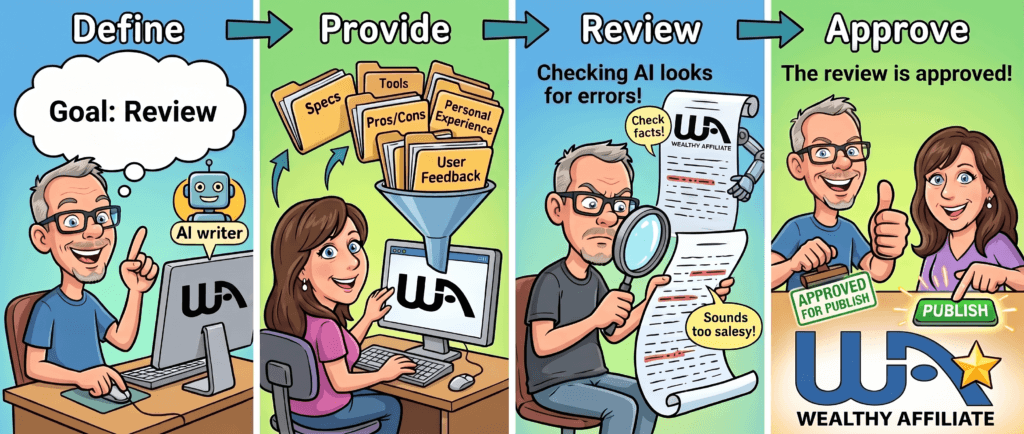
A controlled process helps prevent inaccurate, generic, or repetitive content.
Step 1: Define the Task
Decide what you need help with before opening a tool.
Examples include:
- Organizing an article outline
- Comparing possible keywords
- Editing an existing paragraph
- Summarizing your own analytics
- Creating subject-line alternatives
A clear task makes it easier to judge whether the output is useful.
Step 2: Provide Reliable Information
Give the tool specific instructions and trustworthy source material. Do not assume it automatically has accurate or current information.
Avoid entering confidential information, customer details, passwords, unpublished business data, or anything you do not have permission to share.
Step 3: Review and Improve the Output
Check:
- Facts and statistics
- Product features and prices
- Links and source attribution
- Affiliate and income claims
- Originality
- Tone and readability
- Whether the content answers the reader’s actual question
Step 4: Publish Only After Human Approval
You remain responsible for everything published under your name. Edit the output until it reflects your research, judgment, experience, and readers’ needs.
Only publish after checking the completed article, links, images, disclosures, and claims.
Affiliate disclosure: The Wealthy Affiliate link below is an affiliate link. If you later purchase a paid membership, I may earn a commission at no additional cost to you.
Want Help Building Your Affiliate Workflow?
Some beginners prefer guided training while learning how websites, content, keywords, and traffic strategies work together.
Wealthy Affiliate provides introductory affiliate-marketing training, website tools, and community access. It cannot guarantee rankings, traffic, commissions, or income.
Explore the Free Wealthy Affiliate Starter Membership
Can AI-Generated Content Rank in Google?
AI-assisted content is not automatically prohibited from Google Search. Google says that appropriate use of AI or automation is not against its guidelines, provided it is not used primarily to manipulate rankings.
What matters is whether the completed page is helpful, reliable, original, and created for people. Producing many low-value pages with automation may violate Google’s policies concerning scaled content abuse.
You can read Google’s explanation in its guidance for using generative AI content.
Before publishing AI-assisted content:
- Confirm every factual claim
- Add original analysis or experience
- Remove repetitive and generic wording
- Check that cited sources support the claims
- Make affiliate disclosures easy to notice
- Confirm that the page adds value beyond existing articles
- Make sure the title accurately represents the content
- Review the final page as a reader—not only as a publisher
Related guide:
Can AI Content Hurt Google Rankings?
AI Tools and AI Search Are Different Topics
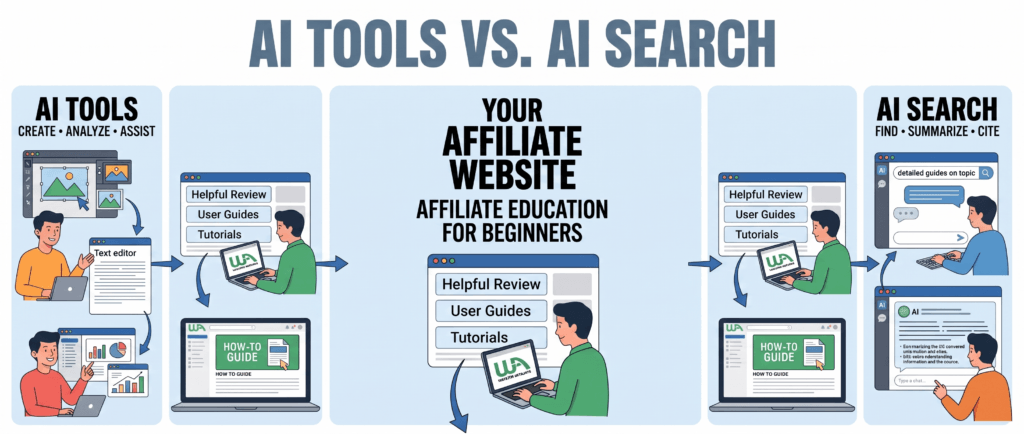
AI tools help you perform tasks. AI search systems use artificial intelligence to generate, summarize, or organize answers for searchers.
Learning to use an AI writing tool does not automatically make your website visible in ChatGPT, Google AI Overviews, Perplexity, or other AI-assisted search experiences.
If you want to understand AI search visibility, continue with:
- AI Search vs. Traditional Search
- How to Rank in AI Search for Beginners
- How to Get Your Website Cited by AI
- GEO vs. SEO for Beginners
Google’s current guidance says that established SEO practices continue to apply to its generative AI search features. It does not recommend special AI files, artificial mentions, or shortcuts marketed as AEO or GEO hacks.
Learn more from Google’s official AI optimization guidance.
Common AI Mistakes Beginners Should Avoid
Using Too Many Tools
Multiple subscriptions can create expense and confusion. Learn one tool before adding another.
Publishing the First Draft
AI output may contain incorrect facts, invented sources, repetitive language, or unsupported conclusions.
Removing Your Own Voice
Generic content does not explain why readers should trust your page instead of dozens of similar pages.
Trusting Every Keyword Suggestion
A suggested keyword may be irrelevant, overly competitive, outdated, or inconsistent with the purpose of your website.
Sharing Private Information
Do not paste passwords, customer information, unpublished business data, or confidential material into an AI tool without understanding its privacy terms.
Making Unsupported Claims
AI-generated product or income claims still belong to the publisher. The FTC requires advertising and endorsement claims to be truthful and supported. Material financial relationships should also be disclosed clearly.
Read the FTC’s endorsement guidance.
How to Choose Your First AI Tool
Ask these questions before joining or purchasing anything:
| Question | Why it matters |
|---|---|
| What specific task will this solve? | Prevents buying tools without a clear purpose |
| Can I test it before paying? | Helps you evaluate the workflow |
| Will I use it regularly? | Avoids unnecessary subscriptions |
| Can I review and edit the output? | Keeps human judgment in control |
| How does it handle my data? | Helps protect private information |
| Does it work with tools I already use? | Reduces workflow complexity |
| Can I cancel easily? | Limits long-term risk |
Start with one tool, use it for a defined task, and evaluate whether it genuinely improves your process.
Want a Structured Place to Start?
You can learn affiliate marketing independently, but some beginners prefer having training, website tools, and community support together.
Wealthy Affiliate’s free Starter membership provides introductory access so you can evaluate the platform before deciding whether a paid plan fits your needs. Features and access levels can change, so review the current terms before joining.
The platform cannot guarantee traffic, rankings, commissions, or income. Your results will depend on your decisions, topic, content, competition, and consistent effort.
Explore the Free Wealthy Affiliate Starter Membership
Affiliate link: I may earn a commission if you later purchase a paid membership, at no additional cost to you.
Final Thoughts
AI tools can make parts of affiliate marketing easier to organize, but they do not remove the need for research, judgment, honesty, or patience.
The best first step is not finding the tool with the longest feature list. It is identifying one task that is slowing you down and testing whether one tool can help you complete that task more effectively.
Keep your own voice, verify important information, and approve everything before it represents you or your website.
Key Takeaways
- AI tools can assist with content, research, email, analytics, images, and customer support.
- AI output must be checked for accuracy, originality, privacy, and usefulness.
- Google does not automatically reject appropriately used AI-assisted content.
- AI tools cannot guarantee rankings, traffic, commissions, or income.
- Beginners should learn one tool at a time and keep human judgment in control.
- AI tools and AI search visibility are related but separate subjects.
Continue Learning
- Main beginner hub: Affiliate Marketing Basics
- Next AI lesson: AI Writing Tools for Affiliate Marketing Beginners
- Supporting SEO hub: Affiliate SEO for Beginners
How This Guide Was Reviewed
This guide was reviewed for:
- Accurate descriptions of how beginners can use AI
- Unsupported ranking, traffic, and income claims
- Clear separation between AI tools and AI search
- Human-review and fact-checking requirements
- Affiliate-disclosure placement
- Relevant internal links
- Consistency with current Google and FTC guidance
The goal is not to present AI as a shortcut. It is to help beginners understand where AI may assist, where it may fail, and why the person publishing the work remains responsible for the result.
Frequently Asked Questions
What is the best AI tool for affiliate-marketing beginners?
There is no single best tool for everyone. Choose a tool that addresses one specific need, such as planning content, editing, keyword research, email, analytics, or images.
Can AI write an entire affiliate article?
AI can create a draft, but publishing it without human research and review is risky. Check facts, sources, originality, claims, links, and whether the page provides genuine value.
Does Google penalize AI-generated content?
Google does not prohibit content simply because AI helped create it. Content produced mainly to manipulate rankings or published at scale without added value may violate Google’s spam policies.
Can AI tools guarantee more traffic or sales?
No. AI tools cannot guarantee rankings, traffic, conversions, commissions, or income.
How many AI tools does a beginner need?
Start with one tool that solves a defined problem. Add another only when you understand why it is needed and how it will improve your workflow.
Should I disclose that I used AI?
Disclosure depends on the context, platform, and nature of the content. Regardless of disclosure, you remain responsible for accuracy, originality, endorsements, and affiliate claims.
About the Author
Written by Donna
Affiliate marketing researcher and founder of AffiliateEducationForBeginners.com.
Donna creates beginner-friendly guides about affiliate marketing, SEO, AI tools, AI search, content strategy, and avoiding misleading online-income claims.
While building and managing Affiliate Education for Beginners, she works directly with WordPress, Google Search Console, Google Analytics, AI-assisted content workflows, internal linking, structured data, and hub-and-cluster organization.
Her goal is to explain complicated topics honestly so beginners can understand what a tool can do, what it cannot do, and what they should verify before acting.
Affiliate Disclaimer
This page contains affiliate links. If you join Wealthy Affiliate through one of my links and later purchase a paid membership, I may earn a commission at no additional cost to you.
Recommendations are based on research and the features available when this guide was reviewed. AI tools, platform features, access levels, and prices can change, so verify current details directly with each provider.
AI tools and training cannot guarantee rankings, traffic, commissions, or income. Results depend on individual decisions, effort, content quality, competition, and other factors.