How to Rank in AI Search: A Beginner’s Step-by-Step Guide
Written by Donna
Affiliate marketing researcher and founder of AffiliateEducationForBeginners.com
↑ Top
If you’ve been following my AI for Affiliate Marketing Beginners series, you’ve probably noticed that artificial intelligence is changing almost every part of building an online business. From brainstorming ideas to writing content and finding keywords, AI tools are becoming part of the everyday workflow for many affiliate marketers.
But there’s one question I keep hearing more than any other:
“How do I get my website to show up in AI search?”
It’s a great question because the way people search for information is changing.
Not long ago, most people opened Google, typed a question, and clicked through a few websites until they found the answer they needed.
Today, many people ask ChatGPT (OpenAI), Google AI Overviews, Microsoft Copilot, Claude (Anthropic), or Perplexity first. Instead of searching through ten blue links, they’re expecting one clear, helpful answer.
If you’re building an affiliate marketing website, it’s easy to wonder whether everything you’ve learned about SEO still matters.
The good news is that it does.
In fact, the websites that are most likely to succeed in AI search are often the ones already following good SEO practices. AI hasn’t replaced helpful content. It’s making helpful content even more important.
So if you’ve been worrying that you need to learn a completely new strategy, you can relax.
You don’t need secret prompts.
You don’t need hidden AI tricks.
And you definitely don’t need to rewrite your entire website.
What you do need is a better understanding of how AI finds information and why some websites become trusted sources while others are ignored.
That’s exactly what we’ll cover in this guide.
By the time you finish reading, you’ll understand how AI search works, what makes content more likely to be referenced, and the practical steps you can start using today to improve your visibility.
Quick Answer: How Do You Rank in AI Search?
No one—not Google, OpenAI, Anthropic, or anyone else—can guarantee that your website will appear in AI-generated answers.
What you can do is create content that clearly answers a reader’s question, demonstrates experience and expertise, and is easy for both people and search engines to understand.
Think of AI as another reader.
If your article is confusing, jumps between topics, or never fully answers the question, AI has the same problem your visitors do.
But when your content is well organized, trustworthy, and genuinely helpful, you’re giving both readers and AI a much better experience.
That’s why so many of the strategies that improve traditional SEO also improve your chances of being discovered through AI search.
AI Insight
AI isn’t trying to find the page with the most keywords.
It’s trying to find the page that gives the clearest, most trustworthy answer.
Why AI Search Isn’t Replacing SEO
One of the biggest misconceptions I’ve seen recently is that SEO is dead.
Personally, I don’t believe that’s true.
I think SEO is changing—but the fundamentals are still incredibly important.
Imagine someone asks ChatGPT:
“How do I start affiliate marketing?”
Where do you think that information comes from?
It doesn’t magically appear out of thin air.
AI learns from enormous amounts of information and favors reliable, well-structured content that explains topics clearly.
Without quality websites, there would be very little trustworthy information for AI to learn from or reference.
That’s why your website still matters.
Actually, I’d argue it matters more than it did a few years ago.
The goal isn’t just to help Google understand your content anymore.
It’s also to make it easy for AI systems to understand what your article teaches and why readers should trust it.
The encouraging part is that this doesn’t require a completely different approach.
If you’ve already been focusing on creating helpful content, organizing your website logically, and answering readers’ questions honestly, you’re already heading in the right direction.
If you’re still building your SEO foundation, don’t worry if AI search feels overwhelming right now. Understanding how search engines discover, organize, and evaluate content first will make everything else much easier to understand.
👉 SEO for Affiliate Marketing for Beginners
Google has spent years encouraging website owners to create helpful, people-first content, and those same principles continue to apply as AI search evolves.
👉 Google Search Central – Creating Helpful, Reliable, People-First Content
So, What Does AI Actually Look For?
This is where many beginners overcomplicate things.
When people hear the phrase AI search, they often assume there’s a secret formula or a special optimization technique that only experienced marketers know.
The reality is much simpler.
Every time someone asks an AI assistant a question, it’s trying to answer one thing exceptionally well:
“What’s the best information I can give this person?”
Think about your own experience using ChatGPT.
When you ask a question, you’re not hoping for the article with the highest keyword density.
You’re looking for an answer that’s accurate, easy to understand, and actually solves your problem.
AI is trying to deliver exactly that.
That’s one of the reasons I built Affiliate Education for Beginners the way I have.
Instead of trying to explain everything about affiliate marketing in one enormous article, each guide focuses on answering one beginner question as thoroughly as possible.
Then, when you’re ready, you move on to the next lesson.
That approach helps readers learn without feeling overwhelmed.
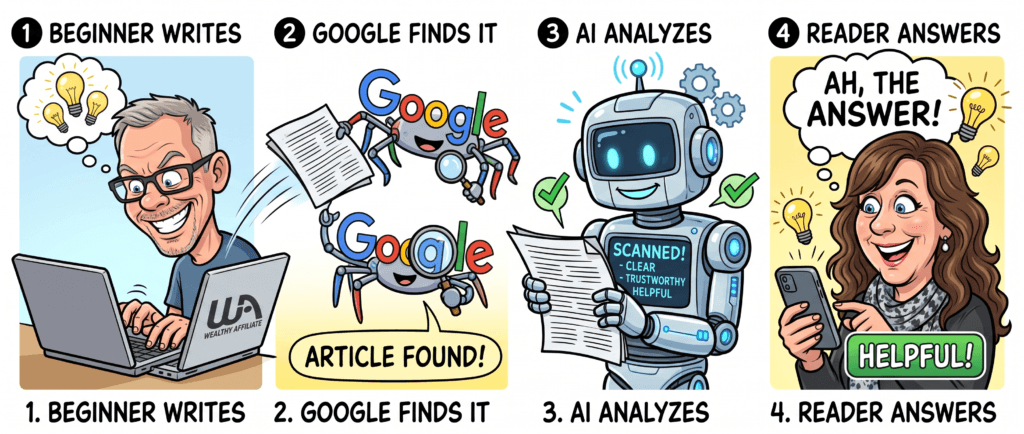
It also makes it much easier for search engines and AI systems to understand what each page is about.
The simpler you make it for your readers, the simpler you make it for AI.
What Makes AI Trust One Website Over Another?
If AI is trying to give people the best possible answer, the next question naturally becomes:
“How does it decide which websites to trust?”
The answer isn’t based on one ranking factor or one magic setting.
Instead, AI looks at a combination of signals that help determine whether your content is accurate, helpful, and worth recommending.
Think about it this way.
If someone asked you where to learn affiliate marketing, you probably wouldn’t recommend the first website you found.
You’d recommend one that explains things clearly, answers questions honestly, and has consistently helped people over time.
AI works in much the same way.
It’s looking for websites that demonstrate experience, stay focused on a topic, and consistently publish content that helps readers.
That’s why I believe beginners should stop worrying about “AI optimization” and start thinking about becoming the most helpful resource they can be.
Five Things AI Looks For
While no company publishes an exact formula, there are several characteristics that consistently appear in high-quality content.
1. Clear Answers
One of the biggest mistakes beginners make is trying to answer ten questions in one article.
Imagine searching for:
“How do I rank in AI search?”
Instead of getting a clear answer, you land on an article that suddenly starts talking about email marketing, Pinterest, YouTube, Facebook ads, and affiliate programs.
That’s frustrating.
AI recognizes that too.
The more focused your article is on answering one question, the easier it is for readers—and AI—to understand exactly what it’s about.
2. Real Experience
One thing I appreciate about Google’s focus on Experience, Expertise, Authoritativeness, and Trustworthiness (E-E-A-T) is that it encourages website owners to share what they’ve actually learned instead of simply repeating what everyone else says.
I try to do that throughout Affiliate Education for Beginners.
I’ve made expensive mistakes.
I’ve purchased courses that promised the world but delivered very little practical education.
Those experiences shaped how I evaluate affiliate marketing platforms today and why I’m careful about recommending products to beginners.
Anyone can summarize information they found online.
Sharing what you’ve genuinely learned creates content that’s much harder to duplicate.
👉 Mistakes To Avoid When Starting Affiliate Marketing (2026)
Learn from the common mistakes that slow beginners down and discover practical ways to build your affiliate business with confidence.
3. Organized Content
Imagine walking into a library where every book has been placed on a random shelf.
Even if the books are excellent, finding what you need becomes frustrating.
Websites work the same way.
When your articles are organized logically and naturally connect to related topics, readers stay engaged because they always know where to go next.
Search engines and AI benefit from that organization too because it helps them understand how your content fits together.
A well-organized website also encourages readers to keep learning. Instead of leaving after one article, they can naturally move to the next topic, building their knowledge one step at a time while helping search engines and AI understand the depth of your content.
4. Helpful Writing
Some articles sound like they’re written to impress search engines.
Others sound like they’re written to help people.
Readers notice the difference almost immediately.
So does AI.
When I’m writing an article, I try to imagine explaining the topic to someone sitting across the table from me.
Would I use complicated jargon?
Probably not.
Would I explain the topic step by step?
Absolutely.
That’s the approach I recommend to every beginner.
If your readers understand what you’re saying, you’re already creating the kind of content AI prefers.
👉 How to Write Affiliate Comparison Content That Converts (2026 Guide)
See how clear, honest writing helps readers make informed decisions while building trust with both Google and AI.
5. Consistency
One great article doesn’t make a trusted website. Consistently publishing helpful content does.
Think about your favorite teacher.
You probably trust them because they’ve helped you understand dozens of topics—not just one.
The same idea applies to your website.
Every article you publish should strengthen the overall picture you’re building.
That’s one of the reasons I organize Affiliate Education for Beginners around beginner questions instead of chasing random trending keywords.
Over time, each article supports the next, helping both readers and search engines recognize that the site covers affiliate marketing in depth.
👉 Affiliate Marketing Basics for Beginners
Build a strong foundation by learning the essential concepts every new affiliate marketer should understand.
Comparison Table: Traditional SEO vs. AI Search
| Traditional SEO | AI Search |
|---|---|
| Focuses on ranking webpages | Focuses on answering questions |
| Keywords help define a topic | Context helps explain a topic |
| Measures page relevance | Measures usefulness and trust |
| Encourages good website structure | Rewards clear, well-organized information |
| Values authority over time | Also values authority over time |
The interesting thing about this comparison is that the two approaches aren’t competing with each other.
They’re becoming more closely connected.
The websites that have always focused on helping people are often the same websites that AI can understand most easily.
Build a Website—Not Just Individual Articles
When I first started learning affiliate marketing, I thought every article had to succeed on its own.
If one article didn’t rank, I felt like I’d failed.
Over time, I realized I was looking at my website the wrong way.
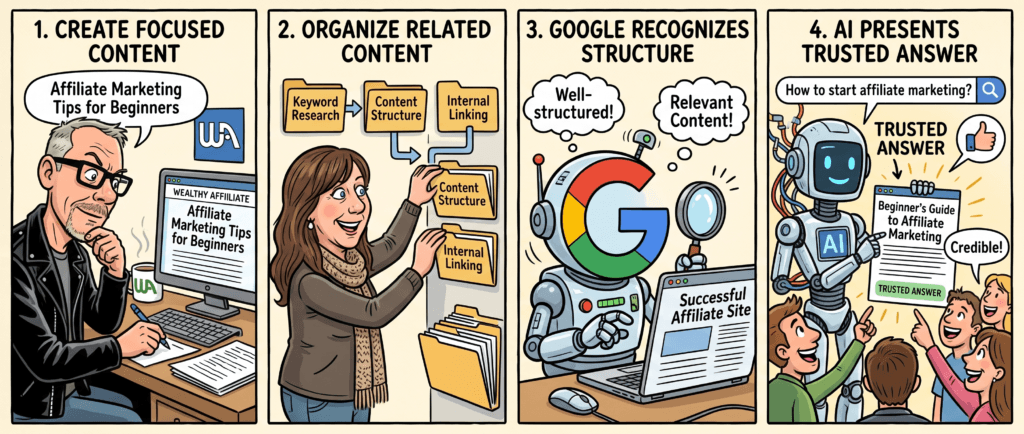
A successful affiliate website isn’t just a collection of blog posts. It’s a collection of related articles that work together to help readers solve one problem after another.
That’s exactly how I’ve built Affiliate Education for Beginners.
Rather than writing one enormous guide that tries to cover every aspect of affiliate marketing, I focus on answering one beginner question at a time. Each article stands on its own, but it also builds on what you’ve already learned and prepares you for the next step in your journey.
That approach makes learning less overwhelming for beginners, and it also helps search engines and AI understand that your website covers a topic in depth instead of only scratching the surface.
For example, this article explains how AI search works and what you can do to improve your visibility. Once you understand those principles, the next step is learning how to apply them when creating the kind of content that both readers and AI find valuable. Honest, helpful comparison articles are one of the best ways to build trust while helping visitors make informed decisions.
The goal isn’t to create one article that answers every question. It’s to build a website where each article makes the next one more valuable—for your readers, for search engines, and for the future of AI search.
How a Beginner-Friendly Website Grows
Building a successful affiliate website doesn’t happen all at once. It happens one article, one improvement, and one lesson at a time. Here’s what that journey typically looks like for beginners.
| Step | Goal |
|---|---|
| Learn the basics | Build a strong foundation. |
| Create focused articles | Answer one question thoroughly. |
| Connect related content | Help readers continue learning. |
| Update and improve | Build trust and topical authority. |
| Grow traffic | Attract more readers over time. |
Every successful affiliate website starts with these same building blocks. You don’t need to master them all at once—just focus on taking the next step, then keep building from there.
6 Practical Ways to Improve Your AI Search Visibility
By now, you’ve probably noticed something.
There isn’t one setting you can turn on that suddenly makes your website “AI friendly.”
There isn’t a secret prompt.
There isn’t a hidden ranking trick.
Instead, AI rewards many of the same habits that have always helped people create successful websites.
Here are the strategies I’d focus on if I were building a new affiliate website today.
1. Answer One Question at a Time
One of the biggest mistakes I see beginners make is trying to answer every affiliate marketing question in a single article.
The result usually looks something like this:
- What is affiliate marketing?
- How do I build a website?
- Which affiliate programs pay the most?
- How does SEO work?
- How do I make money with AI?
None of those topics gets the attention it deserves.
Instead, choose one question and answer it thoroughly.
That’s exactly what I’m doing here.
This article is about ranking in AI search.
If I tried to explain keyword research, backlinks, affiliate programs, and content marketing too, you’d probably leave with more questions than answers.
Focused articles help readers.
They also help search engines and AI understand exactly what your page is about.
2. Make Your Content Easy to Read
Have you ever landed on a website and immediately felt overwhelmed?
Huge paragraphs.
Technical jargon.
No headings.
No clear direction.
Most people leave within seconds.
Good content isn’t just about having the right information.
It’s about making that information easy to understand.
That’s why I use short paragraphs, descriptive headings, comparison tables, and visuals throughout Affiliate Education for Beginners.
The easier your content is to follow, the more likely readers are to stay—and the easier it becomes for AI to understand the main ideas you’re trying to teach.
3. Build Trust Before You Try to Sell
This is one lesson I learned the hard way.
When I first started learning affiliate marketing, I saw countless websites pushing products before they had earned the reader’s trust.
Everything felt like a sales pitch.
I didn’t want Affiliate Education for Beginners to become that kind of website.
My goal has always been to educate first.
If I recommend a product—like Wealthy Affiliate—it’s because I believe it genuinely helps beginners build the skills they’re trying to learn.
That philosophy doesn’t just build trust with readers.
It also creates the kind of content AI is more likely to recognize as useful and informative rather than purely promotional.
One of the best ways to build trust is by recommending products honestly instead of simply trying to make a sale.
👉 Best Affiliate Programs for Beginners (2026)
4. Keep Your Content Current
AI, SEO, and affiliate marketing are constantly changing.
An article that was accurate a year ago may already need updates.
That’s one reason I regularly review my content.
Sometimes the changes are small.
Other times they involve adding new sections, improving examples, or updating recommendations to reflect what’s happening today.
Keeping your content fresh helps readers.
It also shows search engines that your website is actively maintained.
Creating helpful content is only part of the process. Once your articles are published, the next challenge is helping people discover them.
👉 How to Drive Traffic to a New Affiliate Website (2026)
Once you’ve created helpful content, the next step is getting people to find it using beginner-friendly traffic strategies.
5. Share Your Own Experience
Anyone can summarize information they found online.
What readers really remember are the lessons you’ve learned yourself.
Throughout this website, I’ve shared my experiences—the good and the bad.
I’ve talked about spending thousands of dollars on programs that overpromised and underdelivered.
I’ve shared the mistakes I made when I first started learning affiliate marketing.
Those experiences shape how I teach today.
They’re also something AI can’t simply copy from hundreds of identical articles.
Experience is becoming one of the things that separates genuinely helpful content from content that’s been rewritten dozens of times.
6. Never Stop Helping People
If you remember only one thing from this article, let it be this:
Don’t write for AI.
Don’t write for Google.
Write for the person sitting on the other side of the screen.
Every time I start a new article, I ask myself one simple question:
“Will this genuinely help someone who’s just getting started?”
If the answer is yes, I’m on the right track.
If the answer is no, I keep working until it is.
Search engines will continue to evolve.
AI will become smarter.
New technologies will come and go.
Helping people never goes out of style.
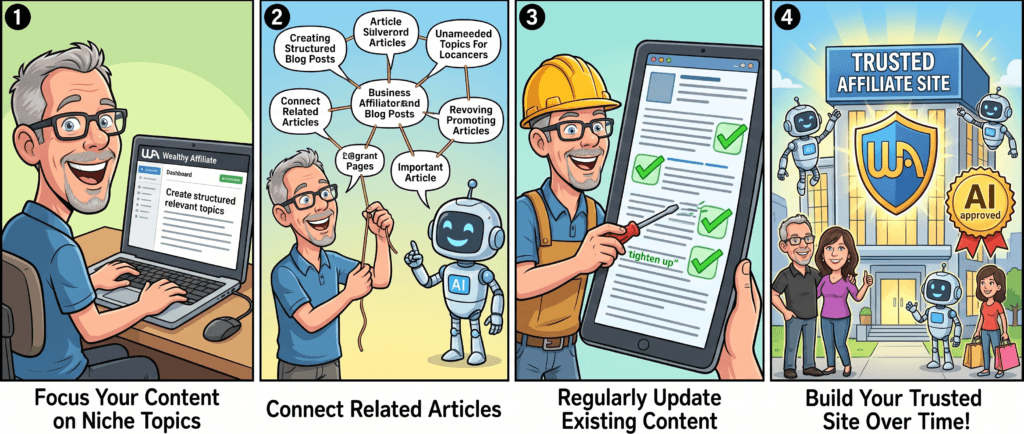
Every article you publish is another opportunity to answer a question, build trust, and move someone one step closer to achieving their goals. If you keep that focus, you’ll be building a website that’s valuable to your readers today and well-positioned for the future of AI search.
Everything you’ve learned in this guide builds on the fundamentals of affiliate marketing. If you’re ready to continue learning, these beginner-friendly guides are the perfect next step.
Ready to Start Building an AI-Friendly Website?
Understanding AI search is one thing.
Putting these strategies into practice is where you’ll really learn.
When I first started building affiliate websites, I quickly realized there was much more to learn than just writing articles. I needed a place to build my website, learn SEO, organize my content, and keep improving over time.
That’s one of the reasons I recommend Wealthy Affiliate.
It combines beginner-friendly training, website hosting, AI tools, keyword research, and a supportive community in one place, making it easier to put everything you’ve learned in this guide into practice.
AI Search Success Checklist
The good news is that you don’t have to guess what works.
If you compare the habits of websites that consistently perform well with the shortcuts that usually fail, a clear pattern starts to emerge. The table below summarizes the biggest differences and where I’d recommend focusing your time as a beginner.
| ✔ Focus On | ✘ Avoid |
|---|---|
| Answer one question thoroughly | Trying to answer everything in one article |
| Write naturally for beginners | Writing for algorithms instead of people |
| Share your own experiences | Repeating what everyone else says |
| Keep articles connected | Publishing unrelated topics |
| Update older content | Letting information become outdated |
| Build trust before promoting products | Making every article a sales pitch |
Common AI Search Mistakes Beginners Make
As AI search becomes more popular, it’s easy to get caught up in the latest trends and advice. Unfortunately, not everything you read online will help your website. Here are some of the most common mistakes I see beginners make—and how you can avoid them.
1. Chasing AI Tricks Instead of Helping Readers
There will always be someone claiming they’ve discovered the latest AI hack or secret ranking method. In reality, the websites that perform well are usually the ones that consistently publish clear, helpful, and trustworthy content. Focus on solving your readers’ problems, not chasing shortcuts.
2. Trying to Answer Everything in One Article
A common mistake is trying to cover an entire topic in a single post. Instead, answer one question thoroughly and then guide readers to the next step. That’s easier for beginners to follow, and it also helps search engines and AI understand exactly what each article is about.
3. Ignoring SEO Fundamentals
Some people believe AI has made SEO obsolete, but that’s simply not true. Good site structure, clear headings, internal links, descriptive titles, and helpful content still matter. AI search builds on many of the same principles that have always helped websites succeed.
4. Publishing Content and Never Updating It
Affiliate marketing, SEO, and AI are constantly evolving. Articles that were accurate a year ago may need new information today. Reviewing and updating your content regularly keeps it useful for readers and shows search engines that your website is actively maintained.
5. Expecting Overnight Results
Whether you’re trying to rank in Google or appear in AI-powered search, success takes time. Building trust, publishing quality content, and establishing authority doesn’t happen after one article. Stay consistent, keep learning, and focus on helping people. The long-term results are worth the effort.
The encouraging part is that you don’t have to master AI overnight. If you stay focused on helping your readers, continue improving your content, and keep learning as the technology evolves, you’ll be building the kind of website that earns trust over time—from both people and AI.
Before you publish your next article, it’s worth taking a minute to check whether you’re focusing on the habits that build long-term success instead of chasing quick wins.
| Do This | Avoid This |
|---|---|
| Answer one question thoroughly | Trying to answer everything in one article |
| Write for people first | Writing only for search engines |
| Share your own experience | Rewriting what everyone else says |
| Update existing articles | Publishing and forgetting about them |
| Build trust over time | Looking for overnight success |
Final Thoughts
When AI search first started making headlines, a lot of people assumed everything they knew about SEO had suddenly become obsolete.
The more I researched it, the more I realized that wasn’t the case.
AI is changing how people find information, but it hasn’t changed what makes great content.
Websites that answer real questions, share genuine experience, stay organized, and put readers first are still the ones most likely to earn trust. Those same qualities have always been the foundation of good SEO, and now they’re becoming even more important as AI-powered search continues to evolve.
If you’re just getting started, don’t worry about chasing every new AI trend or trying to outsmart the latest algorithm. Focus on creating content that genuinely helps people, keep improving your website one article at a time, and continue learning as technology changes.
That’s a strategy that will serve you well—whether someone finds your website through Google today or asks an AI assistant for answers tomorrow.
Key Takeaways
Before you move on, here are the most important points to remember:
- AI search builds on many of the same principles as traditional SEO.
- Focus each article on answering one question thoroughly instead of covering too many topics at once.
- Helpful, well-organized content is easier for both readers and AI to understand.
- Sharing your own experience builds trust and makes your content more valuable.
- Consistently improving your website over time is far more effective than chasing shortcuts or AI “hacks.”
Frequently Asked Questions
What is AI search?
AI search uses artificial intelligence to answer questions by understanding context and summarizing information from reliable sources instead of simply listing webpages. Examples include ChatGPT, Google AI Overviews, Claude, Microsoft Copilot, and Perplexity.
Can I rank in AI search?
No one can guarantee that a website will appear in AI-generated answers. However, creating helpful, trustworthy, and well-organized content improves the chances that AI systems will understand and reference your website.
Is AI search replacing SEO?
No. AI search builds on many of the same principles as traditional SEO. Helpful content, clear website organization, strong internal linking, and demonstrating experience and expertise remain essential for long-term success.
How do I optimize my website for AI search?
Focus on answering one question thoroughly, creating content that’s easy to read, sharing your own experience, keeping your articles updated, and building topical authority through related content. These practices benefit both traditional search engines and AI-powered search.
Does AI search use keywords?
Yes, keywords still help search engines and AI understand what your content is about. The difference is that AI also looks at context, clarity, and how well your content answers a user’s question rather than relying on keywords alone.
How long does it take to appear in AI search?
There isn’t a set timeline. Building trust and authority takes time, just as it does with traditional SEO. Consistently publishing helpful, high-quality content gives your website the best opportunity to be recognized by both search engines and AI systems.
Continue Learning
👉 AI Writing Tools for Affiliate Marketing Beginners (2026)
👉 Affiliate Marketing Scams and Warning Signs
👉 How Beginners Actually Make Their First Dollar Online
Ready to Start Building an AI-Friendly Affiliate Website?
Reading about AI search is one thing. Putting these strategies into practice is where the real learning begins.
That’s one of the reasons I recommend Wealthy Affiliate to beginners. It gives you everything you need to build an affiliate website, learn SEO, create helpful content, and grow your online business—all in one place.
Whether you’re publishing your very first article or improving an existing website, it’s a practical way to apply what you’ve learned in this guide.
Affiliate Disclosure
Affiliate Education for Beginners participates in affiliate marketing programs, including Wealthy Affiliate. This means I may earn a commission if you purchase through certain links on this website, at no additional cost to you. I only recommend products and services I believe provide genuine value to beginners based on my own research and experience.