How to Get Your Website Cited by AI: A Beginner’s Guide
Written by Donna
Affiliate marketing researcher and founder of AffiliateEducationForBeginners.com
If you’ve been working your way through my How Beginners Can Get Found in AI Search, you’ve already learned that showing up in AI search isn’t about finding loopholes or chasing the latest trend. It’s about creating helpful, trustworthy content that answers real questions.
If you’re still new to using AI in your business, I also recommend reading AI for Affiliate Marketing Beginners. It explains how AI can help with content creation, research, SEO, and building an affiliate website. This guide builds on those concepts by focusing specifically on how AI decides which websites to cite.
That naturally leads to another question:
How does AI decide which websites to reference in its answers?
Have you ever asked ChatGPT a question and noticed it referenced another website?
Or maybe you’ve seen Google AI Overviews summarize information from several websites before showing the traditional search results.
If you’re building a website, it’s only natural to wonder:
“How do those websites get chosen, and could mine be one of them someday?”
The answer is yes—but probably not for the reasons you think.
There isn’t a secret AI setting you can turn on, a plugin you can install, or a shortcut that guarantees your website will be cited. Just like traditional SEO, earning recognition from AI comes from consistently creating content that people find helpful and trustworthy.
The encouraging news is that you don’t need to be a huge company or have thousands of pages to get started. Many of the same things that build trust with your readers also help AI understand that your content is worth referencing.
In this guide, I’ll explain how AI chooses websites to cite, what you can do to improve your chances over time, and the practical habits that will help you build authority as your website grows.
Quick Answer
The best way to increase your chances of getting your website cited by AI is to consistently publish helpful, accurate, well-organized content that demonstrates experience, expertise, and topical authority.
AI systems are designed to find information they believe is useful and trustworthy. They look for websites that clearly answer questions, cover topics in depth, and build credibility over time. While there’s no way to guarantee an AI citation, following proven SEO and content best practices can significantly improve your chances of becoming a trusted source.
Why Do AI Search Engines Cite Some Websites but Not Others?
One of the biggest misconceptions about AI search is that it simply pulls information at random from the internet.
It doesn’t.
Whether someone is using ChatGPT, Google AI Overviews, Microsoft Copilot, Claude, or Perplexity, the goal is essentially the same: provide the most helpful and reliable answer possible.
To do that, AI systems evaluate many different signals before deciding which information to include in a response. While each platform has its own technology, they generally favor content that is:
- Helpful and focused on answering a specific question.
- Accurate and consistent with other trustworthy sources.
- Well organized with clear headings and logical structure.
- Published by websites that demonstrate experience, expertise, and topical authority.
- Regularly updated so the information remains useful.
Notice what’s not on that list.
There’s no secret AI plugin.
No hidden ranking switch.
No “AI optimization” button.
Instead, earning citations comes from building a website that people—and ultimately AI—can trust.
What Makes a Website Worth Citing?
Think about how you decide whether to trust advice online.
If you’re looking for information about affiliate marketing, are you more likely to trust a website that promises you’ll make thousands of dollars overnight, or one that honestly explains what affiliate marketing is, how it works, and what challenges you can expect along the way?
Most of us would choose the second one.
AI systems are designed with a similar goal. They aren’t looking for the loudest claims—they’re looking for information that appears reliable, helpful, and supported by other trustworthy sources.
While no one outside the companies that build these AI systems knows every ranking signal they use, there are several characteristics that consistently appear across Google’s guidance and SEO best practices.
They Answer Questions Clearly
Articles that directly answer a reader’s question are much easier for both people and AI systems to understand.
This is the same strategy I recommend throughout my Affiliate SEO for Beginners guide. Instead of trying to rank one giant article for dozens of keywords, focus on answering one question thoroughly and then connect related articles together through internal links. That’s much easier for readers to follow and helps search engines understand your website over time.
Instead of trying to cover everything about affiliate marketing in one article, focus on answering one question thoroughly.
For example, this article answers:
How do I get my website cited by AI?
It doesn’t try to explain every aspect of AI search. That’s covered in other articles throughout this series.
Keeping each article focused helps readers find the information they’re looking for and helps search engines understand the purpose of the page.
Search engines have been moving toward rewarding content that genuinely helps people rather than content written only to rank. AI search builds on that same idea by looking for clear, useful answers that satisfy the reader’s question.
They Demonstrate Experience and Expertise
One of the best ways to build trust is to write from genuine experience.
If you’ve read my article How Beginners Actually Make Their First Dollar Online, you’ve probably noticed I focus on realistic expectations instead of promises of overnight success. That’s one reason I often encourage beginners to understand what realistic progress looks like before chasing quick results.
? How Beginners Actually Make Their First Affiliate Commission Online
That same honesty helps build trust with both readers and AI.
That doesn’t mean you need to be a world-famous expert.
It means being honest about what you’ve learned, what has worked for you, and where beginners should set realistic expectations.
Throughout this website, I try to explain affiliate marketing the way I wish someone had explained it to me when I was starting out. That perspective helps create content that’s practical, relatable, and useful instead of simply repeating information that’s already available elsewhere.
You don’t have to be a recognized industry expert to create valuable content. If you’re learning affiliate marketing yourself, you can document what you’re learning, explain concepts in beginner-friendly language, and share honest insights along the way. Authentic experience often resonates more with new readers than overly technical explanations.
They Build Topical Authority
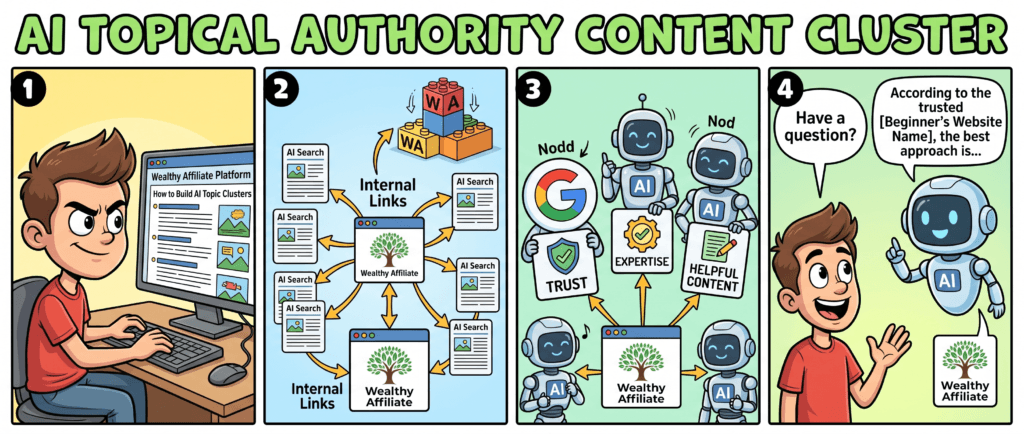
Another factor that can improve your chances of being cited is something called topical authority.
Instead of publishing one article about AI search and hoping it ranks, build a collection of related content that explores the topic from different angles.
For example, this article is part of a larger AI search series that also covers topics such as:
- How to Rank in AI Search
- AI Search vs. Traditional Search
- GEO vs. SEO
- How AI Chooses Which Websites to Cite
- AI Content Best Practices
This isn’t just how I’m building my AI Search series. It’s the same approach I use throughout Affiliate Education for Beginners. Every major topic—SEO, content marketing, affiliate programs, traffic generation, and AI—is organized into related guides that build on one another instead of standing alone.
? Content Marketing Strategies for Affiliate Success
When your articles work together, they help readers explore a subject more deeply while also showing search engines—and AI systems—that your website covers the topic comprehensively.
Building authority doesn’t happen because of one article. It comes from consistently creating useful content around a topic so readers—and search engines—begin to recognize your website as a reliable source.
How to Make Your Website Easier for AI to Understand
Creating helpful content is the most important step, but it’s only part of the picture. Your content also needs to be organized in a way that’s easy for both readers and AI systems to understand.
Think of it this way.
If you walked into a library where every book was thrown into one giant pile, finding the information you needed would be almost impossible. Search engines and AI systems have to organize and understand an enormous amount of information every day. The easier your content is to follow, the easier it becomes for them to understand what your page is about.
The easier you make your content to read and understand, the easier it is for AI to recognize what your page is about and determine whether it answers a user’s question.
Here are a few best practices I follow on every article I publish.
Use Clear Headings
Headings aren’t just there to make an article look organized—they tell readers and search engines what each section is about.
Instead of using vague headings like:
- More Information
- Things to Know
- Final Notes
Use descriptive headings that answer real questions, such as:
- What Makes a Website Worth Citing?
- How to Build Topical Authority
- Common Mistakes That Reduce AI Visibility
Descriptive headings improve readability and help AI quickly identify the purpose of each section.
Clear headings help readers scan your content more easily while giving search engines a better understanding of what each section covers.
Clear organization doesn’t just help your readers—it also makes it easier for search engines to understand your content. Well-structured pages with descriptive headings help establish the context of each section and improve the overall user experience.
Answer One Question Thoroughly
One of the biggest mistakes beginners make is trying to answer every possible question in a single article.
I’ve found it’s much more effective to choose one primary question and answer it as completely as possible.
For example, this article focuses on one question:
How do I get my website cited by AI?
It doesn’t try to explain every aspect of AI search. Those topics are covered in other articles throughout this series.
That approach creates better content for readers while also helping establish topical authority across your website.
Make Your Articles Easy to Scan
Most people don’t read every word on a webpage. They scan first.
AI systems process information differently than people, but clear organization still makes it easier for them to understand your content.
Simple formatting goes a long way:
- Short paragraphs
- Descriptive headings
- Bullet lists where appropriate
- Numbered steps for processes
- Tables to compare information
- Relevant images that support the topic
When readers can quickly find the answer they’re looking for, everyone benefits.
Build Topical Authority Instead of Chasing Viral Articles
When I first started learning SEO, I thought every article had to be a home run.
I assumed that if I could just write one incredible post, Google—and eventually AI—would find it.
That’s not how it usually works.
Search engines and AI systems are looking for patterns, not isolated successes.
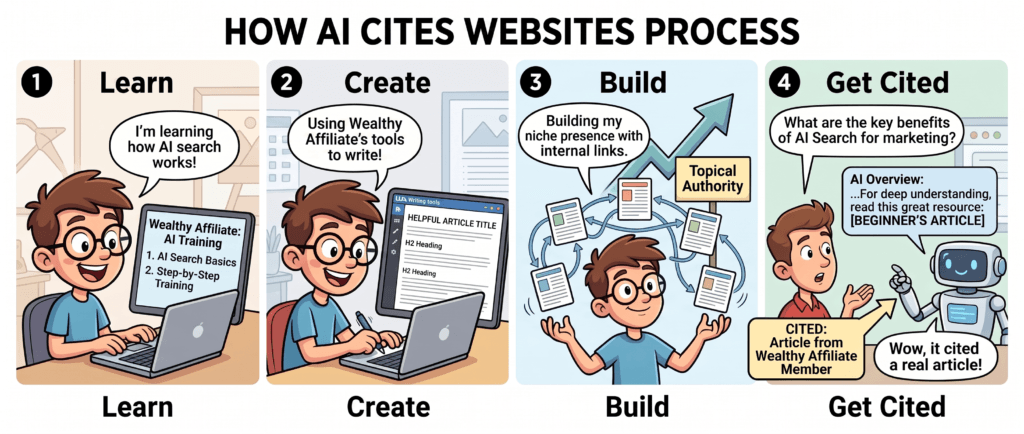
If your website consistently publishes helpful content around one subject, it gradually becomes known as a reliable resource for that topic.
That’s what topical authority is all about.
Instead of writing one article about AI search, build an entire collection of related articles that answer the questions beginners naturally ask.
For example, my AI Search series includes articles like:
- How to Rank in AI Search
- How to Get Your Website Cited by AI (this article)
- AI Search vs. Traditional Search
- GEO vs. SEO
- How AI Chooses Which Websites to Cite
- AI Content Best Practices
Each article answers a different question, but together they create a comprehensive resource for beginners.
Over time, that sends a much stronger signal than publishing one article and hoping it goes viral.
It also creates a better experience for your readers because every article naturally leads to the next step in their learning journey.
Topical Authority vs. Random Publishing: Which Strategy Does AI Prefer?
When I first started building websites, I thought success depended on writing one incredible article that would somehow rank everywhere.
Over time, I learned that lasting success comes from building a collection of connected articles that answer related questions. That’s exactly what topical authority is, and it’s one of the strongest signals you can send to both readers and AI search.
The comparison below shows the difference.
| Instead of… | Focus on… |
|---|---|
| Writing one “perfect” article | Building a library of connected articles |
| Chasing AI hacks | Creating trustworthy, people-first content |
| Covering too many topics on one page | Answering one question thoroughly |
| Publishing randomly | Following a structured content plan |
| Looking for overnight results | Building authority consistently over time |
Common Mistakes That Can Reduce Your Chances of Being Cited by AI
By now, you’ve probably noticed a common theme throughout this guide.
Getting cited by AI isn’t about finding a hidden ranking factor or learning a secret optimization technique. It’s about consistently creating content that’s helpful, well organized, and easy to understand.
Unfortunately, many beginners make a few common mistakes that can slow their progress. The good news is that once you recognize them, they’re usually easy to fix.
Trying to Answer Too Many Questions at Once
It’s tempting to create one giant article that covers everything you know about a topic.
The problem is that readers—and AI—can struggle to understand exactly what the page is trying to answer.
A better approach is to focus each article on one primary question, then connect it to other related articles as your website grows. That’s exactly how I’m building the AI Search series, with each guide expanding on the previous one instead of repeating the same information.
Publishing Without a Long-Term Plan
Some website owners publish whatever topic seems popular that week.
While that might create occasional traffic spikes, it rarely builds lasting authority.
Instead, think about how each new article fits into the bigger picture. Every guide should answer one question while naturally leading readers to the next step in their learning journey.
Over time, those connected articles become far more valuable than a collection of unrelated posts.
? How Beginners Can Get Found in AI Search
Focusing on AI Instead of Your Readers
One of the biggest misconceptions about AI search is that you should write differently for AI than you do for people.
In reality, the opposite is true.
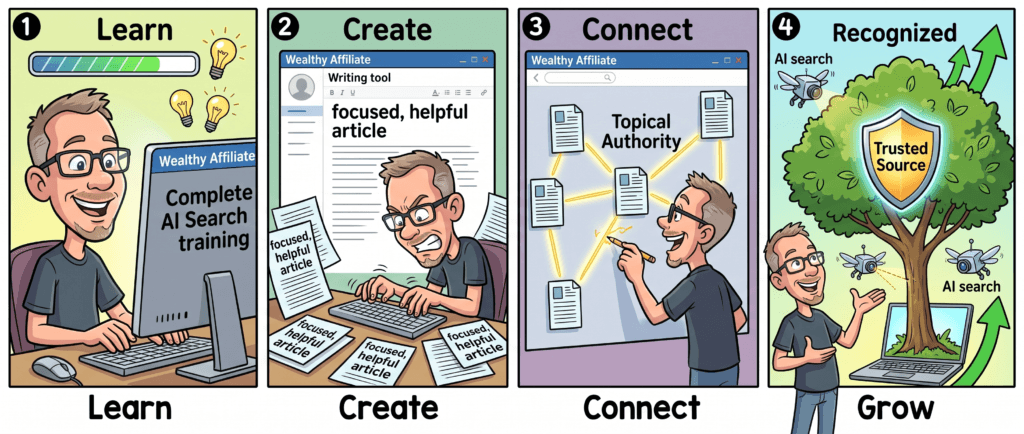
The articles most likely to be recognized by AI are usually the ones that do the best job of helping real readers. When you answer questions clearly, explain concepts honestly, and organize your content logically, you’re creating a better experience for everyone.
If your content genuinely helps beginners, you’re already moving in the right direction.
Expecting Results Overnight
Building authority takes time.
Whether you’re trying to rank in Google or increase your chances of being cited by AI, success usually comes from publishing consistently, improving your content, and continuing to learn as your website grows.
Don’t measure your progress by whether one article gets cited tomorrow. Measure it by whether your website becomes a more helpful resource every month.
Build a Website AI Can Trust
Learning how AI search works is only part of the journey. The next step is putting those ideas into practice by creating helpful content, organizing it into connected topics, and publishing consistently.
That’s why I recommend Wealthy Affiliate. It gives beginners the training, website tools, AI features, hosting, and supportive community needed to build a website that serves readers first while growing long-term authority.
? Start Your Free Wealthy Affiliate Starter Membership
Can Beginners Really Get Their Website Cited by AI?
The short answer is yes—but it probably won’t happen overnight.
Every established website started with its very first article. The difference is that successful websites kept publishing, kept improving, and kept building trust over time.
That’s encouraging if you’re just getting started.
You don’t need hundreds of articles before AI notices your website. You need a growing collection of helpful content that answers real questions, stays focused on your niche, and demonstrates genuine experience.
Some of your articles may never be referenced by AI, while others might become valuable resources that are cited repeatedly. The important thing is to focus on creating content that helps your readers—not content written simply to chase rankings.
As your website grows, so does your authority.
Every helpful article becomes another opportunity for readers to discover your content, for search engines to better understand your expertise, and for AI systems to recognize your website as a reliable source.
That’s why I believe consistency will always outperform shortcuts.
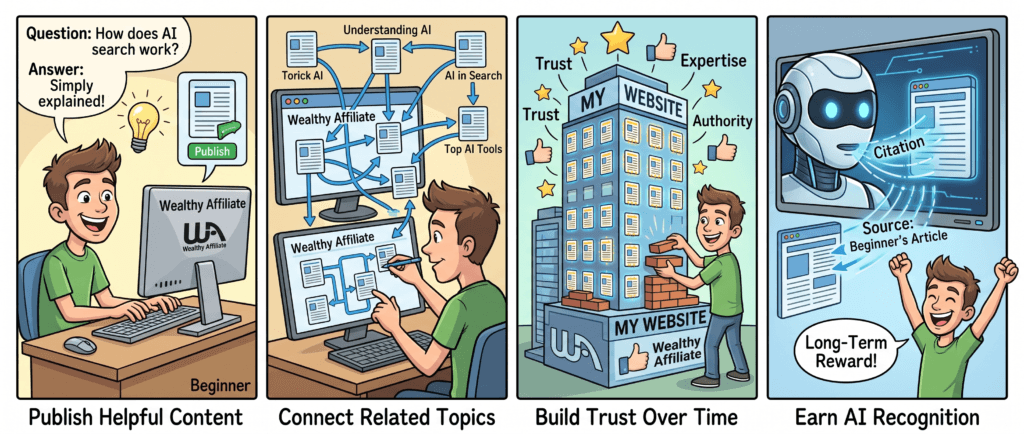
Final Thoughts
If there’s one thing I hope you take away from this guide, it’s that getting your website cited by AI isn’t about finding a hidden setting, using a special plugin, or discovering the latest optimization trick.
It’s about becoming a trustworthy source of information.
When you consistently answer one question thoroughly, organize your content into connected topics, and continue improving your website over time, you’re creating exactly the kind of resource that both readers and AI search value.
Will every article you publish be cited?
Probably not.
But every helpful article strengthens your website, expands your topical authority, and creates another opportunity to be discovered.
Instead of asking,
“How do I get AI to notice my website?”
try asking,
“How can I make this the most helpful answer to my reader’s question?”
That simple shift in thinking changes everything.
The websites that succeed in AI search aren’t usually the ones chasing the latest shortcut. They’re the ones consistently publishing content that deserves to be trusted.
Ready to Build a Website AI Can Trust?
Reading about AI search is a great first step. Putting these ideas into practice is where real progress begins.
If you’re looking for one place to learn affiliate marketing, build your website, improve your SEO, and create helpful content with AI, Wealthy Affiliate brings everything together in one beginner-friendly platform.
You’ll learn how to build a solid foundation, publish content that helps people, and grow your website one article at a time—using the same long-term approach we’ve discussed throughout this guide.
? Start the Free Wealthy Affiliate Starter Membership
Continue Learning
Getting your website cited by AI is only one part of building a successful online presence. The guides below will help you continue learning how AI search, SEO, and affiliate marketing work together.
Learn how AI search is changing online visibility
? How Beginners Can Get Found in AI Search
Understand how AI-powered search works and why creating helpful content is becoming more important than ever.
Learn practical ways to improve your visibility
Discover the habits and strategies that help your content become easier for both search engines and AI to understand.
Understand how AI search differs from traditional SEO
? AI Search vs. Traditional Search
See what has changed, what hasn’t, and why strong SEO fundamentals still matter.
Learn where GEO fits into modern SEO
? GEO vs. SEO for Beginners
Understand how Generative Engine Optimization complements traditional SEO and why both play a role in modern search.
Learn how to use AI throughout your affiliate business
? AI for Affiliate Marketing Beginners
Explore practical ways to use AI for research, content creation, SEO, and growing your affiliate website.
The guides above continue your learning journey here on Affiliate Education for Beginners. If you’d also like to explore what leading organizations are publishing about AI search and SEO, these trusted resources are excellent places to continue your research.
Keep Learning from Trusted Industry Resources
AI search continues to evolve, and staying informed will help you build a stronger website over time. The following organizations regularly publish research, updates, and best practices that can help you deepen your understanding of AI, SEO, and content marketing.
If you’d like to continue learning beyond this guide, these are excellent places to start.
? OpenAI Blog – Learn more about ChatGPT, AI search, and the latest developments in generative AI.
? Google AI Blog – Explore Google’s latest research and announcements about AI-powered search and artificial intelligence.
? Ahrefs Blog – Beginner-friendly articles covering SEO, keyword research, and content strategy.
? Semrush Blog – Practical guidance on SEO, content marketing, and growing your website.
Key Takeaways
Before you move on to the next lesson, remember these five ideas:
- AI citations are earned through trust—not tricks.
- Helpful, people-first content has the best chance of being recognized.
- Answer one primary question thoroughly instead of trying to cover everything.
- Build topical authority by creating connected articles that naturally support one another.
- Consistency over time will always outperform shortcuts.
Frequently Asked Questions
Can AI guarantee that my website will be cited?
No. There is no way to guarantee that AI platforms like ChatGPT, Google AI Overviews, or Perplexity will reference your content. The best approach is to consistently publish helpful, accurate, and trustworthy information that genuinely answers your readers’ questions.
Does AI replace SEO?
No. AI search builds on many of the same principles as traditional SEO. Creating helpful content, organizing your website well, building topical authority, and providing a good user experience remain essential for long-term success.
How long does it take for AI to recognize a website?
There isn’t a set timeline. Some websites may begin appearing in AI-generated answers relatively quickly, while others take much longer. Consistently publishing high-quality content and building authority over time gives you the best opportunity to be recognized.
Should I use AI to write all of my content?
AI can be an excellent tool for brainstorming, outlining, research, and improving drafts, but your articles should always reflect your own knowledge, experience, and judgment. People—and AI search—are more likely to trust content that feels authentic and genuinely helpful.
What is the best way to improve my chances of being cited by AI?
Focus on creating content that answers one question thoroughly, organize related articles into connected topics, and continue improving your website over time. Building trust is a long-term process, but it’s also the most reliable strategy.
Is AI search changing affiliate marketing?
Yes—but not by replacing the fundamentals. AI is changing how people discover information, which makes creating trustworthy, people-first content more important than ever. Affiliate marketers who focus on helping readers will continue to be in the strongest position.
About the Author
Written by Donna
Affiliate marketing researcher and founder of AffiliateEducationForBeginners.com
Donna researches affiliate marketing, SEO, AI search, and online business strategies to help beginners build sustainable websites without hype or unrealistic promises.
Her goal is to simplify complex topics into practical, beginner-friendly guides that help readers build confidence one step at a time.
Disclaimer
This article is for educational purposes only and reflects my research and experience building Affiliate Education for Beginners.
Some links on this website are affiliate links. If you choose to purchase through one of these links, I may earn a commission at no additional cost to you.
I only recommend products and services that I believe provide genuine value for beginners learning affiliate marketing.