Written by Donna
Affiliate marketing researcher and founder of AffiliateEducationForBeginners.com.
AI search is changing how people discover websites, but beginners do not need an entirely new marketing system to get found.
The strongest foundation is still helpful content, sound SEO, clear website organization, trustworthy sources, and genuine human experience. The difference is that your content may now be discovered through traditional search results, Google AI Overviews, AI Mode, ChatGPT search, and other AI-powered services.
As I researched how beginners can get found in AI search, I found that much of the advice online makes the process sound more mysterious than it needs to be.
There is no button that guarantees an AI citation. There is also no special piece of schema or collection of “AI keywords” that automatically makes a website trustworthy.
What you can do is make your content easier to discover, understand, verify, and use.
This guide provides the starting point. It connects the individual AI-search lessons on this website into one clear learning path.
If you are completely new to AI tools, begin with the AI Tools for Affiliate Marketing Beginners hub. If your main concern is Google traffic, the Affiliate SEO for Beginners hub explains the SEO foundation first.
If you are still learning how websites, content, traffic, and affiliate links work together, begin with my Affiliate Marketing Basics guide.
Affiliate disclosure: This guide contains affiliate links. If you join Wealthy Affiliate through one of these links, I may earn a commission at no additional cost to you.
Quick Answer: How Can Beginners Get Found in AI Search?
Beginners can improve their chances of appearing in AI-powered search by publishing original, accurate, well-organized content; making sure their pages can be crawled and indexed; using clear internal links; citing reliable sources; and adding genuine experience or useful judgment.
According to Google’s guidance on AI features and your website, the SEO practices used for regular Search remain relevant to its generative AI features. For Google AI Overviews and AI Mode, a page must first be indexed and eligible to appear in Search with a snippet.
ChatGPT search uses a separate crawler called OAI-SearchBot. A website must allow that crawler to access its public content to be eligible for inclusion, but placement is never guaranteed.
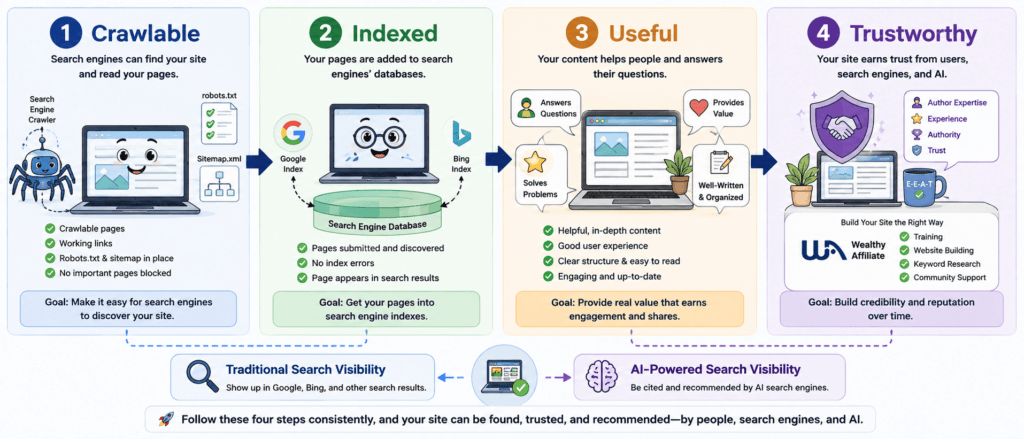
The practical order is:
- Get the page crawled.
- Get it indexed.
- Answer one question clearly.
- Support important claims.
- Add something original.
- Connect the page to related content.
- Monitor actual search performance.
Donna’s perspective: “The goal is not to write for a machine. The goal is to publish information that people find useful and that search systems can confidently understand and support with a link.”
What AI Search Means
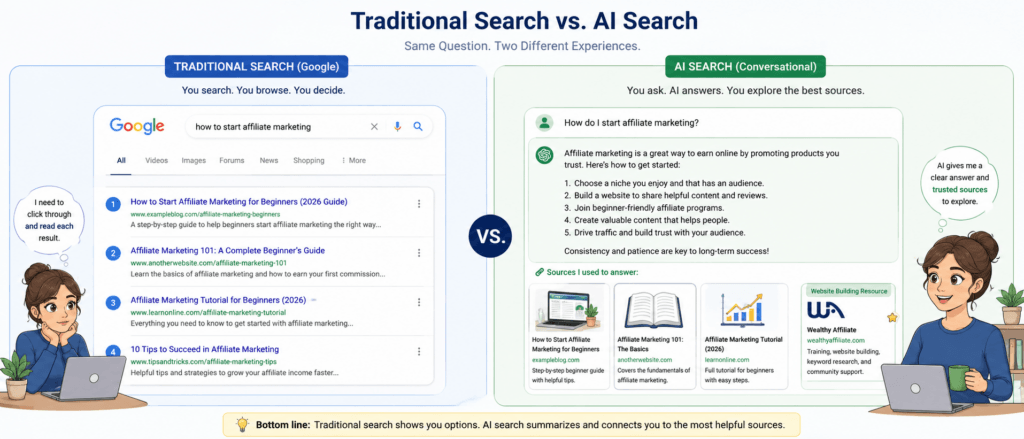
Traditional search usually presents a list of results that people can choose from.
AI-powered search may generate a conversational response, summarize information from multiple sources, and provide links that allow the user to investigate further.
Examples include:
- Google AI Overviews
- Google AI Mode
- ChatGPT search
- Microsoft Copilot
- Perplexity
- Other answer and research tools
These services do not all work the same way. They use different crawling systems, indexes, models, ranking processes, and citation methods.
That means there is no universal “AI ranking formula.”
A page cited by one service may not appear in another. An answer can also change when the wording, context, location, or timing of a question changes.
The sensible strategy is to build a trustworthy website with content that is accessible and useful across different discovery systems.
My AI Search vs. Traditional Search guide explains these differences in more detail.
SEO Still Matters in AI Search
AI search has not made SEO obsolete.
Google’s official guidance says its generative AI features are connected to its existing Search ranking and quality systems. Google also states that there are no separate technical requirements for AI Overviews or AI Mode beyond the requirements used for Google Search.
That makes traditional SEO the foundation:
| Traditional SEO foundation | How it supports AI visibility |
|---|---|
| Crawlable pages | Allows search systems to access the content |
| Google indexing | Makes a page eligible for Google’s AI search features |
| Clear page titles and headings | Helps people and systems understand the subject |
| Helpful content | Gives search systems useful information to retrieve |
| Internal linking | Shows how related topics connect |
| Reliable sources | Makes important claims easier to verify |
| Original experience | Adds information beyond a generic summary |
| Good page experience | Helps visitors use the content after clicking |
You can review Google’s current explanation in its official guide to optimizing websites for generative AI features.
This does not mean every optimized page will be indexed, ranked, or cited. Google explicitly states that crawling, indexing, and appearance are not guaranteed.
It means the work required for good SEO is not wasted when search becomes more conversational.
The First Requirement Is Discovery and Indexing
Before a page can appear in Google AI Overviews or AI Mode, Google must be able to crawl and index it.
That is why beginners should check the technical foundation before worrying about advanced AI-search tactics.
Make Sure the Page Can Be Crawled
A public page should not be blocked by:
- A
noindexdirective - A robots.txt rule
- A login requirement
- A broken redirect
- A server error
- An incorrect canonical URL
Include Important Pages in the Sitemap
According to Google’s sitemap documentation, a sitemap helps search engines discover the URLs you want them to crawl.
A sitemap does not force Google to index a page, but it helps Google discover important URLs and understand information such as when a page was last updated.
Link to the Page Internally
A page should not exist alone.
Link to it from:
- Its main hub
- A closely related article
- A relevant navigation or resource page when appropriate
Internal links help readers continue learning and show search engines how the page fits into the website.
Use Search Console
Google Search Console helps website owners understand how Google crawls, indexes, and displays their pages. It can show whether a page:
- Has been discovered
- Was crawled
- Is eligible for indexing
- Has a canonical conflict
- Is blocked
- Produces impressions or clicks
If Google reports Crawled – currently not indexed, repeatedly pressing Request Indexing is not a complete strategy. Review the page’s quality, originality, overlap, internal links, and role within the website.
I encountered this issue on my own website when Google crawled one of my AI-content articles before I completed its rewrite. Search Console showed that crawling was allowed and the page was indexable, but Google had not yet evaluated the improved version. That experience reminded me to check the crawl date, sitemap discovery, internal links, and current page quality before assuming that another indexing request would solve the problem.
Make Each Page Worth Retrieving
AI tools can already produce basic summaries of common information.
A page that only repeats those summaries gives a search system little reason to choose it as a supporting source.
Google’s guidance on generative AI content emphasizes accuracy, quality, relevance, and adding value rather than using AI to produce large amounts of unoriginal content.
Original value can include:
- Firsthand experience
- An original process
- A useful comparison
- A carefully documented test
- Screenshots showing real steps
- A beginner mistake and what corrected it
- Judgment about who a product does or does not suit
- A clearer explanation than existing sources provide
You do not need decades of experience to contribute something useful.
You can explain what you researched, what you applied, what surprised you, and what a beginner should verify before acting.
The key is accuracy. Never allow an AI tool to invent personal experience, product use, statistics, quotations, or results.
My guide about whether AI content can hurt Google rankings explains why human research and review matter more than whether AI assisted with the first draft.
Answer One Main Question Clearly
A strong page should have one primary purpose.
If an article tries to answer every question about AI, SEO, content creation, affiliate marketing, citations, and website building, the reader may struggle to identify the main answer.
A clearer structure is:
- State the question.
- Give a short answer near the beginning.
- Explain the answer with appropriate detail.
- Support claims with reliable sources.
- Add examples or firsthand observations.
- Direct the reader to the next related lesson.
Clear headings help readers scan the page, but there is no requirement to divide every paragraph into tiny “AI-friendly chunks.”
Google specifically warns against unnecessary tactics such as rewriting content solely for AI systems or creating separate pages for every possible variation of a question.
Write naturally for the reader.
Build Topical Connections
One article rarely establishes complete authority on a broad subject.
A hub-and-cluster structure allows each page to answer a specific question while showing how the topics relate.
Use these connected guides to explore each part of AI-search visibility:
- Learn how discovery is changing in AI Search vs. Traditional Search.
- Understand the relationship between traditional rankings and generative visibility in GEO vs. SEO for Beginners.
- Follow the practical steps in How to Rank in AI Search.
- Learn what may make a page useful as a source in How to Get Your Website Cited by AI.
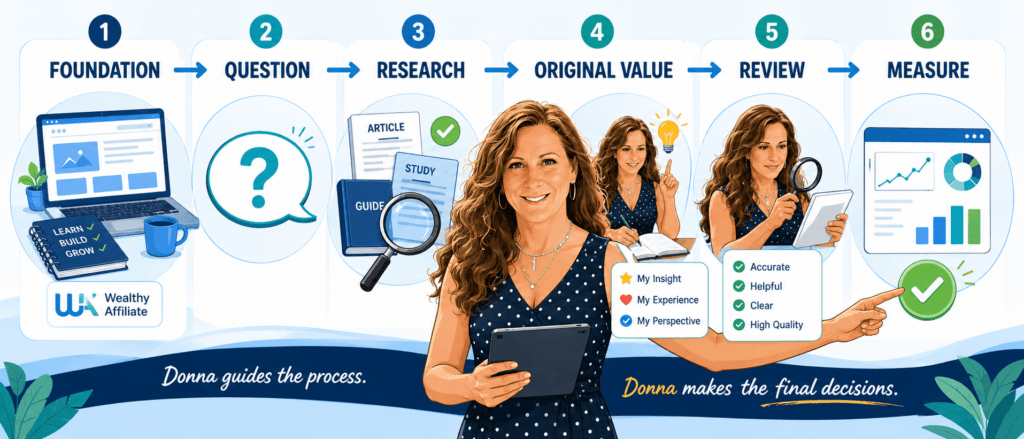
- See Donna’s human-led process in How I Use AI to Create Affiliate Content.
Internal links should be useful, not forced. A link belongs where it helps the reader understand a term, answer the next question, or complete the next step.
A good cluster avoids publishing several pages that answer the same question using slightly different keywords.
On this website, I organize related lessons around broader beginner hubs rather than treating every AI-search question as an isolated article. I am also reviewing older pages to make sure important guides are linked from their parent hubs and from related articles—not merely listed in a sitemap.
Your AI Search Learning Roadmap
Follow these lessons in order if you are new to the subject:
| Step | Lesson | What it teaches |
|---|---|---|
| 1 | AI Search vs. Traditional Search | How conversational answers differ from traditional result pages |
| 2 | Can AI Content Hurt Google Rankings? | How to use AI without publishing inaccurate or low-value content |
| 3 | How I Use AI to Create Affiliate Content | A human-led research, writing, and review workflow |
| 4 | GEO vs. SEO for Beginners | How traditional rankings and generative visibility relate |
| 5 | How to Rank in AI Search | Practical ways to improve discovery and visibility |
| 6 | How to Get Your Website Cited by AI | What can make a page useful as a supporting source |
Check Whether AI Search Crawlers Can Access the Site
Different AI services may use different crawlers.
For ChatGPT search, OpenAI identifies OAI-SearchBot as the crawler used to surface websites in search results. OpenAI recommends allowing the crawler and its published IP ranges if you want the site to be eligible for ChatGPT search.
OpenAI also states that inclusion and placement are not guaranteed.
You can verify the current crawler information in OpenAI’s official crawler documentation.
This is separate from GPTBot, which OpenAI describes for potential model training. A website owner may make different access choices for search visibility and model training.
Google explains that AI Overviews and AI Mode use Google Search’s existing systems. There is no separate Google AI crawler that you need to optimize for.
What Beginners Do Not Need
AI search has produced a growing list of tactics and services that promise special access or guaranteed visibility.
For Google’s generative Search features, beginners do not need:
- Special AI schema
- A guaranteed “AI citation” service
- Hundreds of nearly identical question pages
- A particular AI-content percentage
- An artificial minimum or maximum article length
- Exact-match wording for every possible question
- An
llms.txtfile for Google Search - Inauthentic mentions or manufactured authority
Google states in its AI-feature guidance that no special schema or AI-specific markup is required for AI Overviews or AI Mode.
Google has also stated that it does not use llms.txt for Google Search. Therefore, creating the file should not be treated as a requirement for Google rankings or AI visibility.
Schema should describe the visible content accurately. It should not be treated as a shortcut around indexing, quality, or trust.
A Practical Beginner Action Plan
You do not need to complete everything at once.
Step 1: Strengthen the Website Foundation
Confirm that your site has:
- HTTPS
- A working sitemap
- Self-referencing canonical URLs
- Indexable pages
- Clear navigation
- Mobile-friendly content
- Useful hub-and-cluster connections
Step 2: Choose One Reader Question
Identify the specific question the page must answer.
Do not create a separate article merely because an AI tool suggested another wording of the same question.
Step 3: Research Before Drafting
Open the official sources yourself.
AI may help identify what needs checking, but it should not be the final source for current prices, policies, commissions, platform features, or search-engine requirements.
Step 4: Add Original Value
Include something that a generic summary cannot provide:
- Your research process
- A genuine observation
- A screenshot
- A tested workflow
- A relevant example
- A warning about a mistake
- A balanced decision table
Step 5: Review the Finished Page
Check:
- Accuracy
- Search intent
- Heading structure
- Internal links
- External sources
- Image alt text
- Disclosures
- Tables
- Mobile readability
- The next lesson
Step 6: Monitor Real Results
Use Search Console to see whether Google has crawled and indexed the page.
When data becomes available, review impressions, clicks, queries, and AI-search reporting instead of relying on a third-party promise that the page will rank.
If you want a structured place to learn website building, keyword research, SEO, content creation, and affiliate marketing, Wealthy Affiliate provides training and tools within one platform.
It cannot guarantee rankings, AI citations, traffic, commissions, or income. Its value is giving beginners a place to learn and apply the underlying skills.
👉 Explore the Free Wealthy Affiliate Starter Membership
The Starter option is currently free and does not require a credit card. Confirm current features and conditions on the official website.
Common AI Search Myths
AI Search Has Replaced SEO
It has not.
Google says foundational SEO remains relevant because its generative features use its Search index and core ranking and quality systems.
Every Page Needs Special AI Markup
There is no special schema required for Google AI features.
Use appropriate structured data only when it accurately represents visible content and supports an eligible Search feature.
Longer Content Is Always Better
There is no universal ideal length.
A page should be long enough to answer its question completely without padding it with repeated explanations.
AI-Written Content Cannot Appear
Google focuses on the quality and purpose of the finished content, not simply whether AI assisted.
Mass-producing pages primarily to manipulate search rankings without adding value may violate Google’s scaled content abuse policy.
A Citation Can Be Guaranteed
No ethical SEO service, AI tool, training platform, or affiliate program can guarantee citations or rankings.
Search systems make their own decisions, and results can vary between users and questions.
How to Measure Progress
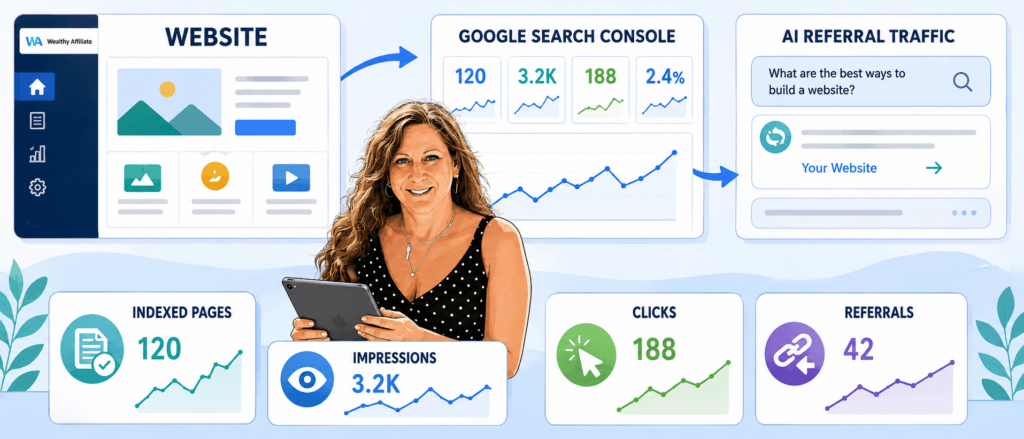
For Google visibility, begin with Search Console.
Look for:
- Indexed pages
- Impressions
- Clicks
- Search queries
- Average position
- Crawl dates
- Canonical selections
- Generative AI performance information when available
A page can be indexed without receiving impressions immediately. A new website may need time to establish stronger content connections and trust signals.
In your analytics, traffic arriving from ChatGPT may be identified by a referral from chatgpt.com or by a URL containing:
utm_source=chatgpt.com
Reporting can vary according to your analytics configuration, so confirm how these visits appear in your own reports.
Do not add that tracking parameter to your own internal links. It belongs only to referrals generated by ChatGPT.
Key Takeaways
- AI search has not eliminated the need for SEO.
- Google requires a page to be indexed and snippet-eligible before it can support AI Overviews or AI Mode.
- ChatGPT search uses OAI-SearchBot for search visibility.
- Allowing a crawler makes a page eligible for discovery but does not guarantee inclusion.
- Helpful, original, well-supported content is more valuable than generic summaries.
- Internal links connect individual lessons into a clear topical structure.
- There is no special Google AI schema or required
llms.txtfile. - Search Console and analytics provide better evidence than guaranteed-ranking claims.
- Human research, experience, judgment, and review remain essential.
Frequently Asked Questions
Can a new website appear in AI search?
A new website can become eligible for AI-powered search, but discovery and inclusion are not guaranteed. Build crawlable, indexable pages and publish original, useful content connected through clear internal links.
Does AI search replace traditional SEO?
No. Google says traditional SEO practices remain relevant to AI Overviews and AI Mode because those features use its Search index and core ranking and quality systems.
Does my page need to be indexed before appearing in Google AI Overviews?
Yes. Google states that a page must be indexed and eligible to appear in Search with a snippet before it can be shown as a supporting link in AI Overviews or AI Mode.
Do I need special schema for AI search?
Google does not require special AI schema. Continue using supported structured data when it accurately represents the page and may qualify for a regular Google rich result.
Does Google use llms.txt?
Google does not require an llms.txt file for Google Search or its generative AI features. Creating one should not be treated as a requirement for Google rankings or AI visibility.
How can my site become eligible for ChatGPT search?
Allow OAI-SearchBot in your robots.txt file and ensure your host or security service permits requests from OpenAI’s published IP ranges. Eligibility does not guarantee that ChatGPT will cite or display the page.
Can AI-generated content appear in AI search?
AI-assisted content may appear when the finished page meets the relevant search system’s requirements. The content should be accurate, useful, original, and reviewed by a person who accepts responsibility for it.
How long does it take to get cited by AI?
There is no reliable timeline. The page must first be discovered and accessible, and each AI service decides which sources support a particular answer. Some eligible pages may never receive a visible citation.
Should beginners optimize separately for SEO, AEO, and GEO?
Beginners should start with strong SEO and people-first content. AEO and GEO can describe ways of thinking about answers and generative visibility, but they do not replace crawlability, indexing, reliable information, or reader usefulness.
Final Thoughts
Getting found in AI search is not about tricking an AI system.
It begins with publishing content that deserves to be discovered: clear answers, accurate information, original value, reliable sources, genuine experience, and a website structure that connects related lessons.
Beginners should focus first on becoming discoverable in traditional search. Then make each indexed page useful enough to support a reader—or an AI-generated answer—when the right question is asked.
There are no guaranteed citations, but there is a practical process you can control:
- Build a sound website.
- Answer focused questions.
- Verify important facts.
- Add something original.
- Connect related content.
- Review everything under your own name.
- Measure what actually happens.
That is a more reliable strategy than chasing every new AI-search shortcut.
Continue Learning
Your next lesson is:
AI Search vs. Traditional Search: A Beginner’s Guide
It explains how the two discovery experiences differ and why websites remain important in both.
Ready to Build the Skills Behind Search Visibility?
Wealthy Affiliate combines beginner training, WordPress website tools, keyword research, AI-assisted tools, and community support in one learning environment.
It will not guarantee Google rankings or AI citations. It can help you learn and apply the website-building, SEO, research, and content skills discussed throughout this hub.
👉 Start With the Free Wealthy Affiliate Membership
Review the current membership features and conditions before joining.
About the Author
Donna is the founder of Affiliate Education for Beginners. She researches affiliate marketing, SEO, AI search, content creation, and online-business platforms while documenting what she learns through building this website.
Her approach emphasizes careful research, human review, transparent affiliate relationships, and realistic expectations.
Affiliate Disclosure and Disclaimer
This article contains affiliate links. If you join Wealthy Affiliate through one of these links, I may earn a commission at no additional cost to you.
This guide is educational and does not guarantee rankings, indexing, traffic, AI citations, commissions, or income. Search systems, AI services, crawler requirements, platform features, and reporting tools can change. Verify current requirements through the applicable provider before making technical or financial decisions.