
Written by Donna
Affiliate marketing researcher and founder of AffiliateEducationForBeginners.com
Last updated: June 2026
Reviewed for beginner-friendly accuracy: June 2026
Quick Answer: What Is Affiliate Blogging?
Affiliate blogging is the process of creating helpful content that attracts readers through search engines, social media, email marketing, and other traffic sources while recommending relevant products or services through affiliate links.
When a reader clicks an affiliate link and takes a qualifying action, such as making a purchase or signing up for a service, the blogger may earn a commission.
Unlike traditional advertising, affiliate blogging focuses on helping readers solve problems, answer questions, and make informed decisions before recommending a product or service.
One thing I learned while building an affiliate website is that successful affiliate blogging is not about placing affiliate links everywhere. It is about creating useful content that people can find, trust, and return to when they need help.
Affiliate blogging can help beginners:
- Build long-term traffic
- Create helpful content around a niche
- Earn commissions without creating products
- Learn SEO and content marketing
- Build authority and trust
- Develop a scalable online business
This guide is part of the Affiliate Marketing Basics learning system.
? Affiliate Marketing Basics: Beginner-Friendly Guide to Get Started
If you’re completely new to affiliate marketing, start here:
? What Is Affiliate Marketing? An Introduction for Beginners

What I Learned About Affiliate Blogging
When I first started learning affiliate marketing, I assumed success came from finding the perfect affiliate program. What I eventually realized was that useful content mattered far more than the program itself.
A great affiliate program cannot help much if nobody visits your website.
Blogging gave me a way to answer beginner questions, organize information, create internal links, and build content that could continue attracting visitors long after it was published.
What surprised me most was how much trust matters. Readers are far more likely to follow recommendations when they feel a website genuinely helps them solve problems instead of simply trying to sell something.
That is one reason affiliate blogging remains one of the most effective long-term affiliate marketing strategies available today.
Why Affiliate Blogging Matters for Beginners
Affiliate blogging appeals to beginners because it allows you to build an online business without creating your own products, managing inventory, handling shipping, or providing customer support.
Instead, your focus is on helping readers find information, solutions, and recommendations.
A blog also creates something many social media platforms cannot provide: a long-term content asset.
A well-written blog post can continue attracting visitors from search engines for months or even years after publication.
| Blogging Benefit | Why It Matters |
|---|---|
| Long-Term Traffic | Content can rank for years |
| Low Startup Costs | No product creation required |
| Flexible Schedule | Create content when convenient |
| Scalable Growth | Content compounds over time |
| Trust Building | Readers return for helpful advice |
| Affiliate Income | Monetize through recommendations |
Google continues to emphasize helpful, people-first content that demonstrates experience and provides value to users.
External resource:
? Google Search Central Helpful Content Guidance
For beginners, this means focusing on useful content rather than shortcuts.
? SEO for Affiliate Marketing for Beginners
? The Role of Blogging in Affiliate Marketing
How Affiliate Blogging Works
Affiliate blogging usually follows a straightforward process:
- Choose a niche
- Build a website
- Join affiliate programs
- Publish helpful content
- Add affiliate links naturally
- Attract targeted traffic
- Earn commissions when readers take action
The process sounds simple, but each step builds on the previous one.
Affiliate bloggers who focus on helping readers first often create stronger long-term results than those who focus only on monetization.
If you want to understand the referral process behind affiliate links, start here:
? How Affiliate Marketing Works: A Step-by-Step Guide
How to Start Affiliate Blogging
If you want to know how to start affiliate blogging, the good news is that the process is much simpler than many beginners expect.
You do not need to be a professional writer, web designer, or marketing expert to get started.
The most important thing is choosing a topic you can consistently create content around while learning the fundamentals of affiliate marketing and SEO.
Step 1: Choose a Niche
A niche is the specific topic your website focuses on.
The strongest affiliate niches typically combine:
- Audience interest
- Search demand
- Monetization opportunities
- Long-term content potential
Examples include:
- Affiliate marketing
- Personal finance
- Fitness
- Technology
- Home improvement
- Outdoor activities
- Hobbies and interests
One lesson I learned is that choosing a niche you genuinely enjoy makes content creation much easier over time. Building an affiliate website often requires publishing dozens or even hundreds of articles, so interest in the topic matters.
? How to Choose the Right Affiliate Program (2026)
Step 2: Build Your Website
Most affiliate bloggers use WordPress because it offers flexibility, control, and long-term growth potential.
Your website becomes the foundation for:
- Blog posts
- Reviews
- Tutorials
- Comparison articles
- Resource pages
A blog gives you complete ownership of your content, unlike social media platforms where algorithms can dramatically affect visibility.
Many beginners also underestimate the importance of website structure.
A well-organized site helps both visitors and search engines understand how your content connects.
? Content Marketing Strategies for Affiliate Success
? Traffic Generation Strategies for Affiliate Marketers
Step 3: Join Affiliate Programs
After choosing a niche and building a website, the next step is joining affiliate programs that fit your audience.
Popular options include:
| Affiliate Network | Best For |
|---|---|
| Amazon Associates | Physical products |
| ShareASale | Multiple niches |
| CJ Affiliate | Established brands |
| Impact | Software and services |
| ClickBank | Digital products |
| Direct Programs | Higher commissions |
The best affiliate program is not always the one with the highest commission.
It is usually the one that best matches your audience’s needs.
? Best Affiliate Programs for Beginners
? Affiliate Programs Explained
Step 4: Create Helpful Content
Content is the engine that drives affiliate blogging.
The most successful affiliate blogs focus on helping readers solve problems before recommending products.
Popular content types include:
| Content Type | Purpose |
|---|---|
| Beginner Guides | Teach fundamentals |
| Tutorials | Solve problems |
| Product Reviews | Evaluate products |
| Comparison Articles | Help readers choose |
| Resource Pages | Recommend tools |
Affiliate blogging works best when recommendations appear naturally within helpful content rather than being the primary focus.
Google continues to reward content that demonstrates experience, expertise, authority, and trustworthiness.
External resource:
? Writing Product Reviews That Drive Sales
? How to Write Affiliate Comparison Content That Converts
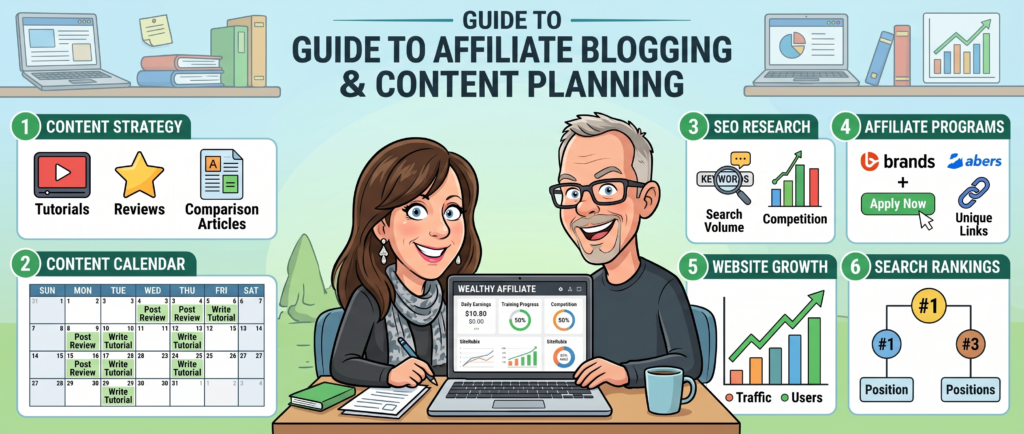
Step 5: Learn Basic SEO
Search engine optimization helps readers discover your content.
Many beginners hear the term SEO and assume it is highly technical.
In reality, basic SEO often comes down to understanding what people are searching for and creating content that answers those questions effectively.
Key SEO skills include:
- Keyword research
- Search intent
- Internal linking
- On-page optimization
- Content structure
- Site organization
One thing that surprised me was how often small SEO improvements produced meaningful results. Better headings, stronger internal links, and more focused keywords can make a noticeable difference over time.
Helpful resources:
? Keyword Research for Affiliate Marketing
? On-Page SEO Techniques for Affiliate Websites
? SEO for Affiliate Marketing for Beginners
Step 6: Add Affiliate Links Naturally
One of the biggest mistakes beginners make is placing affiliate links everywhere.
Readers are more likely to trust recommendations when the links genuinely support the content.
For example:
- A tutorial may recommend a helpful tool.
- A review may link directly to the product being discussed.
- A comparison article may help readers evaluate multiple options.
The goal is not to maximize the number of affiliate links.
The goal is to maximize usefulness.
When recommendations feel relevant and helpful, readers are more likely to engage with them.
How to Monetize a Blog With Affiliate Links
One of the most common beginner questions is how to monetize a blog with affiliate links.
The simplest answer is this:
Create content that helps readers solve problems, then recommend products or services that naturally support the solution.
Affiliate links work best when they feel like a logical next step rather than an interruption.
Common ways affiliate bloggers monetize content include:
- Product reviews
- Comparison articles
- Tutorials
- Resource pages
- Buying guides
- Recommendation lists
A strong affiliate blog focuses on helping readers first and monetizing second.
That approach typically builds more trust and produces better long-term results.
The most successful affiliate blogs do not focus on selling. They focus on solving problems. As traffic, trust, and helpful content grow, affiliate recommendations become a natural part of the reader’s journey.
Affiliate blogging makes money by combining helpful content, targeted traffic, and relevant affiliate recommendations. The most successful affiliate blogs focus on solving problems first and monetizing naturally through products and services that fit the reader’s needs.
If you’re still deciding what to promote, start with 7 Affiliate Programs Beginners Can Actually Make Money With (2026) to see beginner-friendly programs that offer realistic earning opportunities.
? What Actually Converts for Beginners in Affiliate Marketing
? How Beginners Actually Make Their First Dollar Online
Build Your Affiliate Blog While Learning Affiliate Marketing
Many beginners are trying to learn:
- Blogging
- SEO
- Website building
- Content marketing
- Traffic generation
- Affiliate monetization
all at the same time.
That can feel overwhelming.
Wealthy Affiliate combines training, hosting, keyword research tools, website building, and community support into one beginner-friendly platform.
If you’re ready to start building an affiliate website, you can begin with a free Starter Membership.
? Start the Free Wealthy Affiliate Starter Membership
Best Affiliate Networks for Bloggers
Many beginners ask about the best affiliate networks for bloggers because they are unsure where to find products and services to promote.
The truth is that there is no single best affiliate network for everyone. The right choice depends on your niche, audience, and content strategy.
Some popular affiliate networks include:
| Affiliate Network | Best For |
|---|---|
| Amazon Associates | Physical products |
| ShareASale | Multiple niches |
| CJ Affiliate | Established brands |
| Impact | Software and subscription services |
| ClickBank | Digital products |
| Direct Affiliate Programs | Higher commission opportunities |
For example, bloggers in product-focused niches may find success with Amazon Associates, while bloggers focused on online business, software, or education may perform better with direct affiliate partnerships.
One thing I learned is that commission rates only tell part of the story. A lower-paying offer that converts consistently can outperform a higher-paying offer that rarely generates sales.
Helpful resources:
? Best Affiliate Programs for Beginners
? Affiliate Commission Structures Explained
? Why Some Affiliate Programs Convert Better Than Others
Best Tools for Affiliate Marketing Bloggers
Affiliate blogging does not require dozens of expensive tools.
Many successful bloggers start with just a few essentials and expand as their websites grow.
Some of the most useful tools include:
| Tool Type | Purpose |
|---|---|
| WordPress | Website management |
| Keyword Research Tools | Find content opportunities |
| Google Search Console | Track search performance |
| SEO Plugins | Improve optimization |
| Image Creation Tools | Create visuals |
| Email Marketing Platforms | Build subscriber lists |
| Link Tracking Tools | Monitor clicks |
One lesson I learned is that tools rarely create success on their own. Helpful content and consistency matter far more than having the newest software.
That said, the right tools can make content creation and SEO much easier.
? Ahrefs Beginner SEO Resources
? Semrush Content Marketing Resources
? HubSpot Content Marketing Resources
Affiliate Blogging Tips for Beginners
Many beginner affiliate bloggers struggle because they try to do too much too quickly.
A simpler approach usually works better.
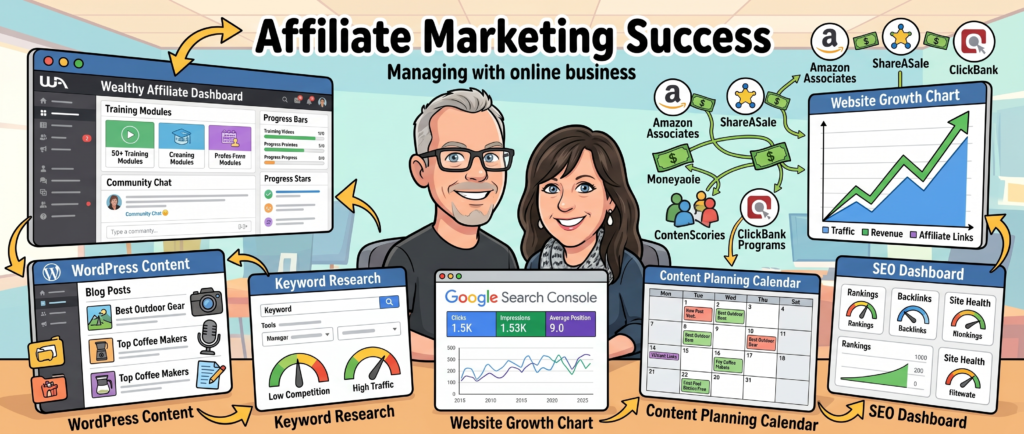
Some affiliate blogging tips for beginners include:
- Choose a focused niche
- Publish consistently
- Learn basic SEO
- Build internal links between related content
- Create content that solves problems
- Recommend products naturally
- Update older articles regularly
- Focus on helping readers first
One thing that surprised me is how much progress comes from consistency rather than perfection. Publishing useful content regularly often produces better results than endlessly tweaking a handful of articles.
Helpful related guides:
? How to Build a Content Calendar for Affiliate Marketing
? How to Drive Traffic to a New Affiliate Website (2026)
? The Role of Blogging in Affiliate Marketing
How Much Do Affiliate Blogs Make?
One of the most common questions beginners ask is:
How much do affiliate blogs make?
The honest answer is that affiliate blog income varies significantly.
Some blogs make little or nothing during their first months. Others gradually grow into side-income businesses or full-time income sources.
A blog’s earning potential depends on factors such as:
- Traffic quality
- Search visibility
- Content quality
- Audience trust
- Affiliate program selection
- Conversion rates
Affiliate blogging is often less about quick wins and more about building a content library that compounds over time.
Traffic, trust, and helpful content usually work together to create results.
Can You Make $1000 a Month With a Blog?
Yes, it is possible to make $1000 a month with a blog.
However, most bloggers do not reach that level overnight.
Reaching consistent income often requires:
- Helpful content
- Search traffic
- Relevant affiliate offers
- Strong internal linking
- Consistent publishing
One lesson I learned is that beginners often focus too much on income goals and not enough on content goals. Building useful content usually comes first. Revenue often follows later.
Rather than asking, “How quickly can I make money?” a better question may be:
“How many helpful articles can I publish that solve real problems?”
That mindset tends to produce better long-term results.
? How Long It Really Takes to Make Money With Affiliate Programs (2026)
? Why Your First Affiliate Commission Takes Longer Than Expected
How to Earn $100 Per Day Through Affiliate Marketing
Another question many beginners ask is:
How do you earn $100 per day through affiliate marketing?
While there is no guaranteed formula, most affiliate marketers who reach that level do not rely on a single article or a single affiliate link.
Instead, they build a content system that works together.
That system often includes:
- Helpful blog content
- SEO-driven traffic
- Multiple affiliate offers
- Internal linking
- Consistent publishing
- Ongoing content updates
A common misconception is that affiliate income comes from one viral article or one lucky promotion.
In reality, most successful affiliate websites grow through dozens or even hundreds of pieces of content that work together over time.
One thing I learned is that consistency often beats intensity. Publishing helpful content regularly usually produces better results than publishing a large amount of content and then disappearing for months.
? Traffic Generation Strategies for Affiliate Marketers
? How to Drive Traffic to a New Affiliate Website (2026)
Affiliate Marketing Trends in 2026
Affiliate marketing continues to evolve, but many of the core principles remain the same.
Some of the most important affiliate marketing trends in 2026 include:
| Trend | Why It Matters |
|---|---|
| Helpful Content | Google continues rewarding useful content |
| Experience-Based Writing | Real-world insights build trust |
| Search Intent Optimization | Better matches user needs |
| Recurring Commission Programs | More predictable income |
| Strong Internal Linking | Improves navigation and SEO |
| AI-Assisted Content Creation | Improves efficiency when used responsibly |
One thing that stands out is that trust has become more important, not less.
As more generic AI content appears online, websites that demonstrate genuine experience and useful insights often have an advantage.
? Content Marketing Institute Research
Top Affiliate Marketing Strategies for 2026
Many affiliate marketing strategies come and go.
The most reliable strategies often remain surprisingly simple.
Some of the most effective approaches include:
- Publishing content around real search questions
- Building topic clusters and internal links
- Creating reviews and comparison content
- Updating older content regularly
- Improving user experience
- Choosing affiliate programs that fit the audience
- Building trust before promoting products
Affiliate blogging works particularly well because every article becomes part of a larger content system.
Instead of relying on one page, multiple articles work together to attract traffic and guide readers toward helpful solutions.
? What Actually Converts for Beginners in Affiliate Marketing
? SEO for Affiliate Marketing for Beginners
Affiliate Blogging Success Stories
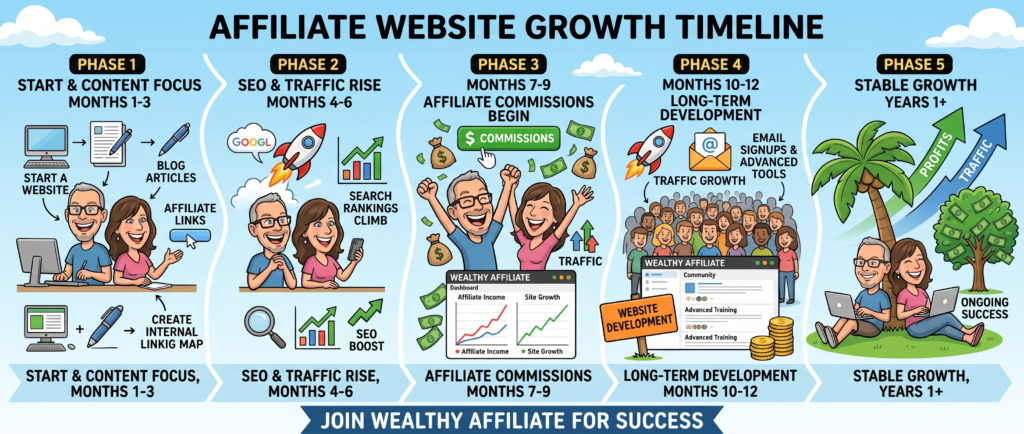
There are many affiliate blogging success stories online, but most are less dramatic than people expect.
Behind most successful blogs is a consistent process:
- Choosing a niche
- Publishing helpful content
- Learning SEO
- Improving content quality
- Building trust with readers
- Staying consistent longer than competitors
What often separates successful bloggers from unsuccessful ones is not talent.
It is persistence.
Many websites never reach their potential because the owner stops publishing before the content has time to gain traction.
One lesson I learned is that affiliate blogging rewards patience. Search traffic, rankings, and commissions often arrive gradually rather than all at once.
Start Here If You Want to Build an Affiliate Blog
If you are serious about building an affiliate blog, these guides are the best next steps:
? What Is Affiliate Marketing? An Introduction for Beginners
? How Affiliate Marketing Works: Step-by-Step Guide
? SEO for Affiliate Marketing for Beginners
? Best Affiliate Programs for Beginners
? Traffic Generation Strategies for Affiliate Marketers
Together, these resources provide a strong foundation for learning affiliate marketing, content creation, SEO, and website growth.
Learn Affiliate Marketing Online
Many beginners struggle because they are trying to learn:
- Blogging
- SEO
- Content creation
- Website building
- Traffic generation
- Affiliate monetization
all at the same time.
Structured training can shorten the learning curve considerably.
For beginners who want training, website hosting, keyword research tools, community support, and step-by-step guidance in one place, Wealthy Affiliate remains one of the most popular beginner-friendly platforms.
It can help you learn:
- How affiliate websites work
- How to create content
- How SEO drives traffic
- How affiliate programs generate commissions
- How to build a long-term online business
? Start the Free Wealthy Affiliate Starter Membership
Frequently Asked Questions About Affiliate Blogging
What is affiliate blogging?
Affiliate blogging is the process of creating blog content that includes affiliate links to relevant products or services. When readers take a qualifying action, the blogger may earn a commission.
How do you start affiliate blogging?
Start by choosing a niche, building a website, joining affiliate programs, creating helpful content, and learning basic SEO to attract targeted traffic.
How do you monetize a blog with affiliate links?
You monetize a blog by publishing useful content that naturally recommends products or services readers already need or are actively researching.
How much do affiliate blogs make?
Affiliate blog income varies widely. Some blogs earn little at first, while others grow into part-time or full-time income sources depending on traffic, content quality, and conversions.
Can you make $1000 a month with a blog?
Yes. Many bloggers eventually reach $1000 per month or more through consistent content creation, SEO, targeted traffic, and relevant affiliate offers.
Is affiliate blogging good for beginners?
Yes. Affiliate blogging can be beginner-friendly because it allows people to start with content, learn SEO gradually, and build traffic over time without creating their own products.
Final Thoughts
Affiliate blogging remains one of the most practical ways for beginners to combine content creation, SEO, and affiliate marketing into a long-term online business.
Rather than chasing shortcuts, successful affiliate bloggers focus on creating helpful content that answers questions, solves problems, and helps readers make informed decisions.
Over time, those articles can attract traffic, build trust, and create opportunities for affiliate commissions.
If you want to build an affiliate blog the right way, focus on helpful content first, learn basic SEO, and choose affiliate programs that genuinely fit your audience.
For beginners who want training, hosting, keyword research tools, and community support in one place:
? Start the Free Wealthy Affiliate Starter Membership
Affiliate Disclaimer
Some links on this page may be affiliate links. If you choose to purchase through them, I may earn a commission at no extra cost to you. I only recommend tools and platforms I genuinely believe are helpful for beginners.