Written by Donna
Affiliate marketing researcher and founder of AffiliateEducationForBeginners.com
Quick Answer: What Is an Affiliate Program?
An affiliate program is a partnership where a company pays you a commission for helping send customers, leads, or signups through a unique tracking link.
You do not create the product, handle shipping, process payments, or manage customer service. Your job is to create helpful content, recommend relevant products or services, and connect the right reader with the right solution.
Affiliate programs can pay in different ways, including one-time commissions, recurring commissions, percentage-based payouts, fixed payouts, or lead-based payments.
The best affiliate program for a beginner is not always the one that pays the most—it is the one that fits your audience, your content, and your ability to explain the recommendation clearly.
This guide will help you understand:
- What affiliate programs are
- How affiliate links and tracking work
- How affiliates get paid
- What commission models mean
- What beginners should look for before joining
- How to avoid poor-fit programs
- How to choose your first affiliate program wisely
This guide is part of my Best Affiliate Programs for Beginners learning series.
Best Affiliate Programs for Beginners: Reviews, Commissions, and What Actually Pays
If you are comparing specific beginner-friendly options, read:
Top 10 Affiliate Programs for Beginners
Why Affiliate Programs Matter for Beginners
Affiliate programs are one of the most common ways beginners try to earn income online because you do not have to create your own product first.
That can make affiliate marketing feel more approachable.
Instead of building software, writing a course, managing inventory, or handling customer service, you can recommend products and services that already exist.
If you are still learning the difference between affiliate marketing and an affiliate program, start with:
What Is Affiliate Marketing? An Introduction for Beginners
But that does not mean affiliate marketing is automatic or easy.
When I first started learning affiliate marketing, I thought choosing a program would be mostly about finding the best commission.
Over time, I learned that how the program works matters just as much as what it pays.
A program can offer a large commission and still be hard for beginners to earn from if the product is confusing, the audience fit is weak, or the company does not provide clear terms.
A smaller commission can sometimes be more realistic if the product is easier to explain and naturally fits what readers already need.
Affiliate programs are not just about links. They are about trust, relevance, and helping readers make better decisions.
That is why beginners should understand how affiliate programs work before joining too many of them.
Still trying to understand how affiliate marketing works in a real business?
You can start learning while building your own beginner website, so the links, content, SEO, and traffic pieces make more sense together.
See How Affiliate Marketing Works While Building Your First Website Free
How Affiliate Programs Work Step by Step
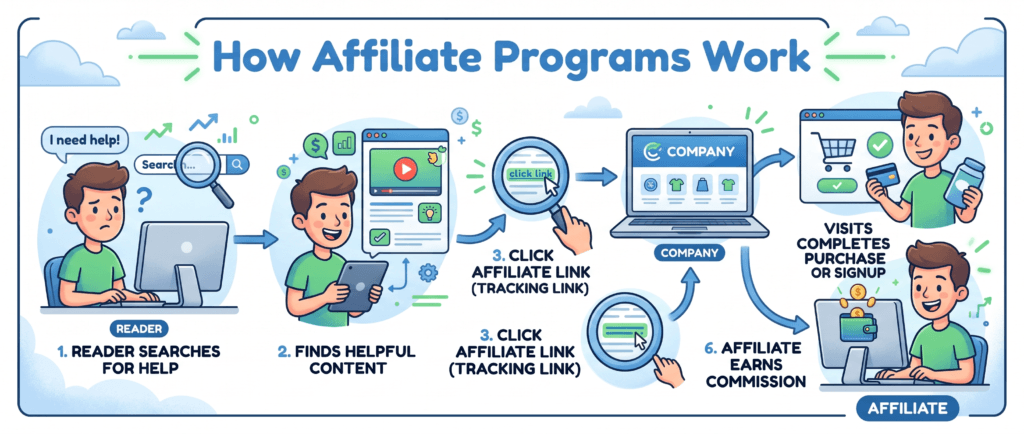
Affiliate programs usually follow a simple process.
A company creates an affiliate program so publishers, bloggers, creators, or marketers can recommend its products or services.
When you join the program, you receive a unique affiliate link.
That link tracks referrals from your website, email, social post, video, or other approved promotional channel.
Here is the basic process:
- You join an affiliate program.
- The company gives you a unique tracking link.
- You create helpful content related to the product or problem.
- A reader clicks your affiliate link.
- The reader visits the company’s website.
- The reader completes a qualifying action.
- The company tracks the referral.
- You earn a commission if the action meets the program terms.
That qualifying action might be a purchase, free trial signup, lead form, account creation, or subscription.
Every affiliate program has its own rules.
That is why beginners should always read the affiliate agreement before promoting any product or service.
How Affiliate Links, Cookies, and Tracking Work
The tracking side of affiliate marketing can sound more technical than it really is.
When you join an affiliate program, you are usually given a unique link connected to your affiliate account.
When someone clicks that link, the program records information that helps identify where the visitor came from.
If the person completes a qualifying action under the program’s rules, the commission may be credited to you.
The exact tracking process varies by program, but three terms are worth understanding.
Affiliate Link
An affiliate link is a unique tracking link connected to your account.
For example, two affiliates may recommend the same product, but each receives a different link so the company can track who referred the customer.
Cookie Duration
A cookie duration is the period during which a referral may remain eligible for commission after someone clicks an affiliate link.
For example, one program may use a 24-hour window while another may use 30 days.
A longer window can give the customer more time to decide, but cookie duration alone does not determine whether a program is worth joining.
A 90-day cookie is not especially valuable if the product does not fit your audience.
Attribution
Attribution determines which affiliate receives credit for a conversion.
Programs may use different tracking and attribution rules, and another referral, device change, expired tracking window, or other condition may affect whether a commission is credited.
You do not need to become a tracking expert before joining your first affiliate program.
You do need to understand the program’s basic rules.
An affiliate link tracks the referral, but the program’s terms determine whether the action qualifies for a commission.
Before promoting a program, check:
- What action earns a commission
- How long referrals are tracked
- Whether repeat purchases qualify
- What happens if a customer cancels or requests a refund
- Whether certain promotional methods are restricted
These details are usually found in the affiliate agreement or program terms.
For a deeper industry explanation of how affiliate tracking, commissions, and payments work, see the Impact Affiliate Marketing Guide.
How Do Affiliate Programs Pay?
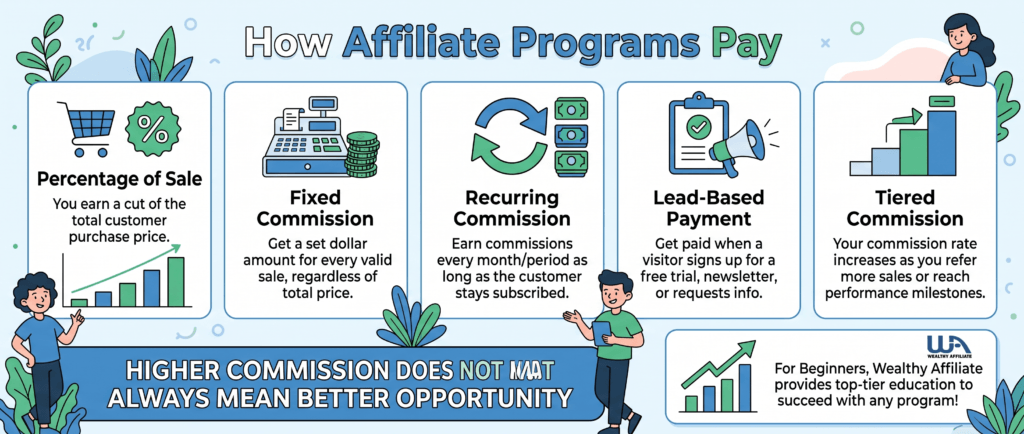
Affiliate programs do not all pay the same way.
Some pay when a customer buys a product. Others pay for a lead, signup, subscription, or another qualifying action.
The most common models include:
| Commission Model | How You Earn | Common With | What Beginners Should Know |
|---|---|---|---|
| Percentage of sale | Earn a percentage of the purchase | Retail and ecommerce | Higher-priced orders may produce larger commissions |
| Fixed commission | Earn a set amount per qualifying sale or action | Services and subscriptions | Easy to understand and compare |
| Recurring commission | Earn while the customer remains eligible or subscribed | Software and memberships | Can create ongoing income, but is not guaranteed |
| Lead-based payment | Earn for a qualifying lead or signup | Services and finance | The visitor may not need to make a purchase |
| Tiered commission | Payout changes based on performance or volume | Some established programs | Often more relevant after traffic and sales grow |
The highest commission is not automatically the best opportunity.
A $200 payout sounds better than a $20 payout, but only if the higher-priced or more complicated offer actually converts.
Beginners should also look at:
- Payment thresholds
- Payment schedules
- Available payment methods
- Refund or cancellation periods
- Minimum payout requirements
- Whether commissions can be reversed
For example, you may earn a commission today but wait until the program’s refund period ends before the payment becomes eligible.
That is normal in many affiliate programs.
What an affiliate program pays tells you the potential reward. How and when it pays tells you what the opportunity actually looks like.
For a deeper explanation of percentage-based, fixed, recurring, and other payout models, read:
Affiliate Commission Structures Explained
Affiliate Program vs. Affiliate Network: What Is the Difference?
These terms are often used together, but they do not mean the same thing.
An Affiliate Program
An affiliate program is usually connected directly to one company.
You apply to promote that company’s products or services and follow its specific terms.
Examples include programs offered by individual retailers, software companies, training platforms, and service providers.
An Affiliate Network
An affiliate network connects publishers with multiple advertisers through one platform.
Instead of creating a separate account system for every company, the network may provide centralized access to tracking, reporting, payments, and program applications.
Established examples include Awin, CJ Affiliate, and Impact.
However, joining a network does not mean you are automatically accepted by every advertiser inside it.
You may still need to apply to individual programs.
| Affiliate Program | Affiliate Network |
|---|---|
| Usually one company | Access to multiple advertisers |
| One main product line or service | Programs across different niches |
| Company manages the relationship | Network helps connect affiliates and advertisers |
| Program-specific dashboard | Centralized platform and reporting |
| One set of terms | Advertisers may have different requirements |
Neither option is automatically better.
A direct program may be ideal if you already know the exact company you want to recommend.
A network may be useful when you have a clear niche and want to find several relevant brands.
An affiliate program gives you something specific to promote. An affiliate network gives you more opportunities to choose from.
If you are considering affiliate networks but your website is still new, this guide can help you understand what programs may look for before approving an application:
How to Get Approved for Affiliate Programs as a Beginner
What Makes an Affiliate Program Worth Joining?
This is where beginners can avoid a lot of wasted time.
A program should offer more than an affiliate link and an attractive commission.
Before joining, I would look at the entire opportunity.
Does the Product Fit Your Audience?
This is the first question.
If your readers do not need the product, the commission rate does not matter.
A website about beginner gardening may have a natural reason to recommend tools, seeds, equipment, or gardening education.
That same audience may have no reason to care about expensive business software.
The closer the program fits the problems your audience already wants to solve, the easier it becomes to create useful content around the recommendation.
Can You Explain What You Are Recommending?
If you do not understand the product, it is difficult to create trustworthy content about it.
You should be able to explain:
- What the product does
- Who it is for
- What problem it solves
- What it costs
- What its limitations are
You do not have to personally use every product you ever mention, but you should be transparent about the basis of your recommendation.
Is the Company Trustworthy?
Look for clear information about:
- Pricing
- Products or services
- Customer support
- Affiliate terms
- Payment policies
- Refunds or cancellations
If basic information is difficult to find, that is worth noticing before you send your readers there.
Can You Create Helpful Content Around It?
One affiliate link is not a content strategy.
A strong program should give you genuine opportunities to create useful content such as:
- Reviews
- Comparisons
- Tutorials
- Buying guides
- Alternatives
- Problem-solving articles
If you have no idea what you would write except “buy this,” the program may not fit your website.
If creating reviews, comparisons, and helpful articles is the part you are still learning, my Content Marketing Strategies for Affiliate Success guide explains how content and affiliate recommendations work together.
A good affiliate program should fit the business you are building—not force you to build your business around an affiliate link.
How to Choose the Right Affiliate Program as a Beginner
Choosing your first affiliate program can feel more complicated than it needs to be.
You do not need to find the perfect program.
You need to find one that makes sense for the audience you want to help and the type of content you can realistically create.
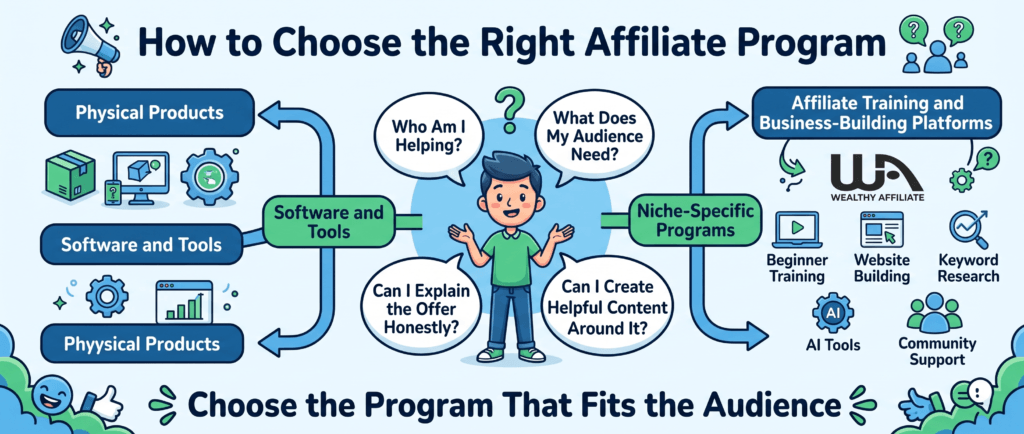
Start with these questions.
Who Am I Trying to Help?
Think about the people you want your website or content to serve.
What are they trying to learn, fix, compare, or buy?
A beginner gardening audience may need tools, supplies, and tutorials.
A new blogger may need website training, hosting, keyword research, and content tools.
A small-business audience may need software or professional services.
The program should connect naturally to the problems your audience already has.
What Kind of Content Can I Create?
Different affiliate programs work better with different types of content.
If you enjoy reviewing physical products, a retail program may make sense.
If you like teaching people how to use online tools, software programs may give you more opportunities for tutorials and comparisons.
If your website focuses on a specific hobby, smaller niche programs may fit better than large general marketplaces.
Choose a program that gives you useful things to talk about.
Can I Recommend the Offer Honestly?
You should be able to explain both the benefits and the limitations.
That does not mean every review needs to be negative.
It means readers should understand:
- Who the product is for
- Who may not need it
- What problem it solves
- What it costs
- What someone should consider before buying
A trustworthy recommendation helps the reader decide—even when the right decision is not to buy.
Does the Program Give Me Room to Grow?
Your first affiliate program does not have to be your last.
But it helps to choose opportunities that can grow with your content.
Look at whether the program gives you room to create:
- Beginner guides
- Tutorials
- Reviews
- Comparisons
- Alternatives
- Problem-solving content
- Updated resources
The more naturally the program fits your topic, the less likely you are to run out of useful things to say.
For a deeper guide focused entirely on evaluating audience fit, products, support, and long-term potential, read:
How to Choose the Right Affiliate Program
Quick Affiliate Program Checklist
Before joining, use this checklist.
| Question | Good Sign | Warning Sign |
|---|---|---|
| Does it fit my audience? | Readers already need the solution | You have to force the product into unrelated content |
| Can I explain the product? | The value and limitations are clear | You do not understand what you are promoting |
| Is the company transparent? | Clear pricing, terms, and support | Important information is difficult to find |
| Is the commission structure clear? | You understand how and when you earn | Payout rules are vague |
| Can I create useful content? | Reviews, tutorials, and comparisons fit naturally | Your only idea is to post the affiliate link |
| Is the customer journey simple? | The next step is easy to understand | Signup or checkout creates confusion |
| Would I recommend it without a commission? | You believe it may genuinely help the right person | The payout is your main reason for promoting it |
You do not need every answer to be perfect.
But if you see several warning signs before you even join, pay attention to them.
The right affiliate program should give you reasons to create better content—not reasons to hide what you are promoting.
Are Affiliate Programs Legit?
Yes. Affiliate marketing is a legitimate business model used by companies across retail, software, education, travel, finance, and many other industries.
But not every opportunity marketed to beginners is equally trustworthy.
A legitimate affiliate program should clearly explain:
- What you are promoting
- How referrals are tracked
- What actions qualify for commission
- How and when affiliates are paid
- What promotional methods are allowed
- What could cause a commission to be reversed
Be cautious when an opportunity relies heavily on:
- Guaranteed income claims
- Promises of fast or effortless money
- Pressure to act immediately
- Vague explanations of the actual product
- Large upfront payments with unclear value
- Earnings claims without context
- More focus on recruiting than helping real customers
I learned the importance of this the expensive way.
Before I found the approach I use now, I spent about $15,000 on an online business platform that relied heavily on upsells. That experience changed the way I evaluate affiliate opportunities.
Today, I look much more closely at what the customer receives, what the affiliate is expected to do, and whether the program is built around genuine value rather than pressure.
A legitimate affiliate program should be able to explain how the customer benefits—not just how the affiliate gets paid.
If you are concerned about misleading online opportunities, read:
Online Business Scams and Warnings
Do Affiliate Programs Really Pay?
Yes, legitimate affiliate programs do pay qualifying commissions according to their terms.
But that answer needs context.
Joining an affiliate program does not create income by itself.
A commission usually requires:
- A real audience
- Helpful content or another approved promotional method
- A relevant offer
- A tracked referral
- A qualifying action
- Compliance with the program’s terms
Beginners sometimes see an affiliate dashboard and imagine that the link itself creates the opportunity.
The link only tracks what happens.
The content, audience, and offer create the reason for someone to click.
An affiliate program cannot pay if the right people never find your content. If traffic is the part you are struggling with, read:
Traffic Generation Strategies: A Beginner-Friendly Guide to Growing Your Website
That is why I would be cautious with claims that beginners should expect to earn a specific amount in their first week or month.
There is no universal timeline.
Affiliate programs can pay you for results, but they do not create the audience, trust, or content that produces those results.
If you want a realistic look at the types of opportunities beginners may be able to build around, read:
7 Affiliate Programs Beginners Can Actually Make Money With
Where Wealthy Affiliate Fits Into This
Wealthy Affiliate is different from a traditional affiliate program because it can play two roles.
First, it is a platform where beginners can learn how to build an affiliate marketing business.
The platform includes training and tools related to:
- Niche selection
- Website building
- Keyword research
- SEO
- Content creation
- Traffic
- Affiliate marketing
Second, members who genuinely find the platform useful can choose to recommend Wealthy Affiliate through its affiliate program.
That is why I include it in my beginner affiliate program guides.
When I was starting, my biggest problem was not finding companies with affiliate links.
It was understanding how all the pieces worked together.
I needed to learn how to build a website, create content, attract the right visitors, and connect relevant recommendations to what readers were already looking for.
That is also why I do not recommend Wealthy Affiliate simply because it has an affiliate program.
I recommend it because the training-and-building side is what I needed first.
The most useful first affiliate opportunity may be the one that teaches you how to build the business behind the affiliate link.
If you want my complete experience, including what I like, what I would change, and who I believe the platform is best for, read:
Want to look inside before deciding?
You can create a free Starter account and explore the beginner training, website tools, keyword research, AI resources, and community for yourself.
Explore the Free Wealthy Affiliate Starter Membership
Common Mistakes Beginners Make When Choosing Affiliate Programs
Most beginners do not struggle because there are too few affiliate programs.
The problem is usually the opposite.
There are so many choices that it becomes easy to join programs before you know what your website is about, who you want to help, or what kind of content you want to create.
Here are the mistakes I would avoid.
Choosing the Highest Commission First
A large payout can make a program look like the obvious choice.
But a high commission does not tell you:
- Whether your audience needs the product
- How difficult the product is to explain
- Whether readers trust the company
- How long the buying decision takes
- Whether the offer actually converts
A lower-paying program that closely fits your audience can be more realistic than an expensive offer no one came to your website looking for.
High commissions create potential. Audience fit creates opportunity.
If you want to understand why some offers are easier for beginners to convert than others, read:
Why Some Affiliate Programs Convert Better for Beginners
Joining Too Many Programs
It is tempting to apply everywhere.
More programs can feel like more opportunities to make money.
In reality, every program gives you more terms to understand, products to research, links to manage, and content decisions to make.
Most beginners do not need ten affiliate programs.
One or two strong matches are enough to start learning what readers click and what type of content attracts the right audience.
Promoting Products You Do Not Understand
You do not need to be the world’s leading expert before mentioning a product.
But you should understand enough to explain what it does, who it may help, and where its limitations are.
If your entire recommendation comes from repeating the company’s sales page, the reader is not getting much additional value from you.
Google’s guidance for affiliate websites makes a similar distinction: participating in affiliate programs is not the problem; thin affiliate pages that add little original value are. Useful affiliate content can add value through original reviews, comparisons, testing, and additional information.
? Google Search Guidance on Affiliate Content
Ignoring the Program Terms
Affiliate programs can have rules about:
- Where links may be shared
- Whether paid advertising is allowed
- Email promotion
- Brand-name bidding
- Coupon promotion
- Incentives
- Product claims
- Required disclosures
Do not assume the rules are the same from one program to another.
Read the agreement before promoting the offer.
Forgetting the Reader
This may be the easiest mistake to make.
When you are focused on commissions, dashboards, clicks, and programs, it is easy to forget that a real person is on the other side of the link.
That person is usually trying to solve a problem or make a decision.
The affiliate link should support the answer—not become the reason the article exists.
How Many Affiliate Programs Should a Beginner Join?
For most beginners, I would start with one or two programs that closely fit the same audience.
That is enough to learn:
- What your readers need
- Which content attracts visitors
- Which recommendations get clicked
- How different offers fit into your website
- What you actually enjoy writing about
You can add more programs as your content grows.
For example, a beginner website about starting a blog might eventually recommend training, hosting, keyword research tools, email software, and design resources.
But those opportunities do not all need to be added on day one.
Start with the clearest connection between your audience and a useful solution.
Then grow from there.
A focused website with two relevant affiliate programs can be stronger than an unfocused website promoting twenty unrelated offers.
If your website is still new and you are concerned about getting accepted, read:
Affiliate Programs with Easy Approval for Beginners
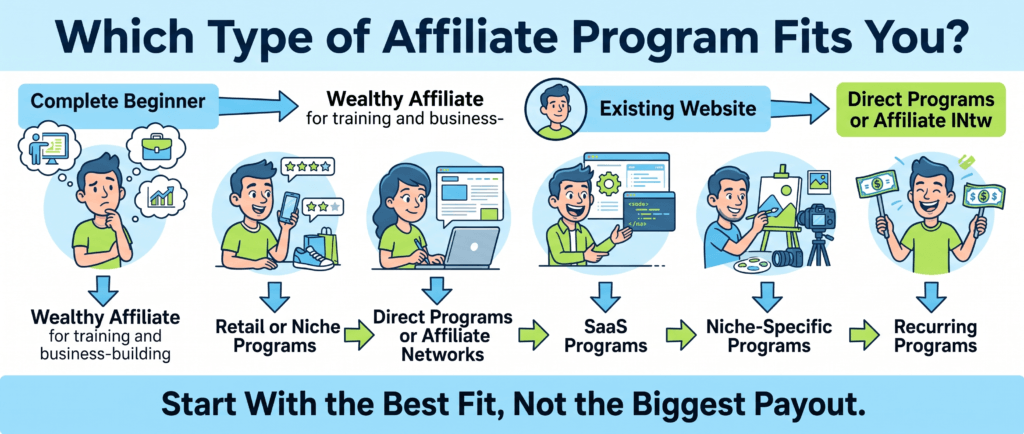
Quick Decision Guide: Which Type of Affiliate Program Fits You?
If you are still unsure where to start, use this quick guide.
You Are Completely New
You may need to learn how websites, content, traffic, and affiliate marketing work before joining multiple programs.
Best starting path: Learn while building with Wealthy Affiliate.
You Want to Review Physical Products
Choose a focused niche and create content around products readers already research and compare.
Consider: Retail affiliate programs or niche-specific product programs.
You Already Have a Website and Published Content
Look at the topics already attracting readers and find companies that naturally fit those needs.
Consider: Direct affiliate programs or affiliate networks.
You Create Software Tutorials
Look for tools you understand well enough to demonstrate, compare, and explain.
Consider: Software and SaaS affiliate programs.
You Teach a Specific Hobby or Skill
Your best opportunity may come from a smaller company that closely serves your audience.
Consider: Niche-specific programs or relevant educational products.
You Want Ongoing Commission Potential
Look at subscription products your audience may continue using.
Consider: Recurring affiliate programs—but remember that recurring income depends on customers remaining eligible or subscribed.
The right answer may change as your website grows.
Your first program does not need to be your final program.
Choose the opportunity that fits what you can help with now.
Affiliate Disclosures: What Beginners Need to Know
If you may earn money or receive another benefit from a recommendation, readers should be able to understand that relationship.
A disclosure should not be hidden where readers are unlikely to see it.
The Federal Trade Commission’s endorsement guidance explains that material connections between endorsers and marketers should be disclosed clearly, and endorsements should be honest and not misleading.
FTC Endorsement Guides for Affiliates and Creators
For beginners, the simplest approach is to be clear.
A disclosure might say:
This article contains affiliate links. If you make a purchase through one of these links, I may earn a commission at no additional cost to you.
A disclosure does not make a recommendation less trustworthy.
Trying to hide the relationship can.
Trust is not built by pretending an affiliate link is not an affiliate link. It is built by being clear about why you are recommending something.
You should also make sure your claims match what you can genuinely support.
Do not promise guaranteed income, guaranteed results, or benefits you cannot verify.
Want to Learn How Affiliate Programs Work While Building Your Own Website?
Understanding affiliate programs is easier when you can see how the pieces connect in a real business.
That was one of my biggest challenges when I started.
I could find definitions of affiliate links, commissions, SEO, and traffic. What I needed was help understanding how to use those pieces together.
Wealthy Affiliate gave me a place to learn while building my own website.
Beginners can explore:
- Step-by-step affiliate marketing training
- Website building and hosting
- Keyword research
- SEO education
- Content and AI tools
- Community support
It is not instant income, and it will not do the work for you.
But if you are starting from zero and want to learn how affiliate programs fit into a real website and content strategy, you can explore the Starter option before deciding whether it fits you.
Learn How Affiliate Marketing Works and Build Your First Website Free with Wealthy Affiliate
Frequently Asked Questions About Affiliate Programs
What is an affiliate program?
An affiliate program is a partnership where a company pays an affiliate for sending qualifying customers, leads, signups, or other tracked actions through a unique referral link.
How do affiliate programs track sales?
Affiliate programs usually use unique tracking links and other attribution technology to connect a referral with an affiliate account. The exact tracking window and attribution rules vary by program.
Do you have to pay to join an affiliate program?
Many legitimate affiliate programs are free to join. However, some platforms, networks, or business tools may have separate membership, application, or service costs. Always understand what you are paying for before joining.
Which affiliate program is best for beginners?
There is no single best program for everyone. Beginners should look for a program that fits their audience, is easy to understand, has clear terms, and gives them realistic opportunities to create helpful content.
How many affiliate programs should a beginner join?
Most beginners can start with one or two closely related programs. This makes it easier to learn what readers need and which recommendations fit before adding more partnerships.
Are affiliate programs legit?
Yes, affiliate marketing is a legitimate business model used by companies across many industries. However, beginners should still review program terms, company reputation, payment information, and promotional rules before joining.
How much do affiliate programs pay?
Payouts vary widely. Programs may use percentage-based commissions, fixed payments, recurring commissions, lead-based payments, or tiered structures. The highest payout is not always the easiest one to earn.
Continue Learning
Now that you understand how affiliate programs work, these guides can help you take the next step.
Find Programs You Can Realistically Join
Affiliate Programs with Easy Approval for Beginners
Improve What You Earn
How to Maximize Your Affiliate Earnings
For the complete collection of beginner program reviews, commission guides, and comparisons, return to:
Best Affiliate Programs for Beginners: Reviews, Commissions, and What Actually Pays
Final Thoughts
Affiliate programs are not complicated once you understand the basic relationship.
A company has a product or service.
You create helpful content for an audience.
A relevant recommendation connects the two.
The tracking system records what happens, and the program pays according to its terms.
The difficult part is not getting an affiliate link.
It is building the audience, content, trust, and relevance that give someone a reason to use it.
That is why I would not tell a beginner to start by searching for the highest-paying affiliate program.
Start with the people you want to help.
Understand what they need.
Create content that answers real questions.
Then choose programs that belong naturally in that process.
The right affiliate program does not give you something to push. It gives you a relevant solution to recommend when your reader actually needs it.
That is a much stronger foundation for long-term affiliate marketing than collecting links and hoping someone clicks.
Affiliate Disclosure
Some links on this page may be affiliate links. If you choose to sign up or purchase through them, I may earn a commission at no additional cost to you.
I only recommend products, services, and affiliate programs that I personally use, have researched extensively, or believe provide genuine value for beginners who want to build a sustainable online business.