
Written by Donna
Affiliate marketing researcher and founder of AffiliateEducationForBeginners.com
Affiliate commission structures determine how, when, and why you get paid.
That sounds simple until you start comparing programs.
One program may pay a percentage of every sale. Another may pay a fixed amount for a signup. Some offer recurring commissions, while others pay only once.
When I first started learning affiliate marketing, I paid too much attention to the commission percentage.
A higher number looked like a better opportunity.
I would see 40% or 50% and assume that had to be better than a program paying 5% or 10%.
But that is not how it always works.
A 50% commission on a product your audience does not want may earn nothing. A smaller commission on a product that closely matches what readers are already looking for may be far more realistic.
The product price, conversion rate, customer demand, refund policy, cookie duration, and audience fit can all affect what you actually earn.
A commission rate tells you how a program calculates a payout. It does not tell you how easy that commission will be to earn.
This guide will help you understand the most common affiliate commission models, how they work, what beginners should compare, and why the highest-paying offer is not always the most profitable one.
If the terms affiliate link, tracking, cookie duration, or attribution are still confusing, start here:
Affiliate Programs Explained: How They Work and How to Choose
If you understand the basics but are still trying to decide which type of program actually fits your audience, read:
How to Choose the Right Affiliate Program
This guide is also part of my complete beginner resource:
Best Affiliate Programs for Beginners: Reviews, Commissions, and What Actually Pays
Quick Answer: What Is an Affiliate Commission Structure?
An affiliate commission structure is simply the method a company uses to decide what you have to do to earn a commission and how much that commission is worth.
The most common models include:
- Pay-per-sale: You earn when someone makes a qualifying purchase.
- Pay-per-lead: You earn when someone completes a qualifying action, such as a signup or application.
- Fixed commission: You earn a set amount for each qualifying conversion.
- Percentage commission: You earn a percentage of the qualifying purchase.
- Recurring commission: You may continue earning while the referred customer remains eligible or subscribed.
- Tiered commission: Your payout may change based on sales, referrals, or other performance requirements.
Some programs use more than one model.
For example, a program might pay a percentage of a sale and offer a higher rate after an affiliate reaches a certain performance level.
The important question is not simply:
Which program pays the highest commission?
A better question is:
What has to happen before I get paid, how much is that action worth, and how realistic is it for my audience to complete it?
The best affiliate commission structure is the one that rewards an action your audience is genuinely likely to take.
If you want to see how different commission structures look across actual beginner opportunities, compare them here:
Top 10 Affiliate Programs for Beginners
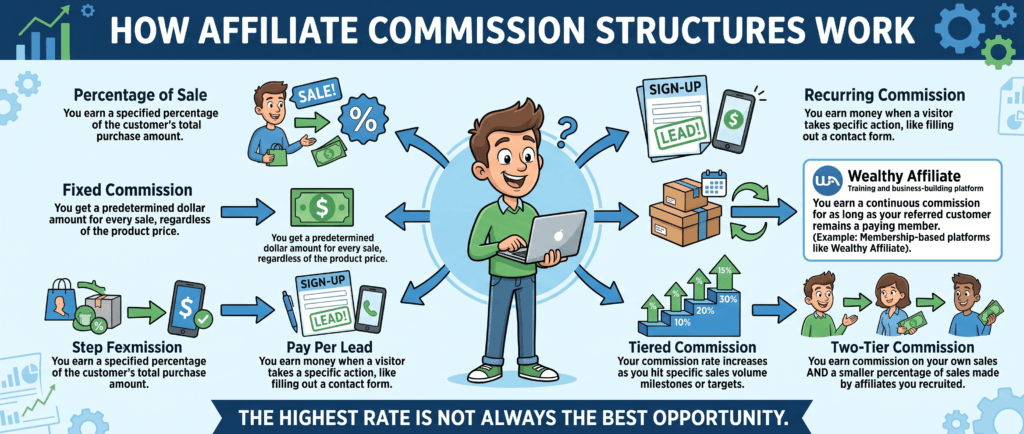
How Affiliate Commissions Actually Work
Here is the easiest way to think about it.
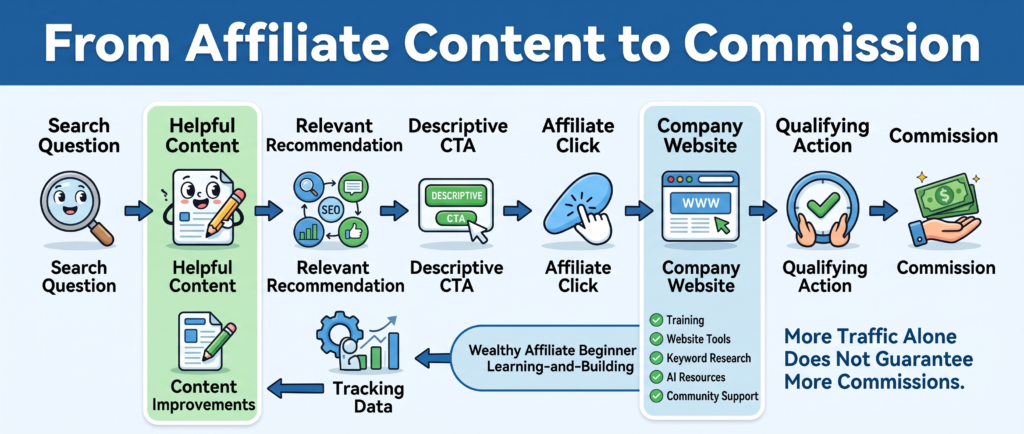
You recommend something using your unique affiliate link.
Someone clicks.
If that person completes the action required by the program, you may earn a commission.
The part that changes is what the program considers a qualifying action.
It might be:
- Buying a product
- Starting a subscription
- Completing an application
- Signing up for a free trial
- Becoming a qualified lead
- Completing another approved action
The company then uses its commission structure to calculate what you earn.
For example:
- A percentage-based program may pay you part of the qualifying sale.
- A fixed-rate program may pay the same amount for every approved referral.
- A recurring program may continue paying while the customer remains eligible under the program terms.
This is why two affiliate programs can promote similar products but create very different earning opportunities.
The product determines what you promote. The commission structure determines how the program rewards the result.
Before joining any affiliate program, I would want clear answers to four questions:
- What action earns a commission?
- How is the commission calculated?
- When does the commission become payable?
- What could cause the commission to be reversed?
If you cannot find clear answers, do not assume the program works the way you expect.
And if you are still comparing opportunities, remember that commission structure is only one part of the decision.
Why Some Affiliate Programs Convert Better for Beginners
Affiliate Commission Models Compared
Here is a simple comparison of the most common affiliate commission structures.
| Commission Model | How You Earn | Often Used For | What Beginners Should Know |
|---|---|---|---|
| Percentage of sale | Earn a percentage of a qualifying purchase | Retail, ecommerce, digital products | The product price affects the actual payout |
| Fixed commission | Earn a set amount per qualifying conversion | Services, software, subscriptions | Easy to calculate and compare |
| Pay-per-lead | Earn when a visitor completes an approved action | Services, education, finance, software | A purchase may not be required |
| Recurring commission | May continue earning while the customer remains eligible | Software, memberships, training platforms | Ongoing potential depends on customer retention and program terms |
| Tiered commission | Payout changes after reaching performance levels | Established affiliate programs | Often more useful as traffic and sales grow |
| Two-tier commission | May earn from direct referrals and qualifying activity from referred affiliates | Some partner and training programs | Rules vary widely and should be reviewed carefully |
No model is automatically best.
A fixed commission can outperform a high percentage if the offer converts more easily.
A one-time payout can be more valuable than a recurring commission if customers rarely remain subscribed.
A pay-per-lead program may be easier to convert because the visitor does not have to make an immediate purchase.
Commission models should be compared by the complete earning opportunity—not by the biggest number on the affiliate page.
If you want to see how commission structure works alongside approval requirements, audience fit, and beginner difficulty, read:
Affiliate Programs with Easy Approval for Beginners
The Main Affiliate Commission Models Explained
The comparison table gives you the quick version.
Now let’s look at what these commission models actually mean when you are choosing something to promote.
You do not need to memorize every affiliate marketing term.
You just need to understand what has to happen before you get paid.
Percentage-of-Sale Commissions
With a percentage-of-sale commission, you earn a percentage of the qualifying purchase.
For example, if a program pays 10%, your actual commission depends on how much the customer spends.
That means two sales through the same program can produce very different commissions.
This model is common with:
- Physical products
- Ecommerce stores
- Digital products
- Online courses
- Some software programs
Percentage-based commissions are easy to understand, but the percentage alone can be misleading.
A 10% commission on a higher-priced order may be worth more than a 50% commission on a very inexpensive product.
You also need to think about whether people are likely to buy the product in the first place.
A commission percentage means very little until you know what the customer is buying and how much the average purchase is worth.
This is one reason physical-product programs can still make sense even when the percentage looks lower.
Readers may already know the product, trust the company, and be close to making a buying decision.
If you want to see how this works with a well-known physical-product program, read:
Fixed Commissions
A fixed commission pays a set amount when a qualifying action happens.
Instead of earning a percentage of the purchase, you know the value of each approved conversion.
For example, a program might pay a fixed amount when someone:
- Buys a service
- Starts a qualifying subscription
- Opens an approved account
- Completes another required action
I like the simplicity of this model.
You do not have to calculate percentages or wonder how much the customer spent.
But a fixed payout still needs context.
A large commission may look impressive, but you still need to consider how difficult the action is, how much trust the decision requires, and whether the offer fits what your readers need.
The more valuable the action is to the company, the more work you may need to do to earn the reader’s trust. That is why higher-paying offers often need stronger reviews, comparisons, or tutorials.
If you are still learning how content can move a reader from a question toward a decision, read:
What Actually Converts for Beginners in Affiliate Marketing
Pay-Per-Lead Commissions
Pay-per-lead programs pay when someone completes a qualifying action without necessarily making an immediate purchase.
Depending on the program, that action might be:
- Requesting information
- Completing an application
- Starting a free trial
- Creating an account
- Booking a consultation
- Becoming a qualified lead
This can sometimes be easier than earning a sale because the reader may only need to try something free or request more information.
But a lead still has to meet the program’s requirements. Duplicate information, incomplete applications, or unqualified signups may not count.
Before promoting a pay-per-lead offer, check exactly what the company considers a qualifying lead.
A free action can be easier for a reader to take, but it still has to be the right action for the right audience.
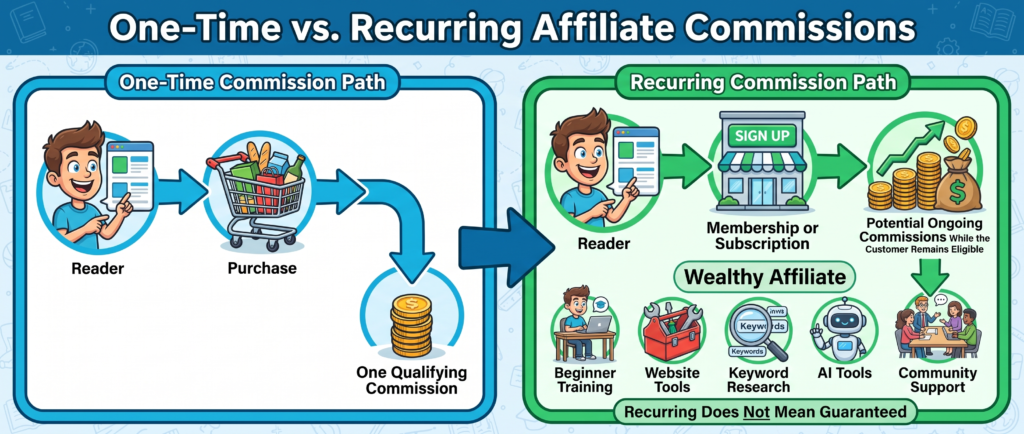
Recurring Commissions
Recurring commissions are one of the models beginners tend to get most excited about.
I understand why.
The idea that one referral could potentially create more than one commission is appealing.
With a recurring commission model, an affiliate may continue earning while the referred customer remains eligible under the program terms.
This model is common with:
- Software
- Memberships
- Online tools
- Hosting
- Training platforms
- Subscription services
But there is one important point beginners should understand:
Recurring does not mean permanent, passive, or guaranteed.
The customer may cancel.
The program may have specific eligibility rules.
Commission terms can change.
And if the product does not continue providing value, customers may not stay.
That is why I would look beyond the recurring percentage and ask:
- Is this something people actually keep using?
- Does the product provide ongoing value?
- Is the price reasonable for the audience?
- Does the company support its customers?
- Would I still recommend it if the commission were paid only once?
That last question matters.
A recurring commission should be a benefit of recommending a useful product—not the only reason you recommend it.
Tiered Commission Structures
Tiered commissions reward affiliates differently based on performance or another program requirement.
For example, a program may increase the commission rate after an affiliate reaches a certain number of qualifying sales.
This can become useful as your website grows, but I would not choose a program mainly because of a higher tier you have not reached yet.
Start with the commission you can realistically earn now and treat better rates as something to grow into.
A future commission tier is a bonus—not a reason to promote the wrong product today.
As your website begins attracting traffic and generating results, tracking what readers click becomes more important.
If you are still working on getting the right people to your content, read:
Traffic Generation Strategies: A Beginner-Friendly Guide to Growing Your Website
Two-Tier Affiliate Commissions
Two-tier programs work differently from standard affiliate commissions.
You may earn from your own qualifying referrals and, depending on the program, receive additional compensation connected to affiliates you refer.
The exact rules can vary significantly.
That is why I would read the terms carefully before assuming how a two-tier program works.
A legitimate two-tier affiliate structure is also not automatically the same as a pyramid scheme.
The key question is where the real value comes from.
Is the business built around useful products or services for real customers?
Or is the main focus simply recruiting more people into the system?
That distinction matters.
A legitimate affiliate opportunity should make sense even when you remove recruitment from the picture.
If you are unsure how to recognize misleading online income claims or recruitment-focused opportunities, read:
? Online Business Scams and Warnings
What Are Typical Affiliate Commission Rates?
This is one of the first questions beginners ask.
It is also one of the hardest to answer with one number.
There is no standard affiliate commission rate.
Rates can vary by:
- Company
- Product category
- Industry
- Customer value
- Commission model
- Affiliate performance
- Promotional method
- Program terms
Even one affiliate program can pay different rates for different products.
Amazon Associates is a good example. Its official commission schedule uses different rates depending on the qualifying product category rather than one percentage for everything.
Amazon Associates Standard Commission Income Rates
That is why I would be careful with broad claims such as:
Physical products pay 1%–10%.
or:
Digital products always pay 30%–50%.
Those ranges may appear in affiliate marketing articles, but they can quickly become outdated and do not tell you what a specific program will pay you.
A better approach is to check the current terms of the actual program you are considering.
Check the current rate, which products qualify, whether different categories pay differently, and what could cause a commission to change or be reversed.
There is no universal “good” affiliate commission rate. A good rate is one that creates a worthwhile opportunity after you consider the product, your audience, and how likely the offer is to convert.
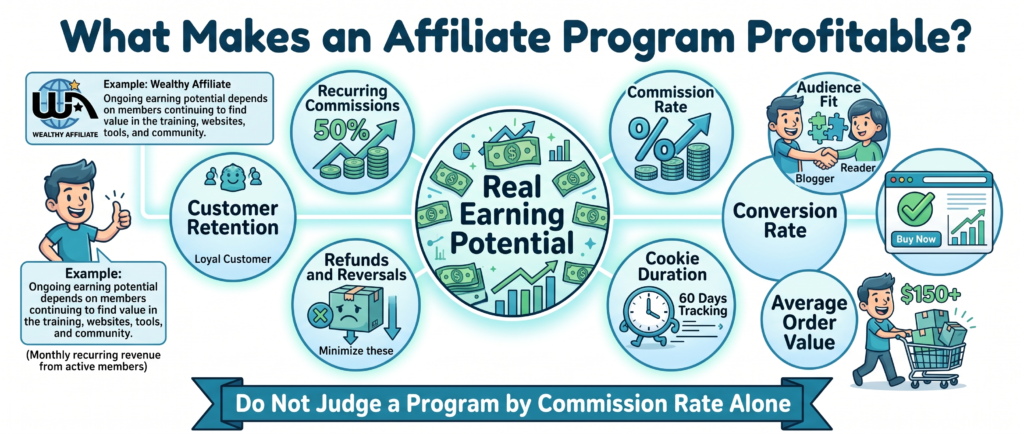
What Actually Makes an Affiliate Commission Structure Profitable?
When I evaluate an affiliate program, I would look at more than the payout.
These factors work together.
Audience Fit
Does your audience actually need what you are recommending?
This is the foundation.
A strong commission structure cannot fix an offer that does not belong in your content.
The closer the product fits the reader’s problem, the more natural the recommendation becomes.
Conversion Rate
Conversion rate is the percentage of visitors who complete the desired action.
If 100 people click an affiliate link and two complete the qualifying action, that would be a 2% conversion rate.
But I would not tell a beginner that one specific conversion rate is automatically “good.”
Conversion rates can vary based on:
- Traffic source
- Audience intent
- Product price
- Type of offer
- Brand trust
- Landing page
- Device
- Niche
Current industry data also shows why clicks should not be confused with conversions. Impact’s 2025 affiliate benchmark reported higher click activity alongside lower transactions and conversion rates, which is a useful reminder that more clicks do not automatically mean more sales.
Impact 2025 Affiliate Marketing Benchmark
That matters for your website too.
Getting someone to click is important.
Getting the right person to click is more important.
Cookie Duration and Attribution
A reader does not always buy immediately after clicking.
Some programs give you a longer tracking window. Others use a much shorter one.
But a longer cookie duration is not automatically better if the offer is a poor fit.
You also need to understand the program’s attribution rules.
For a real example, Amazon Associates explains that its standard shopping window is generally 24 hours after a shopper arrives through an Associates link, subject to the program’s rules and qualifying conditions.
Amazon Associates 24-Hour Shopping Window
The point is not that 24 hours is good or bad.
The point is that every program can define tracking differently.
Read the terms before assuming you will receive credit.
Refunds, Cancellations, and Reversals
A commission appearing in a dashboard does not always mean the money is ready to be paid.
A customer may:
- Return a product
- Cancel a subscription
- Request a refund
- Fail to meet the program’s qualifying conditions
Programs may reverse commissions under their terms.
That is why I would look at approved and paid commissions, not just the first number that appears in a dashboard.
Payment Schedule and Threshold
You also need to know when you can actually receive your earnings.
Some programs pay monthly.
Others delay payment until refund periods have passed or require your balance to reach a minimum threshold.
Amazon Associates, for example, states that commission income is generally paid approximately 60 days after the end of the month in which it was earned, subject to its payment requirements.
Amazon Associates Payment Schedule
This is a good example of why “I earned a commission” and “I received the money” may happen at different times.
Customer Retention
This matters most with recurring commissions.
If customers stay, the affiliate may continue earning under the program terms.
If customers leave quickly, the recurring percentage may not be as valuable as it first appeared.
Recurring commission potential depends on recurring customer value.
That is why the quality of the product matters just as much as the payout structure.
A Simple Way to Compare Two Affiliate Programs
You do not need a complicated spreadsheet to compare affiliate programs.
Let’s say you are choosing between two different opportunities.
Program A offers a higher one-time commission but requires the reader to make a larger purchase.
Program B offers a smaller recurring commission for a service the reader may continue using.
Here is how I would compare them:
| Question | Program A: Higher One-Time Payout | Program B: Smaller Recurring Payout |
|---|---|---|
| Does it fit my audience? | Yes, but mainly readers ready for a larger purchase | Yes, especially readers who need ongoing help |
| What action earns a commission? | A qualifying purchase | A qualifying membership or subscription |
| How is the payout calculated? | One larger commission | Smaller potential ongoing commissions |
| How difficult is the action? | Higher commitment from the customer | Lower initial commitment, but ongoing value matters |
| Can I create useful content around it? | Yes, through reviews and comparisons | Yes, through tutorials and ongoing education |
| Would I recommend it without the commission? | This should be yes | This should also be yes |
Neither program automatically wins.
Program A may earn more from a single conversion, while Program B may create more long-term potential if customers continue finding value in the service. The better choice depends on your audience, what they need, and how realistic the required action is for them.
Instead of asking only which program pays more, ask which one gives your reader the clearest reason to take the next step.
That is something I keep coming back to with my own website. If the only reason I am interested in a product is the affiliate payout, it is probably not the right fit for my readers.
The best commission structure cannot rescue a recommendation you do not believe in.
This also matters when creating affiliate content. Google makes an important distinction between adding affiliate links to genuinely useful content and simply repeating information already available from the merchant.
Helpful affiliate content should give the reader something more. That might be your own experience, a clearer explanation, an honest comparison, additional research, or help making a decision.
Google Guidance on Affiliate Programs and Added Value
This is especially important when creating reviews and comparisons, where readers are often looking for more than a list of product features.
If you are still learning how to create useful content that naturally leads to affiliate recommendations, read:
? Content Marketing Strategies for Affiliate Success
A Beginner-Friendly Way to Learn What Converts
Understanding commission structures is one thing. Learning how content, traffic, affiliate links, and commissions work together is another.
That was the harder part for me when I started.
I did not just need a list of affiliate programs or an explanation of how much they paid. I needed to understand how to build a website, find topics people were searching for, create useful content, and connect the right readers with relevant offers.
That is what I found helpful about Wealthy Affiliate.
Instead of trying to piece everything together from different places, I could learn while building my own website. The training, website tools, keyword research, content resources, and community gave me a structure to follow while I figured out how the different parts of affiliate marketing worked together.
It did not make affiliate marketing automatic. I still had to write, learn SEO, make mistakes, update content, and pay attention to what my readers responded to.
But I was learning by actually building something of my own.
Understanding a commission structure tells you how you could get paid. Learning how to build the business around it gives you a better chance of earning the commission.
If you want to explore the platform before deciding whether it fits you, you can start free and see how the beginner training, website tools, research resources, and community work together.
Start Building Your Affiliate Website Free with Wealthy Affiliate
Quick Decision Guide: Which Commission Model Fits Your Content?
If you are still unsure which commission structure makes the most sense, start with the type of content you can realistically create.
You Write Product Reviews and Buying Guides
Your readers may already be comparing products or preparing to buy.
Look at: Percentage-of-sale or fixed-commission programs.
You Help Readers Find Services or Apply for Something
The reader may need information before making a larger decision.
Look at: Pay-per-lead or fixed-action programs.
You Teach Software or Online Tools
Tutorials, comparisons, and problem-solving content can naturally support products people use over time.
Look at: Recurring or subscription-based programs.
You Have Growing Traffic and Consistent Sales
Performance-based increases may become more relevant as your results grow.
Look at: Tiered commission programs.
You Are Completely New
Do not choose a program only because the commission looks attractive.
Start by learning how content, traffic, audience fit, and affiliate offers work together.
A practical starting path: Learn while building a real affiliate website.
If you want to see the beginner platform I use:
See How Wealthy Affiliate Helps Beginners Build Before They Promote
Your first commission structure does not have to be your last.
As your website grows, you may discover that a different model fits your audience better.
Choose the commission structure that fits the content you can create now—not the income you hope to have later.
What to Check Before Joining an Affiliate Program
Before applying, I would look for clear answers to these questions:
- What exact action earns a commission?
- How is the payout calculated?
- How long is the tracking window?
- Can commissions be reversed?
- When and how will I be paid?
- Are there promotional restrictions?
- Does the product genuinely fit my audience?
You do not need the program with the longest cookie, highest percentage, or biggest advertised payout.
You need a program where the complete opportunity makes sense.
A good commission structure should be easy to understand, easy to verify, and connected to a product your audience actually needs.
How to Estimate the Value of an Affiliate Opportunity
You do not need advanced math to compare affiliate programs.
But it helps to look beyond the advertised commission.
Here is a simple example.
Imagine two programs each receive 100 relevant affiliate clicks.
Program A
- 100 clicks
- 2 qualifying sales
- $50 commission per sale
Estimated commission result: $100
Program B
- 100 clicks
- 5 qualifying sales
- $25 commission per sale
Estimated commission result: $125
Program A pays twice as much per conversion.
Program B still produces the larger result in this example because more readers complete the qualifying action.
The value of an affiliate opportunity depends on both the payout and how often the qualifying action actually happens.
A simple way to think about it is:
Relevant Clicks × Conversion Rate × Commission Value = Estimated Commission Potential
You do not need to predict these numbers perfectly before joining a program.
You probably cannot.
But once you have real traffic and click data, you can stop relying entirely on guesses.
Key Takeaways
- A higher commission rate does not automatically mean a better opportunity.
- Percentage, fixed, lead-based, recurring, and tiered commissions can all work for beginners.
- Audience fit and conversion potential matter as much as the advertised payout.
- Tracking rules, refunds, payment schedules, and customer retention can affect what you actually receive.
- The best commission structure is connected to a product you can recommend honestly to an audience that genuinely needs it.
Do not choose an affiliate program by asking only, “How much does it pay?”
Ask:
What has to happen before I get paid, and how realistic is that action for my audience?
Frequently Asked Questions About Affiliate Commission Structures
What is an affiliate commission structure?
An affiliate commission structure is the method a company uses to determine what action earns a commission and how the payout is calculated. Common models include percentage-of-sale, fixed commission, pay-per-lead, recurring commission, and tiered commission structures.
What is the best affiliate commission structure for beginners?
There is no single best model for every beginner. The right structure depends on your audience, the type of content you create, and how realistic it is for readers to complete the action required for you to earn a commission.
Are recurring commissions better than one-time commissions?
Not always. Recurring commissions can create ongoing earning potential while a customer remains eligible, but one-time commissions may be more valuable if they offer a larger payout or the product converts more easily.
What is a good affiliate commission rate?
There is no universal good commission rate. A lower rate on a product that fits your audience and converts well may be more profitable than a high rate on an expensive or difficult-to-sell offer.
Can affiliate commissions be reversed?
Yes. Depending on the program terms, commissions may be reversed because of refunds, cancellations, returned products, invalid leads, or other actions that no longer meet the program’s qualifying requirements.
How long does it take to receive an affiliate commission?
Payment schedules vary by program. Some programs pay monthly, while others delay payment until refund or cancellation periods have passed. Some also require affiliates to reach a minimum payout threshold.
Should beginners join programs with the highest commissions?
Not automatically. Beginners should also consider audience fit, product demand, conversion difficulty, company reputation, tracking rules, payment terms, and whether they can create genuinely useful content around the offer.
Continue Learning
Now that you understand how affiliate commission structures work, these guides can help with questions that were not covered elsewhere in this article.
Improve the Results From the Programs You Already Promote
How to Maximize Your Affiliate Earnings
Compare Two Different Beginner Business Models
Wealthy Affiliate vs. ClickBank: Which Is Better for Beginners?
Compare a Training Platform With an Ecommerce Platform
Wealthy Affiliate vs. Shopify: Which Is Better for Beginners?
These links give you three different next steps: improve what you are already doing, compare affiliate-focused business models, or explore how affiliate marketing differs from building an ecommerce store.
Final Thoughts
When I first started learning affiliate marketing, I thought the commission rate was one of the most important numbers to compare.
Now I know it is only one piece of the picture.
A program can offer a large payout and still be a poor fit for your audience. Another can offer a smaller commission but connect naturally to the questions your readers are already asking.
Before joining a program, make sure you understand what has to happen before you get paid, then ask whether you can honestly help the right reader take that action.
The best affiliate commission structure is not the one with the biggest number. It is the one connected to a recommendation that makes sense for your audience and your business.
Affiliate Disclosure
Some links on this page may be affiliate links. If you choose to sign up or make a purchase through them, I may earn a commission at no additional cost to you.
I only recommend products, services, and platforms that I personally use, have researched, or believe may provide genuine value for beginners building an online business.