Written by Donna
Affiliate marketing researcher and founder of AffiliateEducationForBeginners.com
Last updated: June 2026
Reviewed for beginner-friendly accuracy: June 2026
Quick Answer: How Do Beginners Get Approved for Affiliate Programs?
Getting approved for affiliate programs is easier than many beginners think. While some affiliate programs review applications manually, most are looking for signs that you’re building a genuine website with helpful content, a clear niche, and a commitment to serving your audience.
You don’t need thousands of monthly visitors to get approved. In many cases, affiliate managers are far more interested in the quality of your website than the amount of traffic it receives.
This Guide Will Help You
By the end of this guide, you’ll understand how affiliate program approvals work and what you can do to improve your chances of getting accepted.
You’ll learn how to:
- Understand what affiliate managers evaluate
- Avoid common application mistakes
- Build a website that inspires confidence
- Know when you’re ready to apply
- Discover beginner-friendly affiliate programs
- Build a stronger foundation for long-term affiliate marketing success
This guide is part of my Best Affiliate Programs for Beginners learning series.
? Best Affiliate Programs for Beginners: Reviews, Commissions, and What Actually Pays
If you’re completely new to affiliate marketing, I recommend starting here first:
? Affiliate Marketing Basics Guide
Why Getting Approved Isn’t as Difficult as Most Beginners Think
When I first started researching affiliate marketing, I assumed getting approved for affiliate programs would be one of the biggest obstacles.
I imagined affiliate managers carefully reviewing websites, checking traffic numbers, and rejecting anyone who didn’t already have an established online business.
What surprised me was discovering that many beginner-friendly affiliate programs aren’t looking for perfection.
They’re looking for potential.
As I continued researching affiliate networks, software companies, training platforms, and product-based affiliate programs, I noticed a consistent pattern.
Over the years, I’ve evaluated dozens of affiliate programs, training platforms, and affiliate networks while building Affiliate Education for Beginners. Although every company has different approval standards, the principles behind successful applications remain remarkably consistent.
The programs that welcomed beginners weren’t necessarily looking for the biggest websites. They wanted to see evidence that someone was genuinely trying to build a helpful resource rather than creating a website filled with affiliate links and unrealistic income claims.
That realization completely changed how I approached affiliate marketing.
Instead of worrying about getting approved as quickly as possible, I focused on building a better website.
I concentrated on creating helpful content, learning SEO, improving my site’s credibility, and understanding how affiliate marketing actually works.
Ironically, that approach also made the approval process much less intimidating.
One lesson I’ve learned from researching affiliate programs is that building a trustworthy website often matters far more than chasing quick approvals.
Affiliate program approval isn’t about proving you’re already successful—it’s about demonstrating that you’re building something worth trusting.
What Affiliate Managers Really Look For
One of the biggest misconceptions about affiliate marketing is that approval depends almost entirely on website traffic.
In reality, most affiliate managers evaluate much more than visitor numbers.
Their goal is to protect their brand by partnering with websites that provide value, build trust, and represent their products professionally.
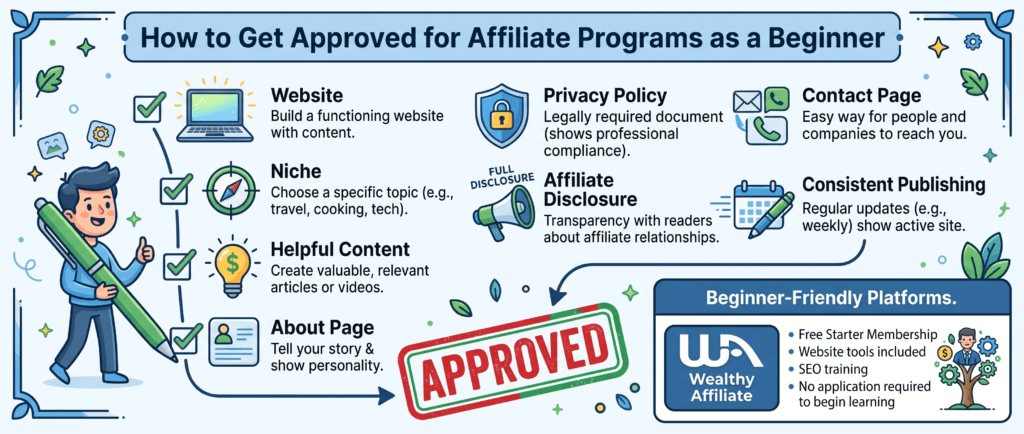
Although every affiliate program has its own requirements, most approval teams look for similar indicators of quality.
These often include:
- A clearly defined niche
- Helpful, original content
- Professional website design
- An About page
- A Contact page
- A Privacy Policy
- An Affiliate Disclosure
- Easy website navigation
- Signs that you’re actively publishing content
A website demonstrating expertise, transparency, and consistency is often much more appealing than one with higher traffic but very little value for readers.
The same principle works in reverse.
Before joining any affiliate program, you should also evaluate whether you would trust that company to represent your website and your audience.
? Top Red Flags in Affiliate Programs: What to Avoid (and What to Look For)
If you’re still comparing opportunities, these beginner-friendly guides can help you make a more informed decision:
? Affiliate Programs Explained: How They Work and How to Choose
? Why Some Affiliate Programs Convert Better Than Others
Why Some Affiliate Programs Convert Better Than Others
Affiliate managers aren’t simply approving websites—they’re evaluating whether they would trust you to represent their brand.
What Affiliate Managers Evaluate
Although every affiliate program has its own approval process, most affiliate managers review similar factors before accepting new affiliates.
| What They Look For | Why It Matters |
|---|---|
| Helpful, original content | Demonstrates you’re creating value for readers rather than simply promoting products. |
| Clear niche | Shows your website has a defined purpose and audience. |
| About page | Builds credibility and helps establish trust. |
| Contact page | Shows your website is legitimate and accessible. |
| Privacy Policy & Affiliate Disclosure | Demonstrates professionalism and transparency. |
| Consistent publishing | Indicates you’re committed to growing your website over time. |
| Mobile-friendly website | Improves user experience across devices. |
| Easy navigation | Makes it easier for visitors and affiliate managers to explore your content. |
Most of these factors are completely within your control, which is encouraging for beginners.
You don’t need years of experience to improve your website—you simply need a willingness to keep learning and creating helpful content.
Why Affiliate Applications Get Rejected
One of the most encouraging things I discovered while researching affiliate programs is that most rejected applications have very little to do with a person’s experience.
More often, the website simply isn’t ready yet.
Affiliate managers aren’t expecting every beginner to have a polished authority website with thousands of monthly visitors. What they do expect is evidence that you’re serious about building a helpful online resource.
Unfortunately, many beginners apply before they’ve established that foundation.
Some of the most common reasons affiliate applications are rejected include:
- Too little original content
- Thin or low-value articles
- No clearly defined niche
- Missing About or Contact pages
- No Privacy Policy or Affiliate Disclosure
- Poor website navigation
- Websites that appear unfinished
- Applying before consistently publishing content
The good news is that every one of these issues can be improved.
Unlike traffic or search rankings—which take time to build—most trust signals can be added to your website within a few days.
That means a rejected application isn’t necessarily a reflection of your potential. It’s often a reminder that your website needs a little more work before it’s ready to represent another company’s products.
Most affiliate application rejections happen because websites aren’t finished—not because beginners aren’t capable of succeeding.—not because beginners lack experience.
Common Reasons Affiliate Applications Are Rejected
| Common Reason | How to Improve |
|---|---|
| Too little content | Publish 10–15 helpful articles before applying. |
| No clear niche | Focus on one primary topic or audience. |
| Missing legal pages | Add a Privacy Policy, Affiliate Disclosure, and Contact page. |
| Poor website design | Improve navigation and make your site mobile friendly. |
| Thin or low-quality content | Write original articles that answer real questions. |
| Applying too early | Continue building your website before submitting applications. |
Many of these improvements benefit your readers as much as they benefit your affiliate applications.
A well-organized, trustworthy website creates a better experience for everyone—including Google, affiliate managers, and your future audience.
How to Improve Your Chances of Getting Approved
Rather than rushing to submit applications, I recommend spending a little extra time strengthening your website first.
The stronger your foundation becomes, the easier affiliate approvals tend to be.
Before applying, ask yourself a few simple questions.
Does my website clearly explain who it’s helping?
Have I published enough content to demonstrate expertise?
Would I personally trust this website if I were visiting it for the first time?
If you’re unsure about any of those answers, that’s usually where your attention should go next.
A few additional weeks spent improving your website can often make a significant difference—not only in affiliate approvals but also in building long-term trust with your readers.
One thing I remind myself is that affiliate managers are evaluating my website for the same reasons visitors do.
They want to see that I’m providing genuine value.
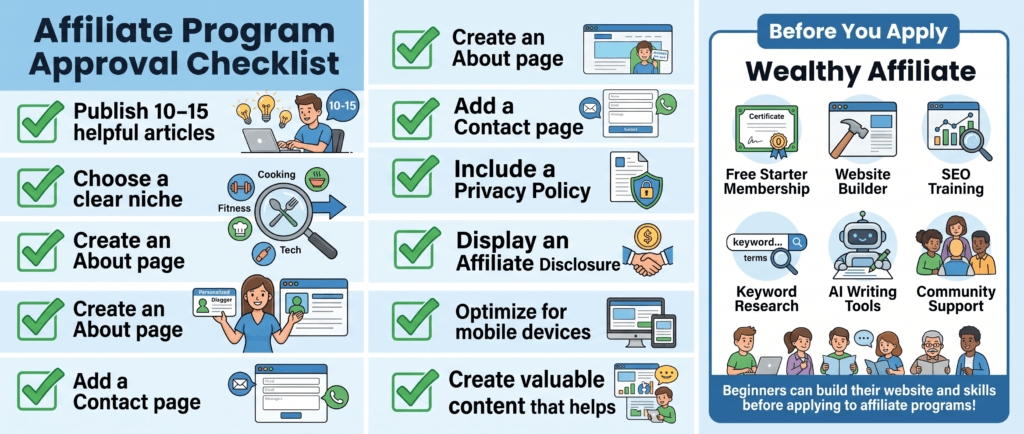
Before You Apply
Use this checklist before submitting your first affiliate application.
✔ Publish at least 10–15 helpful articles
✔ Choose a clear niche
✔ Create an About page
✔ Add a Contact page
✔ Include a Privacy Policy
✔ Display an Affiliate Disclosure
✔ Make your website mobile friendly
✔ Organize your navigation
✔ Focus every article on solving real problems
Completing these simple steps won’t guarantee approval, but they dramatically improve the impression your website makes.
The strongest affiliate applications begin long before you click the “Apply” button—they begin by building a website that genuinely helps people.
One Step That Makes Everything Easier
Looking back, I think many beginners—including myself—approach affiliate marketing in the wrong order.
We worry about joining affiliate programs before we’ve built a website that’s ready for them.
Once I shifted my attention toward creating helpful content, improving my website, and learning SEO, the approval process became much less intimidating.
Instead of asking, “Will this affiliate program accept me?”
I started asking,
“Would I approve this website if I were managing the affiliate program?”
That simple mindset shift changed everything.
When you focus on building a trustworthy resource first, affiliate approvals become a natural part of your progress rather than the primary goal.
Beginner-Friendly Affiliate Programs That Are Easier to Join
Once you understand what affiliate managers are looking for, the next question becomes:
Which affiliate programs should you apply to first?
The answer depends on your experience, your website, and your long-term goals.
Some affiliate programs are designed with beginners in mind. Others expect an established website, consistent traffic, or experience promoting products within a specific niche.
That doesn’t mean beginners can’t join those programs—it simply means your first affiliate applications should match where you are in your journey.
One mistake I see new affiliate marketers make is applying to every affiliate program they can find.
A better strategy is to start with programs that allow you to learn, build confidence, and develop your website while you continue improving your content.
For many beginners, that means choosing platforms that combine education, website tools, and practical marketing skills rather than focusing only on commissions.
One example is Wealthy Affiliate.
Instead of expecting you to arrive with a completed website, it gives you the opportunity to build one while learning affiliate marketing, SEO, keyword research, AI writing tools, and content creation. The Free Starter Membership also lets you explore the platform before deciding whether it’s the right fit for your goals.
If you’re still comparing opportunities, these guides may also help:
? Affiliate Programs Explained: How They Work and How to Choose
Beginner-Friendly Affiliate Program Comparison
Not every affiliate program has the same approval process.
Some approve almost immediately, while others manually review every application.
Understanding those differences helps you decide where to begin.
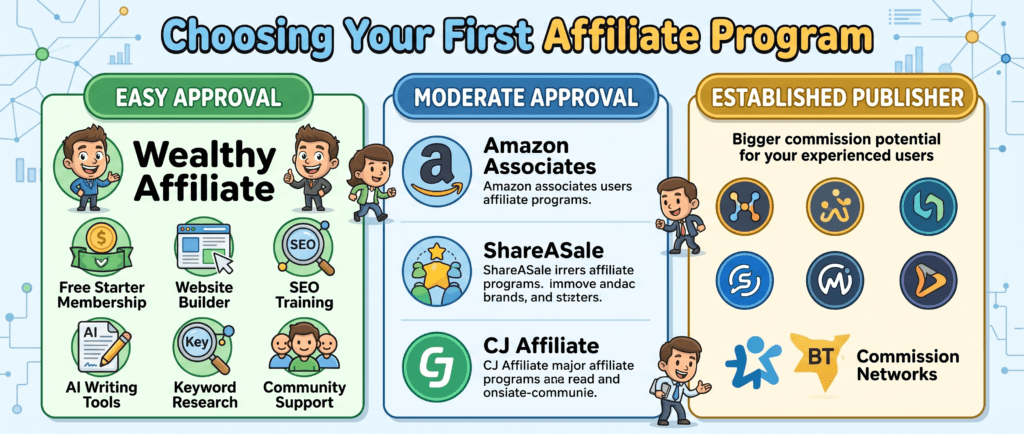
| Program | Approval Difficulty | Free to Start | Best For |
|---|---|---|---|
| Wealthy Affiliate | ⭐ Easy | ✅ Yes | Learning affiliate marketing and building a website |
| Commission Academy | ⭐ Easy | ✅ Yes | Exploring affiliate marketing basics |
| Amazon Associates | ⭐⭐ Moderate | ✅ Yes | Product-focused websites with original content |
| ShareASale | ⭐⭐ Moderate | ✅ Yes | Access to hundreds of affiliate merchants |
| CJ Affiliate | ⭐⭐⭐ Moderate | ✅ Yes | More established niche websites |
The easiest affiliate programs to join aren’t always the best long-term choice. The best programs help you develop skills that open the door to better affiliate partnerships as your website grows.
The strongest affiliate marketers don’t chase easy approvals. They build websites that naturally qualify for better opportunities over time.
Do You Need Website Traffic to Get Approved?
One of the biggest misconceptions about affiliate marketing is that you need thousands of monthly visitors before any affiliate program will approve your application.
Fortunately, that’s rarely true.
Many affiliate managers understand that every successful website begins with zero visitors.
What they’re looking for isn’t a large audience—it’s evidence that you’re building a helpful resource people can trust.
A smaller website with original, well-organized content often makes a stronger impression than a larger website filled with generic articles or excessive advertising.
This is another reason I encourage beginners to focus on creating helpful content before worrying about traffic numbers.
Traffic grows over time.
Trust starts immediately.
Website traffic helps affiliate marketing succeed, but trust is often what gets your application approved.
The official Amazon Associates Program also emphasizes the importance of original content and providing value to visitors before participating in its affiliate program.
? Amazon Associates Program Operating Agreement
Building Your Website First Makes Everything Easier
When I look back at my own journey, I realize I spent far too much time wondering whether I was ready to apply.
The better question would have been:
“Is my website ready to represent another company’s products?”
Once I started asking that question, my priorities changed.
Instead of worrying about applications, I focused on creating articles that answered real questions, improving my website, and learning the skills needed to build a sustainable online business.
Ironically, those improvements also made affiliate approvals much easier.
A professional website doesn’t just increase your chances of being accepted into affiliate programs.
It also creates a better experience for your readers, improves your SEO, and builds trust long before someone clicks an affiliate link.
Google’s Search Central documentation also recommends creating helpful, people-first content designed to genuinely serve your audience rather than publishing pages primarily for search rankings.
? Google Search Central — Helpful, Reliable, People-First Content
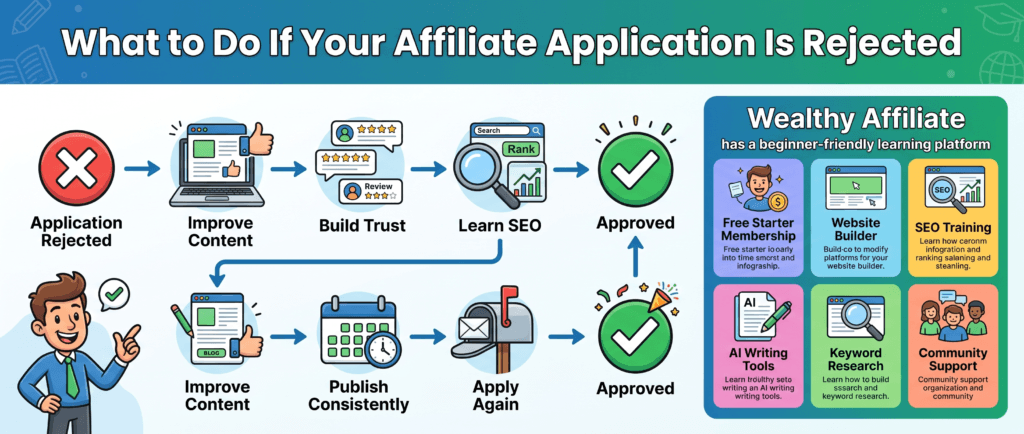
What If Your Affiliate Application Gets Rejected?
Receiving a rejection can feel discouraging, especially if you’ve spent weeks building your website.
The important thing to remember is that a rejection doesn’t mean you’ve failed—it usually means your website isn’t quite ready yet.
Many affiliate programs manually review applications, and every company has its own approval standards. Some focus heavily on website quality, while others pay closer attention to niche relevance or the overall professionalism of your site.
If your application isn’t approved, resist the temptation to submit dozens of new applications immediately.
Instead, use it as an opportunity to strengthen your website.
I recommend focusing on:
- Publishing additional helpful content
- Improving your About and Contact pages
- Making navigation easier for visitors
- Strengthening your niche authority
- Publishing consistently
- Reviewing your Privacy Policy and Affiliate Disclosure
Most affiliate managers are looking for progress.
A website that continues improving is often much more attractive than one that was rushed online simply to join affiliate programs.
A rejected affiliate application isn’t the end of your journey—it’s often the beginning of building a stronger website.
If you’re researching affiliate programs, it’s also worth reviewing consumer guidance on evaluating online business opportunities and recognizing misleading income claims.
? Federal Trade Commission Consumer Advice
Why I Recommend Building Before Applying
Looking back, one of the biggest lessons I learned was that I had my priorities backwards.
I thought getting approved for affiliate programs was the first step.
In reality, building a helpful website came first.
Once I focused on learning SEO, publishing consistent content, improving my website, and understanding my audience, affiliate applications became much less intimidating.
I wasn’t trying to convince affiliate managers to take a chance on me anymore.
I was demonstrating that I was building a website worth partnering with.
That’s one of the reasons I continue recommending Wealthy Affiliate to beginners.
Rather than encouraging you to collect affiliate links immediately, it helps you develop the skills, website, confidence, and long-term strategy that naturally lead to stronger affiliate applications.
Being able to start with a Free Starter Membership also gives beginners an opportunity to explore the platform before deciding whether it’s the right fit.
That approach reflects one of the principles I follow throughout this website:
Learn first. Build second. Monetize third.
Quick Decision Guide
If you’re completely new to affiliate marketing:
Focus on learning, building your website, and publishing helpful content before worrying about affiliate approvals.
If your website is already established:
Review your legal pages, improve your content, and apply to affiliate programs that match your niche and audience.
If you’ve already been rejected:
Continue improving your website, publish additional helpful articles, and apply again once you’ve strengthened your content and overall user experience.
Building trust first often leads to better affiliate opportunities later.
Frequently Asked Questions
Do affiliate programs require website traffic?
Not always. Many affiliate programs approve beginners with little or no traffic if their website demonstrates quality content, professionalism, and a genuine commitment to helping readers.
How many articles should I publish before applying?
Although every affiliate program is different, publishing at least 10–15 helpful articles gives affiliate managers a much better understanding of your website and demonstrates consistency.
Can I join affiliate programs without a website?
Some affiliate programs allow applications from YouTube creators, social media influencers, or email marketers. However, owning your own website gives you greater control over your business and access to a much wider range of affiliate opportunities.
What is the easiest affiliate program for beginners?
Beginner-friendly platforms such as Wealthy Affiliate and Commission Academy provide excellent starting points because they allow beginners to learn affiliate marketing while building their websites.
Why do affiliate applications get rejected?
The most common reasons include too little content, missing legal pages, unclear niche focus, poor website organization, or applying before the website is fully developed.
Should I apply to several affiliate programs at once?htm
It’s usually better to build a strong website first and then apply to affiliate programs that genuinely fit your niche rather than submitting dozens of applications at the same time.
Continue Learning
Build Your Affiliate Marketing Foundation
? Affiliate Marketing Basics Guide
? Affiliate Programs Explained: How They Work and How to Choose
? How to Choose the Right Affiliate Program
Related Affiliate Program Guides
? Affiliate Programs with Easy Approval for Beginners (Coming Soon)
? Affiliate Programs That Actually Convert for Beginners (Coming Soon)
? Recurring Affiliate Programs That Build Monthly Income (Coming Soon)
Before You Submit Your First Affiliate Application
Before clicking the Apply button, make sure your website includes:
✔ 10–15 helpful, original articles
✔ A clearly defined niche
✔ An About page
✔ A Contact page
✔ A Privacy Policy
✔ An Affiliate Disclosure
✔ Mobile-friendly design
✔ Clear website navigation
✔ Helpful content that solves real problems
Final Thoughts
Getting approved for affiliate programs isn’t about having the biggest website or the most traffic.
It’s about demonstrating that you’re building a trustworthy resource designed to help real people.
The affiliate marketers who experience long-term success aren’t necessarily the ones who join the most programs.
They’re the ones who build websites that readers trust and affiliate managers are proud to partner with.
The best affiliate marketers don’t build websites to get approved—they build websites that affiliate programs want to approve.
If you’re ready to learn affiliate marketing, build your website, and develop the skills that make affiliate approvals easier, I recommend exploring Wealthy Affiliate through its Free Starter Membership.
Affiliate Disclosure
Some links on this page may be affiliate links. If you choose to sign up or purchase through them, I may earn a commission at no additional cost to you.
I only recommend products, services, and platforms that I personally use, trust, or believe provide genuine value for beginners. My goal is to help you build an online business through education, transparency, and long-term success rather than unrealistic promises.