Written by Donna
Affiliate marketing researcher and founder of AffiliateEducationForBeginners.com
Quick Answer: Why Do Some Affiliate Programs Convert Better?
Some affiliate programs convert better for beginners because the product matches what the audience already needs, the offer is easy to understand, the company is trustworthy, and the buying decision does not require a long explanation.
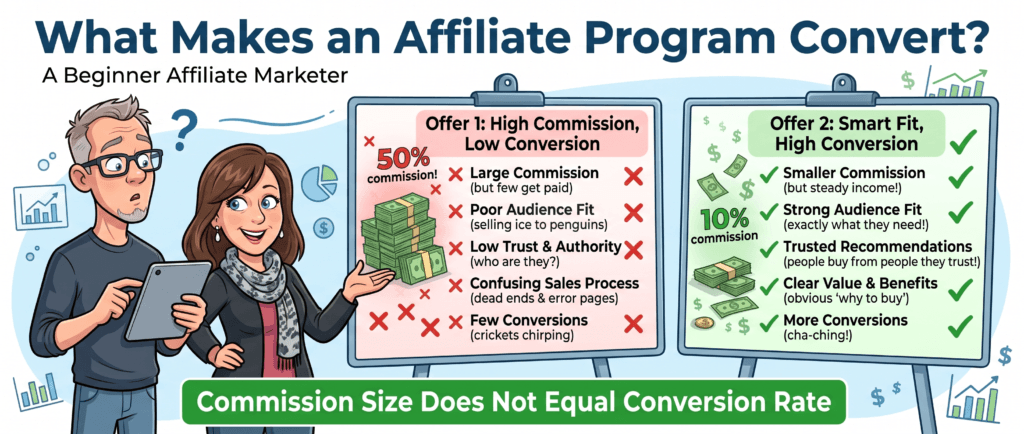
High commissions alone do not create conversions.
A lower-paying affiliate program can earn more if the product closely matches the reader’s problem and feels like a natural next step. A high-paying program may struggle to convert if the offer is expensive, confusing, unfamiliar, or wrong for the audience.
The affiliate programs that convert best are usually the ones that make the buying decision easier—not the ones that offer affiliates the biggest commission.
This guide will help you understand:
- Why some affiliate programs convert better than others
- What makes an affiliate offer easier for beginners to promote
- How audience fit affects affiliate conversions
- Why trust can matter more than commission size
- How price and buying intent influence sales
- Which types of content attract visitors who are ready to take action
- How to evaluate an affiliate program before spending months promoting it
This guide is part of my Best Affiliate Programs for Beginners learning series.
Best Affiliate Programs for Beginners: Reviews, Commissions, and What Actually Pays
Why I Stopped Choosing Affiliate Programs by Commission Rate
When I first started learning affiliate marketing, high commission rates naturally caught my attention.
A program offering a large payout seemed more valuable than one paying a smaller amount. I assumed that if I was going to spend time creating content, I should promote the offer with the biggest potential commission.
What I did not understand yet was that a commission only matters after someone buys.
A program can offer $500 per sale and earn you nothing. Another can pay a much smaller amount but generate more consistent results because the product is easier to understand, better matched to the audience, or already trusted by potential customers.
My own experience with expensive online business opportunities also changed the way I look at conversions. I encountered one program that wanted $15,000 for me to continue learning. No matter how attractive an affiliate commission might have been, I would not feel comfortable recommending that kind of offer to a beginner looking for a low-risk way to start.
That taught me something I still use when evaluating affiliate programs today:
A high commission can attract the affiliate, but only the right offer can attract the customer.
Now, I look beyond the payout and ask:
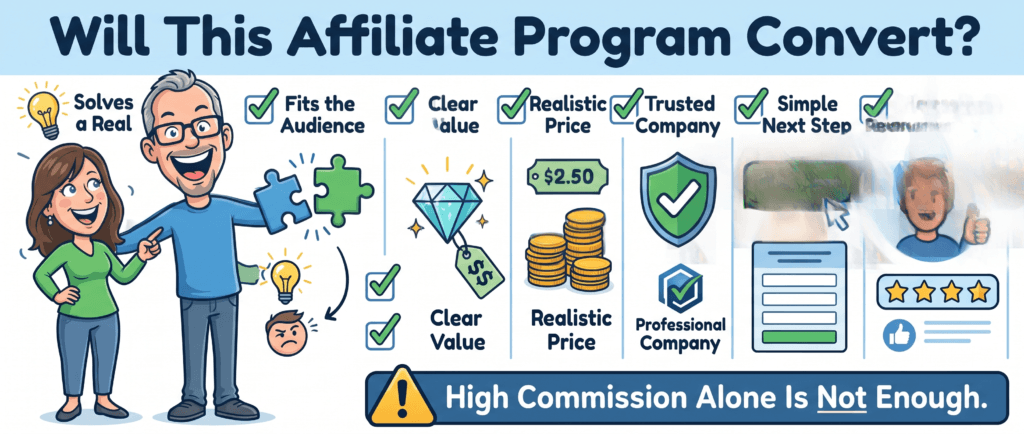
- Does the product solve a real problem?
- Does it fit the audience?
- Is the offer easy to understand?
- Does the company appear trustworthy?
- Is the price realistic for the people reading the content?
- Can I explain why someone would genuinely benefit from it?
- Does the program support the type of content I want to create?
Those questions tell me much more about conversion potential than the advertised commission rate.
The 7 Factors That Make Affiliate Programs Convert Better
When beginners struggle to earn commissions, the problem is not always their effort or the amount of traffic they have.
Sometimes the offer itself is difficult to convert.
After comparing affiliate programs and studying how content, audience needs, and recommendations work together, I believe seven factors have the biggest influence on whether an affiliate program is realistic for a beginner to promote.
1. Strong Audience Fit
The product should solve a problem your audience actually has.
Someone reading about starting an affiliate website may need training, hosting, keyword research, or content tools. That same reader probably does not need an unrelated fitness product simply because it offers a high commission.
The closer the offer matches the reason someone came to your website, the easier the recommendation is to understand.
2. A Clear Product or Service
People are less likely to buy something they do not understand.
Beginner-friendly affiliate offers usually have a clear purpose. The customer can quickly understand what the product does, who it is for, and why it might help.
If you need several paragraphs just to explain what the customer is buying, the offer may require more education before it converts.
3. Trust
Readers are more comfortable considering recommendations from companies, products, and websites they trust.
Trust can come from:
- Familiar brand recognition
- Clear pricing
- Transparent policies
- Helpful reviews
- Realistic claims
- Secure websites
- Honest affiliate content
This is one reason a lower-paying familiar product can sometimes outperform an unfamiliar offer with a much larger commission.
4. Realistic Price and Commitment
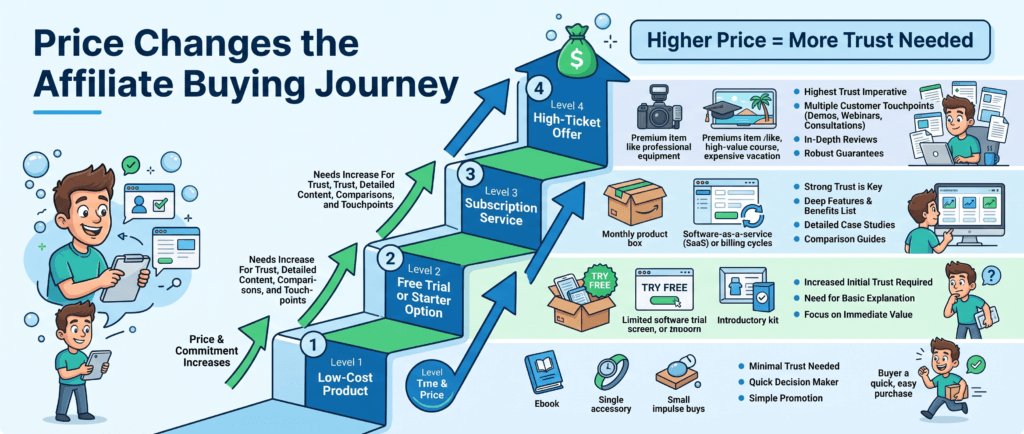
The more expensive or complicated the decision, the more trust a buyer usually needs.
A low-cost product may convert after one helpful article. A high-ticket program may require multiple visits, detailed comparisons, reviews, proof, and much more confidence before someone is ready to buy.
That does not mean expensive affiliate products cannot convert.
It means beginners should understand that a $20 purchase and a $2,000 purchase require very different content and sales journeys.
5. Strong Buying Intent
Not every website visitor is equally close to making a purchase.
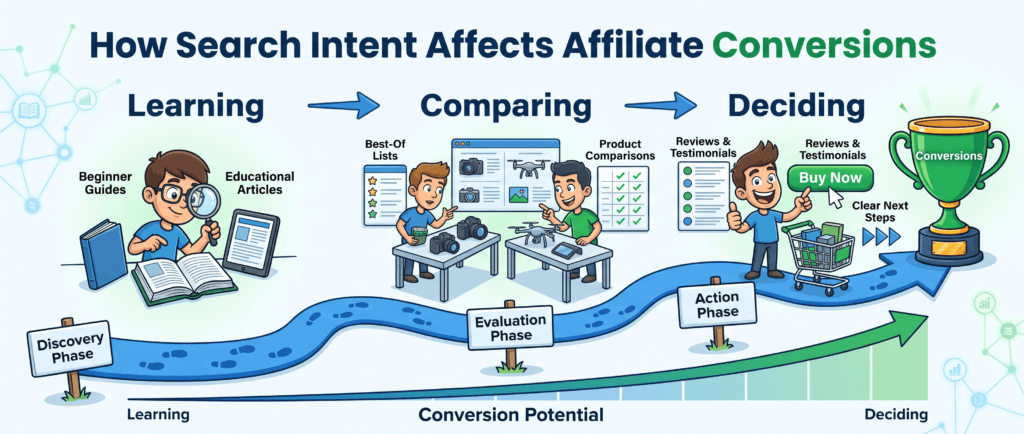
Someone searching “what is affiliate marketing?” is probably still learning.
Someone searching “best affiliate programs for beginners” is comparing options.
Someone searching “Wealthy Affiliate review” may be much closer to making a decision.
The affiliate program has not changed—but the visitor’s intent has.
6. A Simple Customer Journey
Every unnecessary step can create another opportunity for a potential customer to leave.
Offers may be easier to convert when readers can clearly understand:
- What they are getting
- What it costs
- What happens next
- Whether there is a free trial or starter option
- How to cancel or change plans
- Where to find help
Confusing pricing, unclear checkout processes, and exaggerated claims can make even a good product harder to recommend.
7. Helpful Affiliate Support
Good affiliate programs make it easier for publishers to understand what they are promoting.
Useful support may include:
- Clear program terms
- Accurate tracking
- Product information
- Promotional guidelines
- Affiliate dashboards
- Responsive support
- Training or educational resources
Support does not create conversions by itself, but it helps beginners avoid mistakes that can prevent good content from performing.
Affiliate conversion happens when the right audience meets the right offer at the right stage of the buying decision.
Audience Fit Is the Biggest Conversion Advantage Beginners Have
Beginners often assume they need huge amounts of traffic before affiliate marketing can work.
Traffic matters, but relevance matters too.
One hundred visitors who are actively looking for the solution you recommend can be more valuable than thousands of visitors who have no reason to care about the offer.
This is why niche focus can help newer affiliate marketers.
A smaller website may not have the reach of a major publication, but it can create highly specific content for a clearly defined reader.
For example:
| Content Topic | Natural Affiliate Fit | Poor Affiliate Fit |
|---|---|---|
| How to start an affiliate website | Training, hosting, keyword tools | Unrelated consumer products |
| Best hiking gear for beginners | Boots, backpacks, outdoor equipment | Business software |
| How to learn graphic design | Courses, design tools, freelance services | Home appliances |
| Starting an online store | Ecommerce platforms, business tools | Collectibles |
| How to improve website SEO | SEO tools, training, content resources | Fashion products |
The strongest recommendation is usually the one that feels like it belongs in the article.
Readers should not have to wonder why the affiliate link is there.
When the recommendation feels like part of the answer, the affiliate link becomes useful instead of intrusive.
This is also why choosing a clear niche and understanding your audience should come before joining dozens of affiliate programs.
The program should fit the content you are already creating—not force you to create unrelated content just to have something to promote.
Why Trust Often Converts Better Than a Higher Commission
Trust is one of the biggest reasons some affiliate programs convert better than others.
A reader may be interested in a product, but interest alone does not always lead to a purchase.
Before buying, people often want to know:
- Is this company legitimate?
- Does the product do what it promises?
- Is the price clear?
- Can I find honest reviews?
- What happens if I need help?
- Is the recommendation based on real value or just a commission?
The more doubts a reader has, the harder the offer may be to convert.
This is one reason familiar brands can sometimes perform well even when their commission rates are lower. The customer may already know the company, understand what it sells, and feel comfortable making a purchase.
However, brand recognition is not the only way to build trust.
Smaller companies and less familiar products can also convert when the affiliate does a good job of explaining:
- Who the product is for
- What problem it solves
- What it costs
- What its limitations are
- Who should not buy it
- What alternatives are available
This is where honest reviews and educational content become especially important.
I do not believe every review should end with a recommendation to buy.
Sometimes the most useful conclusion is that a product is not right for a particular reader.
That kind of honesty may cost an occasional commission, but it can strengthen something much more valuable: the reader’s trust in future recommendations.
The goal is not to convince every reader to buy. The goal is to help the right reader make the right decision.
The Federal Trade Commission requires clear disclosure of material connections between affiliates and the products or companies they promote. Beyond the legal requirement, clear affiliate disclosures also help readers understand how a website makes money.
Trust grows when readers know why you are making a recommendation and can see that your advice is not based on commission size alone.
Why Buying Intent Changes Affiliate Conversion Rates
Two people can read about the same product and be at completely different stages of the buying process.
One may be learning about a problem for the first time.
The other may already know what they need and be comparing two final options.
That difference is called search intent, and it has a major effect on affiliate conversions.
Informational Intent
A reader is trying to learn.
Examples:
- What is affiliate marketing?
- How do affiliate programs work?
- What is recurring commission?
These visitors may not be ready to buy anything yet.
Comparison Intent
A reader is narrowing down options.
Examples:
- Best affiliate programs for beginners
- Amazon Associates vs other affiliate programs
- Wealthy Affiliate vs Shopify
These visitors are closer to making a decision but may still need detailed information.
Transactional or Decision Intent
A reader is actively evaluating a specific product or next step.
Examples:
- Wealthy Affiliate review
- Is Wealthy Affiliate worth it?
- Join Wealthy Affiliate free
- Best affiliate platform for complete beginners
These visitors are often much closer to taking action.
| Search Intent | What the Reader Needs | Conversion Potential |
|---|---|---|
| Informational | Clear education and answers | Usually lower |
| Comparison | Differences, pros, cons, and alternatives | Moderate to high |
| Decision | Reassurance, details, and a clear next step | Often highest |
This does not mean informational content is less valuable.
Informational articles build trust, attract new readers, answer beginner questions, and help people move toward future decisions.
The mistake is expecting every article to convert at the same rate.
A helpful article can succeed without producing an immediate sale if it moves the reader closer to the right decision.
For beginners, understanding this can prevent a lot of frustration.
A page answering a broad question may attract more traffic but produce fewer affiliate clicks. A detailed comparison or review may attract fewer visitors but convert a larger percentage because those readers are closer to making a decision.
That is why I look at the purpose of the content before judging whether an affiliate program is converting well.
The Type of Content Can Matter as Much as the Affiliate Program
Sometimes beginners blame the affiliate program when the real problem is the content connecting the reader to the offer.
A strong program can still perform poorly when it appears in the wrong article.
For example, placing an affiliate link for website hosting inside a general article explaining what affiliate marketing means may be too early for many readers.
The same hosting recommendation may make much more sense in an article about how to build an affiliate website.
The offer did not change.
The context did.
Content that often attracts stronger buying intent includes:
- Product reviews
- Product comparisons
- Best-of lists
- Buying guides
- Tutorials using a specific tool
- Alternatives articles
- Problem-and-solution content
- Case studies
- Pricing and feature comparisons
Educational content still plays an important role, but the affiliate recommendation should match the reader’s stage.
| Content Type | Reader Stage | Best Affiliate Approach |
|---|---|---|
| Beginner explainer | Learning | Educate first; use only highly relevant recommendations |
| How-to tutorial | Solving a problem | Recommend tools needed to complete the process |
| Best-of list | Comparing options | Help readers choose among relevant products |
| Product comparison | Narrowing choices | Explain differences, strengths, and limitations |
| In-depth review | Evaluating one option | Answer objections and explain who the product fits |
| Alternatives article | Looking for a better fit | Compare options based on different needs |
I have learned that adding more affiliate links does not automatically improve monetization.
A single recommendation in the right article can be more useful than several links added where the reader has no reason to click.
Affiliate content converts when the recommendation matches both the reader’s problem and the purpose of the page.
For a deeper look at the types of content that can lead beginners toward their first commissions, read:
How to Create Content That Sells
Why Free Trials and Low-Risk Entry Can Help Beginners Convert
The amount of risk a customer feels can influence whether they take the next step.
An expensive product from an unfamiliar company usually requires more trust than a free trial, free membership, or low-cost starting option.
This is one reason low-risk entry points can be useful for beginner affiliate marketers.
A reader may feel more comfortable exploring an offer when they can:
- Start free
- Try the product before paying
- See how the platform works
- Cancel without a long-term commitment
- Upgrade only if they find value
However, a free option does not automatically make an affiliate program good.
The product still needs to be useful, the upgrade path should be clear, and the affiliate should explain honestly what is included for free and what requires payment.
This is one reason I recommend Wealthy Affiliate to complete beginners.
The free Starter Membership gives someone a way to explore the platform, begin the training, and see the tools and community before deciding whether they want more.
That is very different from the online business opportunities I encountered that required large payments before I fully understood what I was buying.
Reducing the customer’s risk can make the first step easier, but trust is what determines whether they keep moving forward.
If you want to see exactly what I found useful, what I would change, and who I believe the platform is best for, read:
Affiliate disclosure: If you join Wealthy Affiliate through my link, I may earn a commission at no additional cost to you.
Explore the Free Wealthy Affiliate Starter Membership
Why Product Price Changes the Conversion Strategy
Price does not determine whether a product is good or bad.
It changes how much information and trust the buyer may need before making a decision.
A low-cost purchase may require:
- A clear recommendation
- Basic product information
- A simple reason to buy
A higher-priced offer may require:
- Detailed reviews
- Comparisons
- Proof of value
- Clear pricing information
- Answers to common objections
- Multiple visits before a decision
This is why high-ticket affiliate programs can look attractive to beginners while still being difficult to convert.
The commission may be larger, but the buying decision is also bigger.
| Offer Type | Typical Buying Decision | Content Usually Needed |
|---|---|---|
| Low-cost product | Lower risk | Review, recommendation, or buying guide |
| Free trial or starter option | Low initial risk | Tutorial, review, or clear next step |
| Subscription service | Ongoing commitment | Features, pricing, benefits, and limitations |
| High-ticket product | Higher risk | Detailed review, comparisons, trust, and strong audience fit |
Beginners should not automatically avoid higher-priced products.
But they should understand that expensive offers usually require more than adding an affiliate link to an article.
The bigger the buying decision, the more trust and clarity the content needs to provide.
This is also why commission size alone is a poor way to predict which affiliate program will earn more.
A program with smaller but more frequent conversions may outperform a high-ticket offer that rarely matches the audience.
Why Beginner-Friendly Affiliate Programs Can Be Easier to Promote
A beginner-friendly affiliate program is not simply one that approves new affiliates quickly.
The product itself also needs to make sense for the people you are trying to help.
Programs may be easier for beginners to promote when they offer:
- A clear product or service
- Transparent pricing
- Simple program terms
- Useful affiliate support
- Strong audience relevance
- Low-risk ways for customers to explore
- Realistic claims
- A straightforward customer journey
These qualities reduce the amount of confusion between the reader’s problem and the recommended solution.
They also make it easier for a newer affiliate to create useful content.
For example, it is easier to explain a product when you understand:
- What it does
- Who needs it
- What problem it solves
- What it costs
- What its limitations are
That clarity helps both the affiliate and the reader.
The easiest affiliate programs to promote are often the ones you can explain clearly, recommend honestly, and connect naturally to a real audience need.
If you are still looking for opportunities with lower barriers to entry, read:
Affiliate Programs with Easy Approval for Beginners
Why Some Affiliate Programs Fail to Convert
Sometimes the problem is not the affiliate marketer.
The offer itself may be difficult to sell.
A program can have an attractive commission structure and still struggle to convert because the customer experience creates too much doubt, confusion, or risk.
Common conversion problems include:
- A product that does not match the audience
- Unclear pricing
- Complicated checkout or signup processes
- Unrealistic income or benefit claims
- Poor reviews or a weak reputation
- Little information about what the customer receives
- An offer that requires too much explanation
- High prices without enough proof of value
- A website that feels outdated or untrustworthy
- Weak customer support
Beginners sometimes spend months trying to make an offer work because they assume they simply need more traffic.
More traffic does not always solve a poor fit.
If the wrong people are seeing the offer, the company is difficult to trust, or the product does not solve the reader’s problem, increasing traffic may simply send more people to something they still do not want.
More traffic can increase opportunity, but it cannot fix an offer your audience does not need.
This is why I believe beginners should evaluate both their content and the affiliate program before assuming they have failed.
Ask:
- Are the right readers reaching the page?
- Does the recommendation match why they came?
- Is the product easy to understand?
- Does the price fit the audience?
- Is the company trustworthy?
- Is the next step clear?
- Does the content answer the questions someone would have before acting?
Sometimes the answer is to improve the content.
Sometimes the answer is to choose a better-fitting affiliate program.
Knowing the difference can save months of frustration.
How to Evaluate an Affiliate Program’s Conversion Potential
You cannot know exactly how well an affiliate program will convert before you promote it.
However, you can look for signs that an offer has a realistic chance of matching your audience.
Use this checklist before investing months of content into a program.
| Conversion Question | Strong Sign | Warning Sign |
|---|---|---|
| Does it solve a real audience problem? | Readers already need the solution | You have to create interest from nothing |
| Is the offer easy to understand? | The value is clear quickly | The product needs a long explanation |
| Is the price realistic? | Fits the audience and problem | Requires a major commitment too early |
| Does the company build trust? | Clear policies, pricing, and support | Vague claims or missing information |
| Does it fit your content? | Natural connection to existing topics | Requires unrelated promotional content |
| Is the next step simple? | Clear signup, trial, or purchase process | Confusing customer journey |
| Can you recommend it honestly? | You understand the benefits and limits | You are promoting mainly for the commission |
The final question matters most to me.
If I cannot explain why a product may help someone—and who should probably choose something else—I am not ready to recommend it.
That standard became especially important after my own experiences with online business opportunities that relied heavily on sales pressure and expensive upsells.
The best affiliate offer is one you can recommend without needing to hide its limitations.
Before joining any program, I also recommend reviewing:
- The affiliate agreement
- Commission terms
- Payment requirements
- Cookie or attribution rules
- Promotional restrictions
- Disclosure requirements
- Termination policies
A program may have excellent conversion potential and still be a poor choice if its rules do not fit the way you create content.
For a complete guide to evaluating opportunities before applying, read:
How to Get Approved for Affiliate Programs as a Beginner
My Recommendation for Complete Beginners
If you are completely new to affiliate marketing, I would not begin by searching for the program with the highest advertised commission.
I would begin by learning the skills that make any affiliate program easier to promote:
- Understanding your audience
- Choosing a focused niche
- Building a website
- Researching keywords
- Creating useful content
- Understanding search intent
- Learning how affiliate links and conversions work
That is why Wealthy Affiliate became my starting point and why I continue recommending it to complete beginners.
The platform combines affiliate marketing training with website building, hosting, keyword research, content tools, and community support.
More importantly, it gave me a place to learn how the pieces fit together instead of trying to choose affiliate programs before I understood how to attract the right audience.
The program that taught me how to build an affiliate business became more valuable than the programs that simply gave me something to promote.
If you want to explore the platform before deciding whether it fits your goals, you can start with the free Starter Membership.
Explore Wealthy Affiliate Free
Affiliate disclosure: If you join Wealthy Affiliate through my link, I may earn a commission at no additional cost to you.
Quick Decision Guide: Is the Program or Your Content the Problem?
Use this quick guide before giving up on an affiliate program.
You Probably Need More Traffic If:
- Very few people are seeing the content
- The page is new and has not had time to gain visibility
- You do not have enough data to evaluate clicks or conversions
You Probably Need Better Content Alignment If:
- Readers visit but rarely click
- The affiliate offer feels disconnected from the topic
- The recommendation appears without enough context
- The content attracts people who are not looking for the solution
The Affiliate Program May Be the Problem If:
- Interested readers click but consistently do not convert
- Pricing or product details are unclear
- The sales process creates confusion
- The product has poor reviews or trust issues
- The offer no longer fits your audience
You May Need a Different Commission Model If:
- The offer converts but earnings remain too low
- The product requires significant content work for very small returns
- A recurring or higher-value program better fits the same audience need
Do not change everything at once.
Identify where the process is breaking down, make one improvement, and give yourself enough information to judge the result.
Good affiliate marketers do not guess why something is not converting—they look for the point where the reader stops moving forward.
Frequently Asked Questions About Affiliate Program Conversions
Why do some affiliate programs convert better than others?
Some affiliate programs convert better because the product closely matches the audience, the offer is easy to understand, the company is trustworthy, and the customer is already interested in solving the problem.
Commission size alone does not determine conversion potential.
What is a good affiliate conversion rate for beginners?
There is no single conversion rate that applies to every affiliate program.
Conversion rates can vary based on the niche, product price, traffic source, search intent, content type, brand trust, and how closely the offer matches the audience.
Beginners should focus first on understanding whether readers are visiting the content, clicking affiliate links, and moving toward the offer.
Do high-paying affiliate programs convert less?
Not always, but higher-priced offers often require more trust, more detailed content, and a longer buying decision.
A high-paying program can convert well when the product strongly fits the audience. However, a lower-priced or lower-risk offer may be easier for beginners to promote because the customer needs less reassurance before taking action.
How can I tell if an affiliate program is not converting?
Look at where readers stop moving forward.
If the page gets no traffic, you do not have enough information to judge the program. If readers visit but do not click, the problem may be the content or audience fit. If readers click but do not buy, the offer, price, sales page, or customer experience may be the issue.
Should beginners switch affiliate programs if they are not making sales?
Not immediately.
First determine whether enough people have seen the content and whether readers are clicking the affiliate links. Switching programs will not fix a traffic problem or content that attracts the wrong audience.
Change the program when the evidence suggests the offer itself is a poor fit.
Does more website traffic always lead to more affiliate sales?
No.
More relevant traffic can create more opportunities for affiliate sales, but traffic alone cannot fix a poor offer or weak audience fit.
A smaller number of visitors who are actively looking for the recommended solution may convert better than a much larger audience with little interest in the product.
What type of affiliate content converts best?
Product reviews, comparisons, buying guides, tutorials, alternatives articles, and problem-solving content often attract readers with stronger buying intent.
However, the best-converting content is usually the content that matches the reader’s current question and stage of the buying journey.
Continue Learning
Understanding why affiliate programs convert is only one part of building a successful affiliate business.
These guides will help you continue learning without repeating the resources already linked throughout this article.
Understand Affiliate Earnings
Affiliate Commission Structures Explained
How to Maximize Your Affiliate Earnings
Compare Beginner Opportunities
7 Affiliate Programs Beginners Can Actually Make Money With
For the complete collection of affiliate program reviews, commission guides, and platform comparisons, return to:
Best Affiliate Programs for Beginners: Reviews, Commissions, and What Actually Pays
Final Thoughts
Some affiliate programs convert better for beginners because they make it easier to connect the right person with the right solution.
The product fits the audience. The value is clear. The company feels trustworthy. The price matches the level of commitment. The content reaches the reader at the right stage of the buying journey.
None of those things can be replaced by a large commission rate.
Beginners often assume that earning more means finding a program that pays more.
In reality, a better question is:
Which offer can I genuinely help the right reader understand and evaluate?
That question has changed the way I look at affiliate programs.
I no longer believe the goal is to find the highest-paying offer or add affiliate links to as many articles as possible.
The goal is to build useful content, understand what the reader needs, and recommend a product only when it makes the next step clearer.
The affiliate programs that convert best are not always the ones that pay the most—they are the ones that fit the audience, the content, and the moment.
Start with relevance.
Build trust.
Track what happens.
Then improve one part of the process at a time.
That is a much stronger foundation for long-term affiliate income than chasing every program with an attractive commission.
Affiliate Disclosure
Some links on this page may be affiliate links. If you choose to sign up or purchase through them, I may earn a commission at no additional cost to you.
I only recommend products, services, and affiliate programs that I personally use, have researched extensively, or believe provide genuine value for beginners who want to build a sustainable online business.