
Written by Donna
Affiliate marketing researcher and founder of AffiliateEducationForBeginners.com
Last updated: June 2026
Reviewed for beginner-friendly accuracy: June 2026
Quick Answer: What Can You Learn From Real Affiliate Marketing Scam Cases?
Real affiliate marketing scam case studies help beginners recognize warning signs before they invest time or money into the wrong opportunity.
Many scams follow similar patterns, including:
- Unrealistic income claims
- Expensive upsells
- Recruitment-focused business models
- Lack of genuine training
- High-pressure sales tactics
- “Done-for-you” promises
Learning how these scams operate can help you avoid costly mistakes and focus on legitimate affiliate marketing education instead.
These real affiliate marketing scam case studies highlight some of the most common affiliate marketing scams beginners should avoid when researching online business opportunities.
This guide is part of the Online Business Scams & Warnings learning hub.
? Online Business Scams & Warnings
If you’re new to affiliate marketing, start here:
? Affiliate Marketing for Beginners
Why I Believe Scam Awareness Matters
Over the years, I’ve spoken with many people who were excited about starting an online business but ended up frustrated after investing in programs that failed to deliver what was promised.
Most weren’t careless.
They were motivated, hopeful, and genuinely looking for a way to improve their financial situation.
One thing I learned is that scams often succeed because they sound like shortcuts. They promise faster results, less work, and easier success than reality allows.
Understanding how these schemes operate can help beginners avoid common traps and focus on building real skills instead.
Many of the same warning signs appear repeatedly in affiliate marketing scams beginners should avoid, work-from-home scams, and misleading online business opportunities for beginners. Learning to recognize these online business scam warning signs early can help protect both your time and your money.
? Better Business Bureau Scam Tracker
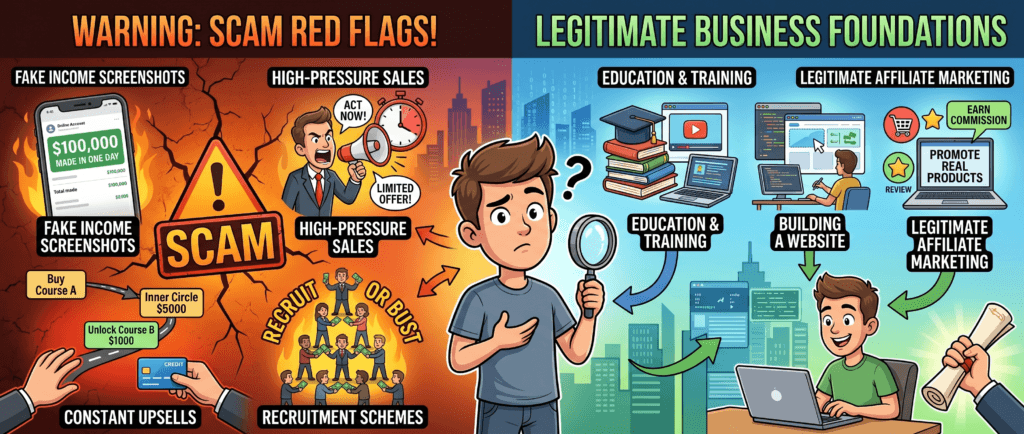
Common Patterns Found in Affiliate Marketing Scams
While scams often appear different on the surface, many share similar warning signs.
These affiliate program red flags appear repeatedly across work-from-home scams, affiliate marketing scams, and other online business opportunities that target beginners.
| Common Scam Tactic | Why It’s Dangerous |
|---|---|
| Guaranteed income claims | No business can guarantee earnings |
| Expensive upsells | Costs increase before real training begins |
| Recruitment focus | Emphasis on recruiting instead of marketing |
| Push-button promises | Creates unrealistic expectations |
| Vague business model | Makes it difficult to understand how income is generated |
| High-pressure sales | Discourages careful research |
Scam warning signs and deceptive marketing practices are common enough that consumer protection agencies regularly publish guidance to help people avoid fraud and misleading business opportunities.
These warning signs appear repeatedly in many of the stories shared below.
Case Study #1: The “Done-For-You Money Machine”
One beginner I spoke with was excited about a program that promised a fully automated website that would generate income with little effort.
The sales page suggested that most of the work had already been done. They simply needed to sign up, activate the system, and watch the commissions roll in.
The reality was very different.
After joining, they received a basic website template but no meaningful training on content creation, SEO, traffic generation, or audience building. The website itself was not the problem. The problem was the expectation that a website alone could generate income without a marketing strategy behind it.
### Warning Signs
- Heavy emphasis on automation
- Little discussion about traffic generation
- Unrealistic income examples
- Minimal training provided
### Lesson Learned
Websites do not make money automatically.
Successful affiliate websites require content, traffic, SEO, and ongoing effort. Any opportunity promising hands-off income should be examined carefully.
? Online Scams Exposed: How to Avoid Online Business Traps
Case Study #2: The $2,500 Private Mentorship Group
Another beginner was encouraged to join an exclusive mentorship group costing more than $2,500.
The sales presentation emphasized direct access to successful marketers, private coaching, and insider strategies.
After joining, they discovered that meaningful interaction was limited, questions often went unanswered, and much of the content consisted of motivational messages rather than practical training.
The biggest disappointment was that there was no structured learning path.
Warning Signs
- High upfront costs
- Vague promises of mentorship
- No clear curriculum
- Heavy focus on exclusivity
Lesson Learned
Paying more does not automatically mean receiving better training.
Before joining any program, look for a clear roadmap, training structure, support system, and transparent expectations.
? Safe Platforms for Beginners: Avoiding Scams and Finding Legit Opportunities
Case Study #3: Recruitment First, Training Second
One of the most common stories I hear involves programs that initially appear to teach affiliate marketing but eventually reveal that recruiting new members is the primary focus.
A beginner joined a program believing they would learn how to build a website, create content, and generate traffic.
Instead, much of the training centered around recruiting additional members into the same program.
While referral programs are common in many businesses, legitimate affiliate marketing should focus primarily on marketing products and services—not recruiting people.
This is one reason why learning how to spot affiliate marketing scams is so important. Legitimate affiliate marketing training focuses on helping members learn content creation, traffic generation, SEO, and audience building rather than making recruitment the primary source of income.
? Federal Trade Commission Guidance on Multi-Level Marketing
Warning Signs
- Recruitment emphasized more than skills
- Little discussion of traffic generation
- Few examples of successful content marketing
- Commissions tied heavily to member recruitment
Lesson Learned
Affiliate marketing should focus on helping people find products and services that solve problems.
If recruitment becomes the main strategy, proceed carefully and research further.
? Top Red Flags in Affiliate Programs: What to Avoid and What to Look For
Case Study #4: The Free Trial That Became Expensive
A beginner signed up for what appeared to be a free training program.
The initial offer looked attractive and included promises of step-by-step guidance.
However, before completing the first lessons, numerous upsells appeared. Essential tools, advanced training, and key resources were all locked behind additional purchases.
The free trial itself was real, but it did not provide enough information to achieve meaningful progress.
Warning Signs
- Constant upsell offers
- Important training hidden behind paywalls
- Lack of transparency about total costs
- Pressure to upgrade quickly
Lesson Learned
Free offers should provide genuine value before asking for larger commitments.
Legitimate platforms are usually transparent about costs and allow beginners to evaluate the training before making major financial decisions.
? How to Spot Affiliate Marketing Scams Before You Lose Money
What Legitimate Affiliate Training Looks Like
One thing all of these case studies have in common is that the people involved were looking for guidance, support, and a clear path to building an online business.
Unfortunately, many scam-like programs use the same marketing language as legitimate training platforms.
Terms like:
- Financial freedom
- Passive income
- Work from home
- Affiliate marketing
- Online business
can appear in both legitimate opportunities and misleading offers.
That is why it is important to look beyond the marketing claims and evaluate what is actually being provided.
Understanding the difference between legitimate affiliate marketing training and misleading online business opportunities can help beginners avoid expensive mistakes and focus on programs that teach real, transferable skills.
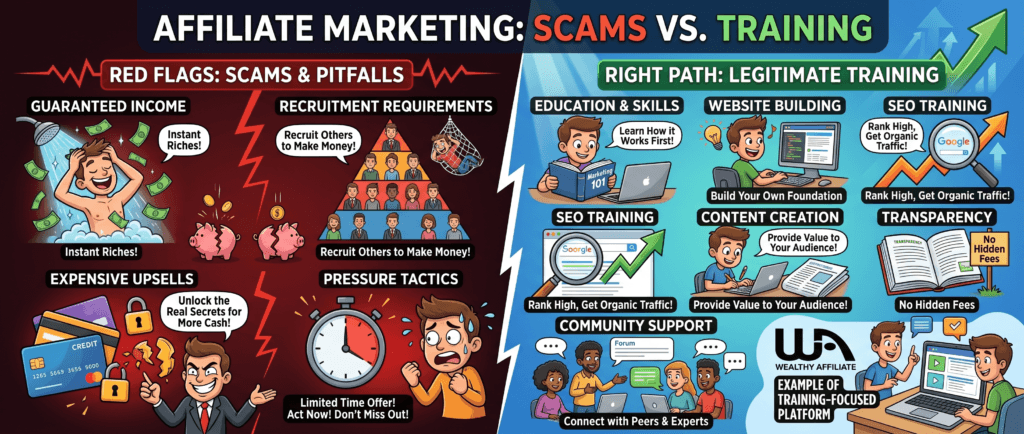
Scam Programs vs Legitimate Training Platforms
| Scam-Focused Programs | Legitimate Training Platforms |
|---|---|
| Guaranteed income claims | Realistic expectations |
| High-pressure sales tactics | Transparent pricing |
| Recruitment-focused | Skill-focused |
| Expensive upsells before value | Training before upgrades |
| Vague business model | Clear learning path |
| Quick-money promises | Long-term business building |
| Little support | Ongoing support and community |
When evaluating any affiliate marketing platform, I look for several things:
- Transparent pricing
- Structured training
- Website-building tools
- SEO and traffic education
- Community support
- Realistic expectations
Platforms that provide these elements are often better positioned to help beginners develop long-term skills rather than chase short-term promises.
How I Evaluate Online Business Opportunities Today
After researching affiliate marketing programs for years, I now evaluate every opportunity using the same criteria:
- Transparent pricing
- Realistic income expectations
- Structured training
- Website-building tools
- SEO and traffic education
- Community support
If a program cannot clearly explain how members succeed, what skills they will learn, or how income is generated, I usually keep looking.
This simple framework has helped me avoid many programs that looked attractive on the surface but offered very little long-term value.
Why Wealthy Affiliate Stands Out
One example is Wealthy Affiliate, which combines affiliate marketing training, website hosting, keyword research tools, content creation resources, and community support in one platform.
What I appreciate most is that beginners can start with a free Starter Membership and explore the training before making a financial commitment.
That level of transparency is something I always look for when evaluating online business opportunities.
For beginners who are nervous about scams, the ability to explore training before making a financial commitment can be a valuable way to evaluate whether a platform is the right fit.
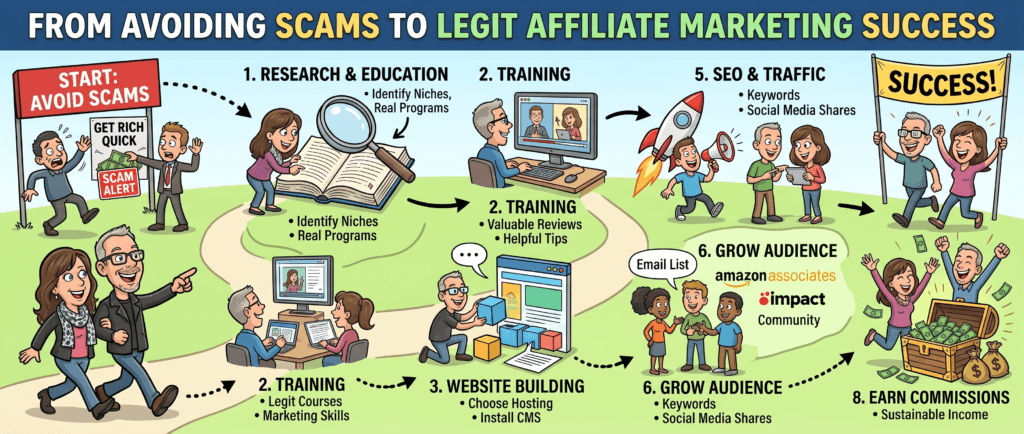
Lessons Learned From Real Affiliate Marketing Scam Case Studies
Although each story is different, several important lessons appear repeatedly.
1. If It Sounds Too Good To Be True, It Usually Is
Promises of easy money, guaranteed income, and effortless success should always be approached with caution.
Building an online business requires learning, testing, patience, and consistent effort.
2. Real Training Matters
Many scam-like programs spend more time selling the dream than teaching the skills.
Legitimate platforms focus on helping people learn:
- Content creation
- Website building
- SEO
- Traffic generation
- Audience growth
These skills create long-term opportunities.
3. Transparency Builds Trust
Before investing in any program, you should understand:
- What you’re buying
- What it costs
- How commissions are earned
- What support is available
- What results are realistic
The less transparent a program is, the more cautious you should be.
4. Research Before You Buy
One of the simplest ways to avoid scams is to slow down and research.
Look for:
- Independent reviews
- Community discussions
- Refund policies
- Training previews
- Real student experiences
A few minutes of research can prevent expensive mistakes.
Consumer protection organizations regularly recommend researching companies before making financial commitments. Looking for independent reviews, transparent pricing, and realistic expectations can help you avoid affiliate marketing scams and identify legitimate affiliate programs for beginners.
? Consumer Financial Protection Bureau Consumer Resources
5. Focus on Skills, Not Shortcuts
The people who build successful affiliate businesses usually focus on:
- Learning
- Creating helpful content
- Building trust
- Generating traffic
- Improving consistently
Shortcuts often create disappointment.
Skills create opportunities.
Common Scam Promises vs Reality
| Scam Promise | Reality |
|---|---|
| Make money while you sleep immediately | Building traffic takes time |
| No experience required | Skills still need to be learned |
| Done-for-you system | Success still requires effort |
| Guaranteed income | No legitimate business can guarantee earnings |
| Secret insider strategy | Most successful marketers follow proven fundamentals |
| Fast results | Most affiliate sites take months to gain traction |
Ready to Learn Affiliate Marketing the Right Way?
If you’re researching online business opportunities, the next step is identifying programs that focus on real products, real training, and realistic expectations.
If you’re still deciding what to promote or which programs deserve your attention, start with:
? 7 Affiliate Programs Beginners Can Actually Make Money With (2026)
This guide compares beginner-friendly affiliate programs and explains what makes them worth considering.
Still wondering why some programs succeed while others struggle to convert? See:
? Why Some Affiliate Programs Convert Better Than Others
If you’d like a platform that combines training, website hosting, keyword research tools, content creation support, and community guidance in one place, you can also explore:
The goal isn’t finding a shortcut.
The goal is building the skills that help create long-term results.
Frequently Asked Questions About Affiliate Marketing Scams
What are the most common affiliate marketing scams?
Some of the most common affiliate marketing scams include unrealistic income claims, expensive upsells, fake mentorship programs, recruitment-focused systems, and “done-for-you” websites that promise passive income with little effort.
While the tactics vary, most scams rely on creating unrealistic expectations rather than teaching practical business skills.
Are high-ticket affiliate programs scams?
Not necessarily.
Some high-ticket affiliate programs provide legitimate products, services, coaching, or training. However, beginners should be cautious of programs that focus primarily on recruiting new members instead of teaching marketing, content creation, or traffic generation.
Always research the business model before joining.
How can beginners avoid affiliate marketing scams?
The best way to avoid scams is to slow down and research thoroughly before investing.
Look for:
- Transparent pricing
- Real training
- Community support
- Independent reviews
- Clear explanations of how commissions are earned
Avoid opportunities that guarantee income or pressure you to act quickly.
Is affiliate marketing a legitimate way to make money online?
Yes.
Affiliate marketing is a legitimate business model used by companies worldwide.
However, it is not a get-rich-quick system.
Successful affiliate marketers typically build websites, create helpful content, generate traffic, and earn commissions over time.
What should I look for before joining an affiliate program?
Before joining any affiliate program, evaluate:
- Commission structure
- Product quality
- Company reputation
- Payment reliability
- Available training
- Support resources
Programs that are transparent about these areas tend to be more trustworthy.
Why do scam programs often target beginners?
Beginners are often searching for guidance and may not yet understand how legitimate online businesses operate.
Scammers take advantage of this by promoting shortcuts, guaranteed results, and unrealistic success stories.
Learning how affiliate marketing actually works makes it much easier to recognize these tactics.
Can beginners succeed without expensive coaching programs?
Absolutely.
Many successful affiliate marketers start with affordable or free training resources and gradually build their skills over time.
Consistent learning and implementation are usually far more important than purchasing expensive coaching packages.
Continue Learning
If you want to continue learning how to build an affiliate business safely and avoid costly mistakes, these guides are a great next step:
? What Is Affiliate Marketing? An Introduction for Beginners
? How Affiliate Marketing Works: Step-by-Step Guide
? Understanding Affiliate Marketing Terminology
? Benefits of Becoming an Affiliate Marketer
? How Beginners Actually Make Their First Dollar Online
? SEO for Affiliate Marketing for Beginners
? Traffic Generation Strategies for Affiliate Marketers
More Scam Awareness Guides
Continue exploring the Online Business Scams & Warnings learning hub:
? My Journey in Finding a Legitimate Online Business Opportunity
? Common Affiliate Marketing Scams and How to Avoid Them
? How to Spot Affiliate Marketing Scams Before You Lose Money
? Top Red Flags in Affiliate Programs: What to Avoid and What to Look For
? Safe Platforms for Beginners: Avoiding Scams and Finding Legit Opportunities
? Online Scams Exposed: How to Avoid Online Business Traps
Final Thoughts
One thing I’ve learned while researching affiliate marketing and online business opportunities is that most people who fall for scams are not careless.
They’re motivated.
They’re optimistic.
They’re looking for a way to improve their lives.
The problem is that scammers understand this and often use hope, urgency, and unrealistic promises to attract attention.
The good news is that legitimate opportunities do exist.
By focusing on education, skill-building, transparency, and realistic expectations, you can avoid many of the traps that catch beginners and instead build a solid foundation for long-term success.
If you’re still learning how affiliate businesses actually generate income, start with:
? What Actually Converts for Beginners in Affiliate Marketing
Once you understand what converts, the next step is choosing the right program to promote:
? 7 Affiliate Programs Beginners Can Actually Make Money With (2026)
If you’d like a beginner-friendly platform that combines training, website hosting, keyword research tools, and community support, you can also explore:
? Start the Free Wealthy Affiliate Starter Membership
You can explore the training, tools, and community before spending any money, which makes it easier to evaluate whether it’s the right fit for your goals.
Building an online business takes time, but choosing the right foundation can help you avoid costly mistakes and stay focused on what actually works.
Affiliate Disclosure
Some links on this page may be affiliate links. If you choose to sign up or purchase through them, I may earn a commission at no additional cost to you.
I only recommend products, services, and platforms that I personally use, trust, or believe provide genuine value for beginners.