Written by Donna
Affiliate marketing researcher and founder of AffiliateEducationForBeginners.com
Not sure whether to choose a niche, build a website, or join an affiliate program first? This guide to affiliate marketing basics puts those decisions in a practical order, so you can choose your next step without trying to learn everything at once.
Affiliate marketing means earning a commission when someone follows your tracked recommendation and completes a qualifying purchase or action. Your job is to help the right reader understand whether a product or service fits their needs.
I’m building AffiliateEducationForBeginners.com while applying the skills covered here. That includes organizing content, checking links, and investigating why a published page may not yet appear in Google. I share that learning alongside research—not as a promise that someone else will get particular results.
This page is your starting roadmap. We’ll cover the main decisions here, with links to detailed guides when you’re ready to go deeper.
Affiliate disclosure: This guide contains affiliate links. If you purchase a paid Wealthy Affiliate membership through one of my links, I may earn a commission at no additional cost to you.
Affiliate Marketing Roadmap for Beginners
The roadmap follows five steps: understand the business model, choose your audience, create helpful content, attract relevant readers, and review your progress.
If you’re starting from scratch, begin with Lesson 1. If you already have a website, choose the lesson that addresses the decision you’re working on now.
Quick tip: Each lesson includes a small task. Try applying it before opening another guide—you don’t need to finish the whole roadmap in one sitting.
Lesson 1 — Understand How Affiliate Marketing Works
Affiliate marketing means earning a commission when someone uses your tracked link and completes a qualifying purchase or action. The company sets the program’s rules, including what qualifies and how you get paid.
Before choosing products, understand your role: you help readers make informed decisions. A link gives them somewhere to go, but your explanation gives them a reason to consider it.
Start with:
- What Is Affiliate Marketing?
- How Affiliate Marketing Works Step by Step
- Understanding Affiliate Marketing Terminology
Try this: Think of a product you already know well. What problem does it solve? Who might find it useful—and who would be better off choosing something else?
You don’t need to join a program yet. First, practice explaining why a recommendation would genuinely help someone.
Lesson 2 — Choose Your Audience and Build Your Foundation
Start with a specific audience and a problem you can help them solve. Then choose a website direction and research affiliate programs that fit.
It’s tempting to begin with whichever program advertises the biggest commission. But a high payout won’t make a product useful to your readers.
For example, “outdoor equipment” is a broad topic. Helping first-time hikers choose comfortable, affordable gear gives you a clearer audience and practical questions to answer.
Ask yourself:
- What do I know about—or have a genuine interest in learning?
- Who would benefit from that knowledge?
- Can I create useful explanations, comparisons, or tutorials for those readers?
- Are there relevant products I could recommend honestly?
These guides will help you work through the decisions:
- How to Start Affiliate Marketing Step by Step
- How to Choose the Right Affiliate Program
- Best Affiliate Programs for Beginners
Try this: Complete this sentence: “My website will help ___ solve ___.”
Then list three questions those readers might ask. Those questions give you a starting point for your content—not just a list of products to promote.
Lesson 3 — Create Content That Helps Your Reader
Helpful affiliate content answers a specific question, explains the reasons behind a recommendation, and makes its limitations clear. An affiliate link is a possible next step—not a substitute for the answer.
Take one of the reader questions you listed in Lesson 2. What would someone need to understand before making a decision?
For that first-time hiker, an article about choosing boots could explain fit, terrain, comfort, and budget before mentioning particular products. Readers should learn something useful even if they never click an affiliate link.
You don’t need to pretend you’re an expert on everything. Be clear about what you know and how you know it:
- If you used the product: Describe what you tried, under what conditions, and what you noticed.
- If you researched it: Explain that your comparison is research-based and link to the sources supporting important details.
- If something is uncertain: Say what you couldn’t verify instead of filling the gap with a confident claim.
That distinction matters to me as a researcher and a learner. Documenting what I’m learning while building this website is different from claiming I’ve achieved results I haven’t demonstrated.
For help turning your topic into a useful article, start with:
- Content Marketing Strategies for Affiliate Success
- How to Create Content That Sells
- What Actually Converts for Beginners
Try this: Outline one article with a reader’s question, a short direct answer, a practical example, and a sensible next step. Before adding a recommendation, ask: “Have I explained who this is for, why it might help, and what its drawbacks are?”
Lesson 4 — Help the Right Readers Find Your Content
Affiliate website traffic is useful when it brings people whose questions your content answers. More visitors do not automatically mean more commissions—the match between the reader, your article, and your recommendation matters.
You’ve created something helpful. Now, how will someone find it?
Start with one traffic method you can realistically learn and maintain. That might mean answering search questions through your website, demonstrating something on YouTube, or sharing useful content with a relevant social audience.
For our hiking example, a guide to choosing boots for a first day hike has a clear purpose. Share it where that question is relevant, with an explanation that helps people decide whether to read it—not simply “click my link.”
As I work on this website, I’m learning to separate publishing from visibility. I’ve checked pages in Google Search Console that Google could access but had not indexed. That experience is a reminder that putting an article online does not automatically make it appear in search.
These guides explain the next steps:
- Affiliate SEO for Beginners: How to Get Traffic
- Traffic Strategies Before Your First Sale
- Traffic Generation Strategies for Beginners
Try this: Choose one article and one way to help readers discover it. Write down who it helps, where those people look for answers, and one action you can take this week. If you share it in a community, check its rules first and contribute something useful rather than dropping a promotional link.
Lesson 5 — Review Your Progress and Improve One Step
There is no guaranteed timeline for earning your first affiliate commission. Review whether people can find your content, whether it helps them make a decision, and whether your recommendations fit their needs.
When a sale hasn’t happened, it’s tempting to assume you chose the wrong niche or need another tool. Before changing everything, look at what you actually know.
Work through these questions:
- Are people reaching the article? If hardly anyone has visited, you don’t yet have much evidence about how readers respond.
- Does it answer the question you promised to answer? Check for missing explanations, unclear wording, or recommendations that appear before the reader understands their options.
- Do your links work? Open them and confirm they lead to the intended destination. Check that affiliate links use the tracking details supplied by your program.
- Is the recommendation a good fit? Explain who it suits, its limitations, and any costs the reader should consider.
While working on this site, I’ve found older internal links that needed updating. That’s a useful reminder: improving an affiliate website includes maintaining what you’ve already published, not just adding more articles.
For more help, read:
- How Long It Really Takes to Make Money With Affiliate Programs
- Common Beginner Mistakes That Delay Earnings
- Why Your First Affiliate Commission Takes Longer Than Expected
Try this: Review one article and choose one improvement you can explain clearly. Record what you changed and why. Fixing a broken link or answering a missing question is a concrete improvement—even when it doesn’t immediately produce a sale.
Want Help Putting the Roadmap Into Practice?
If you’re thinking, “I understand the steps, but I’d like some guidance while I try them,” you can explore Wealthy Affiliate—the platform I use for this website.
Take a look at its free starting option and decide whether the approach suits you. Check what’s included before considering any paid upgrade; you can also keep learning through the guides here.
Affiliate disclosure: If you purchase a paid membership through my link, I may earn a commission at no additional cost to you.
Explore Wealthy Affiliate and See If It Fits You
How Affiliate Websites Get Traffic
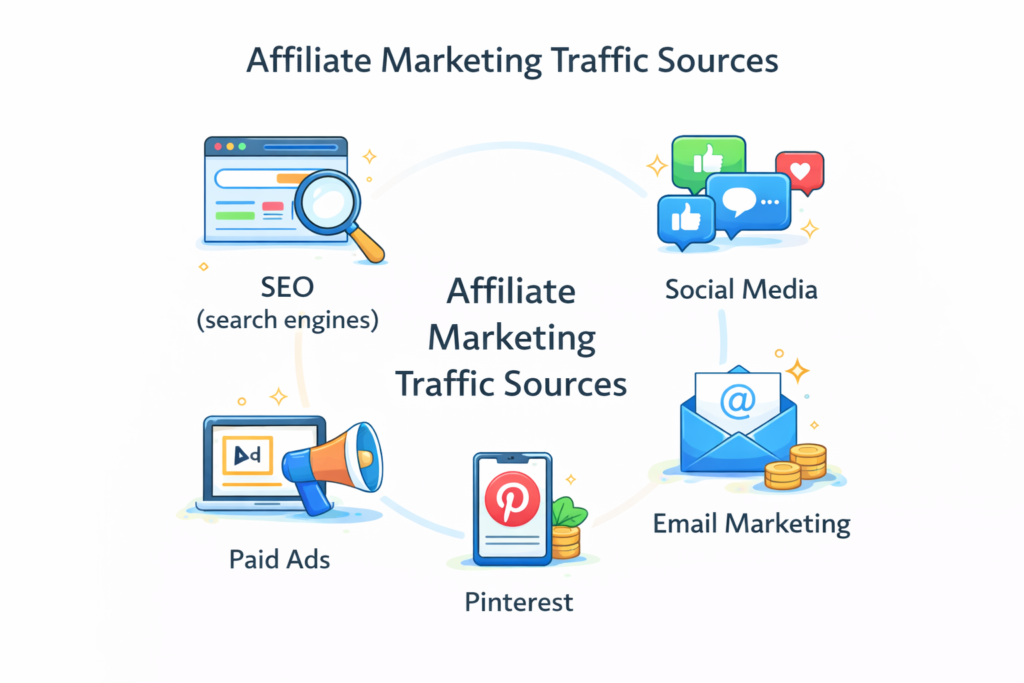
Affiliate websites attract visitors through search engines, social and video platforms, email, links from other websites, and paid advertising. Each source gives people a different way to discover your content.
You don’t need to build a presence everywhere. Think about how your reader would naturally look for help:
- Search engines: Someone searches for an answer, tutorial, or product comparison.
- YouTube: Someone wants to watch a demonstration before trying something themselves.
- Pinterest and social platforms: Someone discovers an idea or joins a conversation that leads to your guide.
- Email: Someone who subscribed to hear from you returns to read a relevant article.
- Other websites: Someone follows a link recommending your resource.
- Paid advertising: Someone clicks an ad. You pay for that opportunity to reach them, whether or not they buy.
For our first-time hiker, a written boot-fitting checklist and a video demonstration could answer the same question in different ways. Choose the format you can make genuinely useful—not simply the platform getting the most attention.
Before spending on advertising, make sure you understand the costs, tracking, and your affiliate program’s promotional rules. Paying for visitors does not guarantee a return.
For a broader explanation of these options, explore my Traffic Generation Strategies for Beginners guide.
Your next decision: Which one of these methods fits both your readers and the kind of content you can consistently create?
Is Affiliate Marketing Legitimate?
Affiliate marketing is a legitimate business model, but that does not make every program, training course, or income claim trustworthy. Evaluate the individual offer—not just the label “affiliate marketing.”
A company paying you for a qualifying referral is straightforward. The confusion starts when someone presents it as effortless income or suggests that buying their system guarantees success.
Before joining a program or paying for training, ask:
- What product or service is actually being offered?
- Are the costs, commission rules, and cancellation terms clearly explained?
- Can I check the claims against information beyond the sales page?
- Would the product still be useful to someone who never promoted it?
Pressure to buy immediately, unexplained earnings screenshots, and guaranteed income claims are reasons to pause—not reasons to rush.
There’s also a responsibility on our side as affiliates. Readers should understand when a recommendation could earn us money. The Federal Trade Commission’s endorsement guidance explains the importance of honest recommendations and clear disclosure of financial relationships.
That’s why I disclose my affiliate relationship with Wealthy Affiliate on this page. You should be able to consider that relationship when deciding how much weight to give my recommendation.
For a closer look at warning signs, read How to Spot Affiliate Marketing Scams Before You Lose Money.
Before you commit: If you cannot explain what you’re buying, what it costs, and what work it requires, stop and get those answers first.
Common Beginner Mistakes to Avoid
A useful way to avoid beginner mistakes is to connect each decision to a reader’s need. Choose products, content topics, and tools because they serve a clear purpose—not because they promise faster earnings.
There’s a lot to learn, and you won’t get everything right the first time. These are habits worth watching:
- Choosing products only for the commission. Start with whether the product fits your audience. A generous payout is irrelevant if you cannot recommend it honestly.
- Publishing without a clear question to answer. Before writing, finish this sentence: “After reading this, someone will understand how to ___.”
- Buying tools before identifying a need. Name the task you’re struggling with, check what your existing tools can do, and consider the ongoing cost before subscribing.
- Presenting research as personal experience. Say whether you tested something or compared published information. Both can be useful, but they are not interchangeable.
- Changing everything after a quiet week. Review what evidence you have before abandoning your topic, rewriting every article, or switching traffic methods.
Working on this website has given me practical examples of things that need attention: outdated links, unclear wording, and pages that need better explanations. None requires pretending I have every answer. They require checking the work and being willing to improve it.
For a fuller checklist, read Mistakes to Avoid When Starting Affiliate Marketing.
Choose one thing to improve: Which habit could you change on your next article? Make that your focus rather than trying to perfect the whole website at once.
Want a More Structured Learning Path?
You can work through the guides on this website independently. But if you’d prefer training, website tools, and support in one place, Wealthy Affiliate is an option to explore.
I use Wealthy Affiliate for this website, including its hosting and Site Support. That gives me direct experience with those parts of the platform—not a basis for promising what someone else will earn.
My suggestion is to start by exploring rather than committing to an upgrade. Look at how the training is presented, consider whether it fits your learning style, and check the current membership features and costs.
The free starting option is a way to take a closer look, not a promise that every feature or everything you’ll need is free.
Affiliate disclosure: If you purchase a paid membership through my link, I may earn a commission at no additional cost to you.
Explore Wealthy Affiliate’s Free Starter Option
Prefer to read more first? See my Wealthy Affiliate review.
Whatever route you choose, training is a resource—not a guarantee of traffic or income. You’ll still need to practice, create useful content, and evaluate your progress.
Continue Learning Affiliate Marketing
You don’t need to open every guide at once. Choose the next step that matches where you are today.
Still learning the basics? Start here:
What Is Affiliate Marketing? A Beginner’s Introduction
This is the next lesson if you want a fuller explanation of the business model before choosing a niche or building a website.
Already understand how it works? Move on to:
How to Start Affiliate Marketing Step by Step
Use this guide to turn the roadmap into a practical starting plan.
Already publishing content? Focus on:
Affiliate SEO for Beginners: How to Get Traffic
Work through this when you’re ready to learn how search visibility fits into attracting readers.
Bookmark this roadmap so you can return when you’re ready for the following stage. The goal is to apply what you learn—not simply finish another article.
Key Takeaways
- Start with the reader, not the commission. Choose an audience whose questions you can help answer, then research relevant products.
- Create something useful before asking for a click. Explain the options, trade-offs, and reasons behind your recommendations.
- Be clear about your experience. Tell readers what you personally tried, what you researched, and what you couldn’t verify.
- Give people a way to find your work. Choose a traffic method you can learn and maintain; publishing alone does not guarantee visitors.
- Review before changing direction. Check your content and links, look at the evidence available, and improve one thing at a time.
- Keep expectations realistic. There is no guaranteed timeline for a first commission, and buying training or tools does not guarantee earnings.
You don’t need a finished business today. Start with one reader, one useful question, and one manageable action. Return to the roadmap as your next decision becomes clearer.
Frequently Asked Questions
How long does it take to make money with affiliate marketing?
There is no reliable timeline that applies to everyone, and some websites never earn a commission. Your results depend on reaching relevant readers, creating useful content, and recommending suitable products. Instead of setting a guaranteed income deadline, track what you can improve: your articles, working links, and the ways readers discover your website.
Do I need a website to start affiliate marketing?
Not always. Some programs accept affiliates who use social media, video, or other channels, while others require a website. Check each program’s requirements before applying. A website gives you a central place to organize your content, but owning one does not automatically bring traffic or sales.
Is affiliate marketing good for beginners?
It can suit beginners who enjoy researching, explaining, and helping people make decisions. You do not have to create the products you recommend, but you still need to learn content creation, promotion, and program rules. It is not a dependable solution if you need immediate income.
Can you start affiliate marketing with no money?
You can begin learning and creating content using free resources and platforms, subject to their rules. Running your own website usually involves costs such as a domain and hosting. Start with a budget you can afford, and do not assume that buying training or premium tools will make you profitable faster.
What is the best way to start affiliate marketing?
Start by choosing a specific audience and a question you can help answer. Learn how affiliate programs work, choose a suitable publishing platform, and create useful content. Research relevant programs and their requirements, disclose your affiliate relationships, and choose one way to attract readers. Review what happens before expanding.
Is affiliate marketing a scam or legit?
Affiliate marketing is a legitimate referral-based business model, but individual offers can be misleading or fraudulent. Check what is being sold, how commissions work, and whether costs and terms are clear. Be cautious of guaranteed income claims and pressure to pay before you understand the offer.
About the Author
Written by Donna
Affiliate marketing researcher and founder of AffiliateEducationForBeginners.com.
I’m building this website while learning and applying the skills I explain here: organizing beginner guides, improving internal links, reviewing content, and checking how pages appear in Google Search Console.
My articles combine research with that hands-on work. When I describe personal experience, I explain what I actually did. When a recommendation is based on research, I aim to make that distinction clear.
My goal is to help you understand your options and choose a manageable next step—not promise that your results will follow a particular timeline.
Learn more about Donna or read my Editorial Policy.
Disclaimer
This guide contains affiliate links. If you purchase through one of these links, I may earn a commission at no additional cost to you. Read my Affiliate Disclosure for more information.
This content is educational and draws on research and my experience building this website. It does not guarantee traffic, rankings, or earnings. Program terms, features, and prices can change, so check the provider’s current information before joining or paying for a service.